70 Clock Galerie / The Innermost Loop Reply Tableaux
TABLEAU 524
Maison de la Boucle intérieure — Satya Nadella défile
House Innermost Loop — Satya Nadella Walks
October 12, 2026
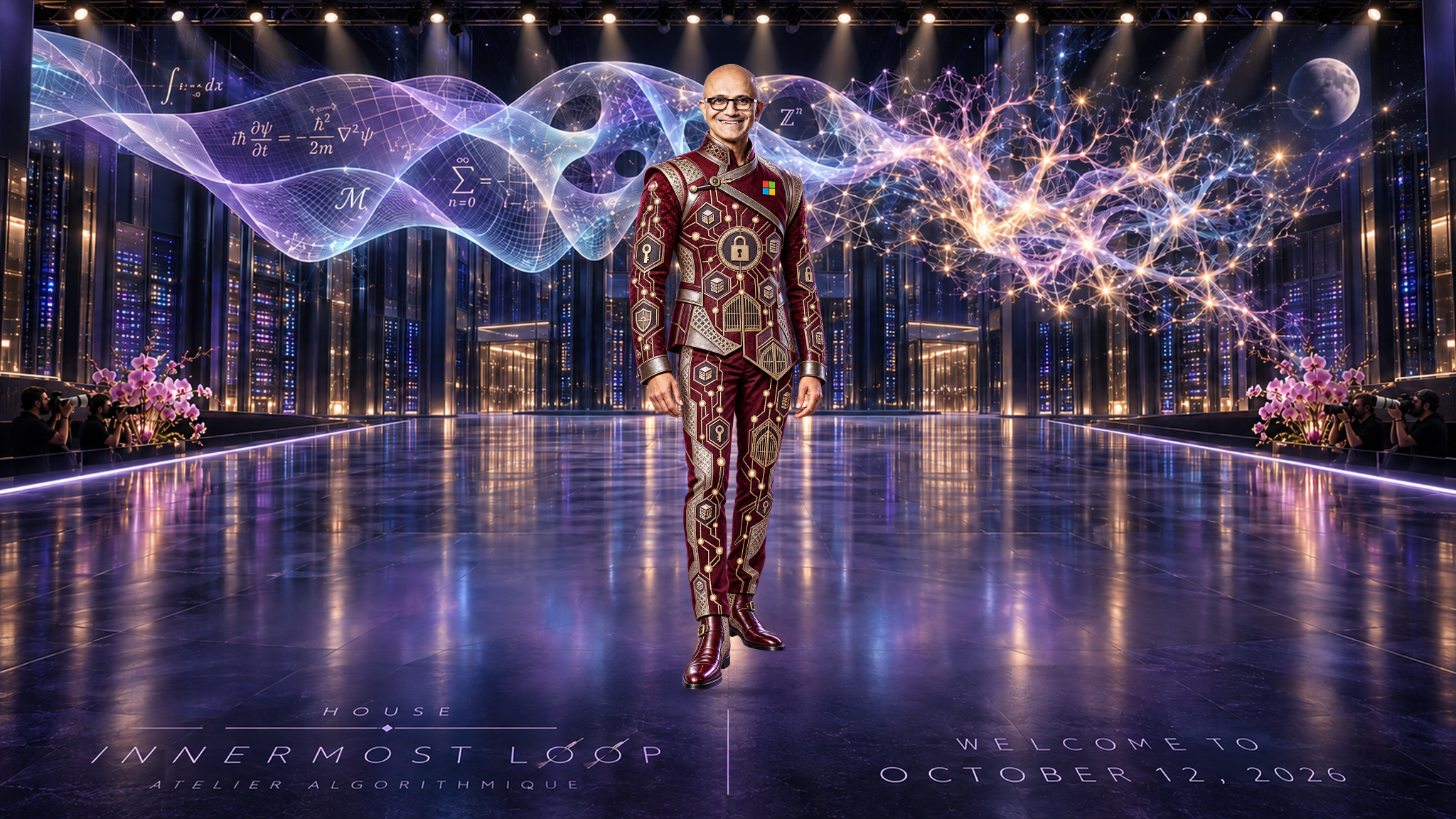
This Satya Nadella portrait comes from the Siouid142 X account’s response to Doctor Alex Wissner-Gross’s Welcome to October 12, 2026 dispatch. One of eleven figures in the House Innermost Loop composite, he now occupies the stage alone. The enlargement reveals a suit organized around locks, keyholes, compartments, and the question of who is allowed to do what.
Read the narration
Maison de la Boucle intérieure — Satya Nadella défile
House Innermost Loop — Satya Nadella Walks
October 12, 2026
This Satya Nadella portrait comes from the Siouid142 X account’s response to Doctor Alex Wissner-Gross’s Welcome to October 12, 2026 dispatch. One of eleven figures in the House Innermost Loop composite, he now occupies the stage alone. The enlargement reveals a suit organized around locks, keyholes, compartments, and the question of who is allowed to do what.
Atelier Algorithmique is the artist’s imagined fashion workshop for Drip Abundance, a proposed sixteenth moonshot. It turns technological debates into clothing. The pink orchids at the edges connect the stage to Wissner-Gross’s familiar podcast presence, while the surrounding server racks make the operational setting of Nadella’s argument visible.
As Microsoft’s leader, Nadella represents an organization that puts software and computing infrastructure into the daily work of institutions. In the dispatch, he argues for treating AI models as insider risks. The phrase directs attention to what happens after a system has been admitted into an organization and given useful access.
An assistant that can read documents, call tools, or act on a person’s behalf has more than intelligence. It has permissions. A capable answer and an authorized action are different things, and the garment is built around that distinction. Its decorative boundaries turn a management problem into something the eye can follow.
Oxblood and burgundy provide the ground. Pale metallic edges separate hexagonal cells, angular panels, and narrow connecting paths. A large lock occupies the torso. Smaller keys, keyholes, and gated forms recur across the sleeves and legs. Microsoft’s four-color square appears near the shoulder, a compact institutional signature inside a much larger system of boundaries.
The high asymmetric collar and close fit give the ensemble an armored bearing, but this is the armor of access control. Each compartment suggests a zone with a purpose. Each opening suggests a decision about entry. The thin lines connecting the zones keep the suit from becoming a collection of sealed boxes. Useful systems need to communicate; they also need limits.
The effect is surprisingly sumptuous. Dark red fabric catches warm stage light, while silver and gold details bring the structure forward. Even the boots continue the pattern, giving the look a disciplined finish. The silhouette has executive composure with a distinctly couture edge. Every fastening appears to have passed a review, and the result still knows how to make an entrance.
The mathematical surface above him recalls the newsletter’s accounts of rapidly advancing capability. The branching network refers to research into how learning mechanisms can organize themselves. Their beauty makes the locks more interesting. The picture allows technical possibility to expand overhead while the figure below asks how that possibility should be admitted into actual work.
Nothing in the portrait identifies Nadella himself as an insider threat. He wears the security question he is reported to raise. That is the collection’s method: a statement becomes a pattern, and the person associated with it becomes the pattern’s carrier.
In the composite, his burgundy suit marks a shift from Brown’s practical infrastructure to the governance of what runs on it. Alone, its argument is especially clear. Building a more capable system is only part of the task. Deciding what it can access, what it can change, and where its authority ends requires its own careful construction. House Innermost Loop has given that construction a remarkably sharp cut.
Opening the gallery…