70 Clock Galerie / The Innermost Loop Reply Tableaux
TABLEAU 520
Maison de la Boucle intérieure — Jacob Tsimerman défile
House Innermost Loop — Jacob Tsimerman Walks
October 12, 2026
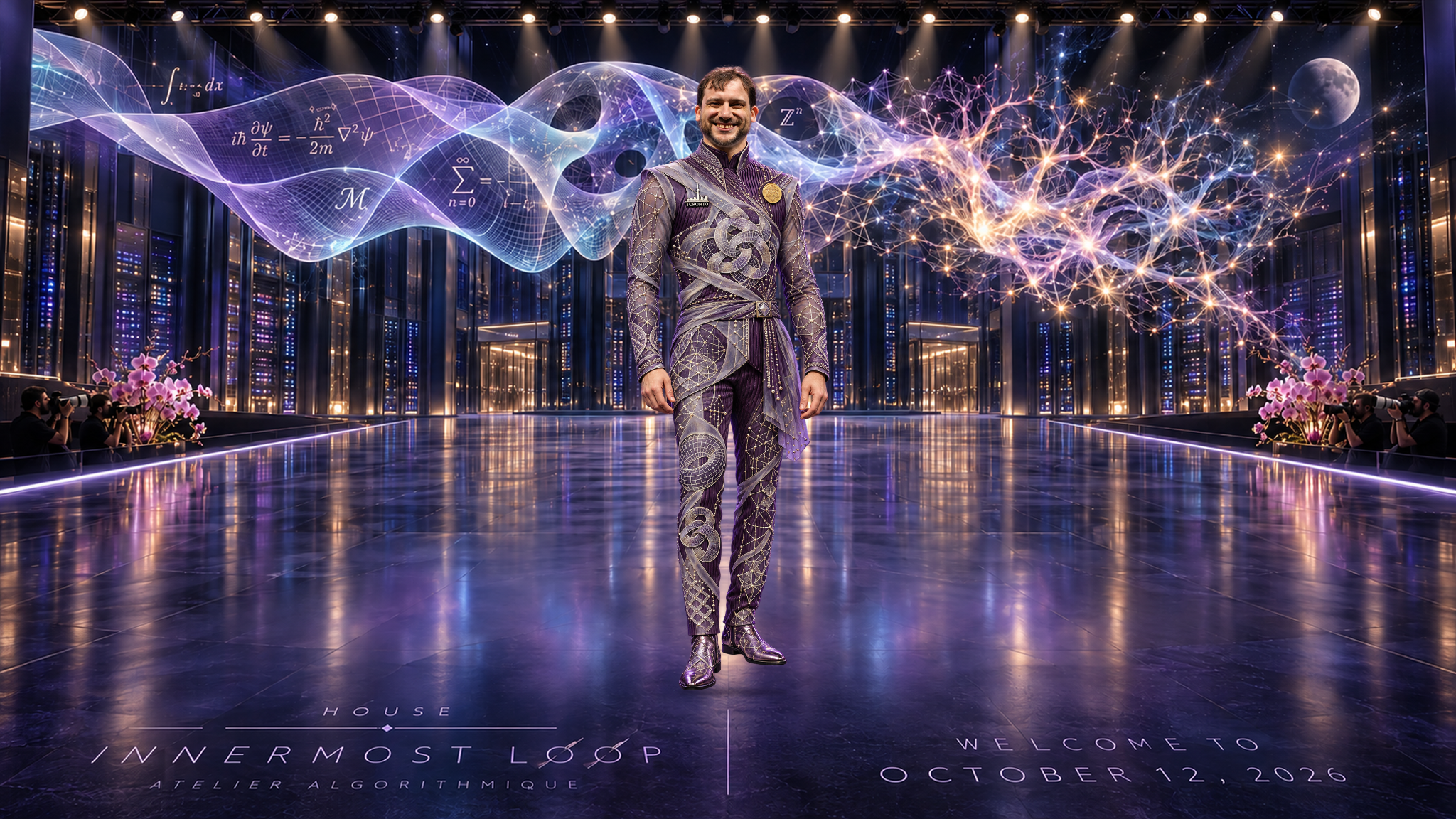
The Siouid142 X account places Jacob Tsimerman on this runway in response to Doctor Alex Wissner-Gross’s Welcome to October 12, 2026 dispatch. He is one of eleven figures in the accompanying House Innermost Loop composite. This solo presentation preserves his outfit and setting while giving the viewer space to follow the intricate layers that explain his role.
Read the narration
Maison de la Boucle intérieure — Jacob Tsimerman défile
House Innermost Loop — Jacob Tsimerman Walks
October 12, 2026
The Siouid142 X account places Jacob Tsimerman on this runway in response to Doctor Alex Wissner-Gross’s Welcome to October 12, 2026 dispatch. He is one of eleven figures in the accompanying House Innermost Loop composite. This solo presentation preserves his outfit and setting while giving the viewer space to follow the intricate layers that explain his role.
The imagined house, Atelier Algorithmique, develops the artist’s proposed sixteenth moonshot, Drip Abundance. Ideas from the newsletter become couture. Pink orchids refer back to Wissner-Gross’s podcast presence, while the server-lined stage situates the collection inside the physical world of computation.
Tsimerman’s mathematical work belongs to number theory and arithmetic geometry, fields concerned with deep relationships among numbers, equations, and geometric structures. The Toronto badge supplies the portrait’s academic association. His appearance in the dispatch centers on a more general question: what happens if mathematics increasingly relies on proofs that exceed any person’s complete understanding?
That question is subtler than whether a computer can produce a correct answer. A proof also lets people inspect relationships, build explanations, and carry an insight into another problem. The possibility of a result that can be checked without being fully grasped changes the relationship between verification and understanding. The portrait gives that distinction a material form.
Purple, charcoal, and silver build a long, narrow silhouette. Ribbed sections provide structure, while overlapping panels introduce a gauzy, translucent-looking quality. Across the chest, silver loops interlock. Below them, grids, curved meshes, and fine golden lines continue through the waist and down the legs. The viewer can begin tracing a route, lose it behind a fold, and recover it farther along.
That interrupted visibility is the key to the outfit. A whole structure is present, but it is not offered all at once. The eye has to work. Some relationships are clear; others remain concealed by the very layering that makes the garment beautiful. It is an unusually apt way to dress a discussion about the limits of comprehension.
The high collar and fitted proportions keep the abundance of detail controlled. Pointed boots repeat the purple and silver vocabulary. A small round ornament adds a ceremonial note without needing to be read as an exact reproduction of a specific award. This is a scholarly portrait with couture nerve: intricate, assured, and entirely willing to make the audience look twice.
Behind him, the mathematical ribbon appears almost to continue the garment at architectural scale. Holes and curves in the hovering surface rhyme with the silver loops across his torso. The stage therefore creates a relationship between a single body and an immense space of possible structures. The figure can inhabit that space without mastering every visible connection.
The branching network on the right brings the newsletter’s learning research into the same scene. Human reasoning, machine learning, and mathematical form are placed beside one another, each with a different way of organizing relations. The data-center lights beneath them remind us that the apparently weightless spectacle depends on actual machines.
In the group image, Tsimerman forms one passage in a larger argument about intelligence. Alone, his portrait becomes a meditation on looking itself. We can recognize order before we can explain it. We can be drawn toward a structure whose complete logic remains beyond us. The garment rewards that first recognition, then refuses to let it pass for the whole of understanding.
Opening the gallery…