70 Clock Galerie / The Innermost Loop Reply Tableaux
TABLEAU 519
Maison de la Boucle intérieure — Noah Giansiracusa défile
House Innermost Loop — Noah Giansiracusa Walks
October 12, 2026
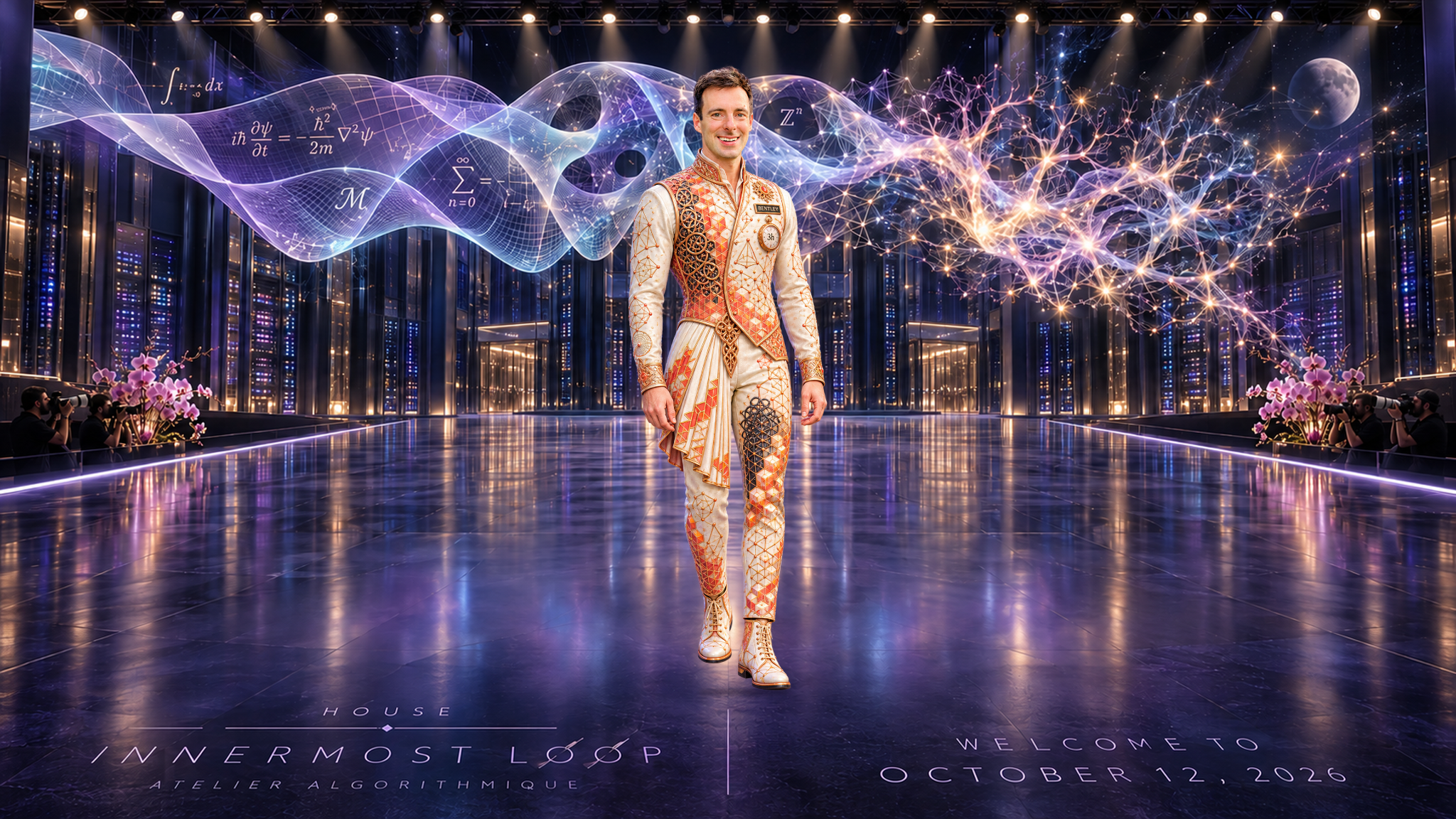
In response to Doctor Alex Wissner-Gross’s Welcome to October 12, 2026 dispatch, the Siouid142 X account assembled eleven figures on the runway of House Innermost Loop. This individual portrait brings Noah Giansiracusa forward from that composite, enlarging an outfit in which mathematical patterns and a small timing emblem explain his place in the day’s discussion.
Read the narration
Maison de la Boucle intérieure — Noah Giansiracusa défile
House Innermost Loop — Noah Giansiracusa Walks
October 12, 2026
In response to Doctor Alex Wissner-Gross’s Welcome to October 12, 2026 dispatch, the Siouid142 X account assembled eleven figures on the runway of House Innermost Loop. This individual portrait brings Noah Giansiracusa forward from that composite, enlarging an outfit in which mathematical patterns and a small timing emblem explain his place in the day’s discussion.
Atelier Algorithmique is the house’s imagined workshop. Its proposed sixteenth moonshot, Drip Abundance, turns developments in intelligence into expressive clothing. The pink orchids bordering the stage recall Wissner-Gross’s podcast presence. They identify the conversation behind the spectacle, while the server racks make its computational setting unmistakable.
Giansiracusa is a Bentley University mathematician with a doctorate in algebraic geometry from Brown. His public work also examines algorithms, misinformation, and the ways mathematical systems shape everyday choices. That combination is useful here: he belongs to the technical discipline being transformed, and he also thinks about how people learn to live with powerful algorithms.
The dispatch presents him responding to AI’s mathematical progress by considering how problems might be ranked according to their difficulty for machines. It reports nearly four hundred successes at roughly three hours of computation apiece. Those numbers belong to the newsletter’s account. In the portrait, the three-hour figure becomes a small medallion, worn with the ease of an accessory.
That is a wonderfully compact editorial decision. A period of computation, which might otherwise remain buried in a technical report, becomes something visible on the chest. Fashion has always displayed time through watches and inherited jewelry. Here, the ornament measures a newly disruptive pace of intellectual work.
The clothes are ivory, coral, orange, and gold, with a fitted waistcoat and a pleated panel extending over the hip. Circular forms resemble openwork mechanisms, rosettes, and interlocking geometrical constructions. Triangular patterns break into brighter tiles along the legs. Pale sleeves prevent the densely worked torso from becoming visually heavy, while the high patterned shoes complete the line.
This is mathematical dandyism with serious precision. The warm palette gives the portrait a buoyancy that suits its interest in adaptation. He looks ready to work with a changed landscape, to sort its problems and test its possibilities. The sharp silhouette has runway confidence without requiring a grandiose pose. The garment is doing the talking, and it has excellent diction.
Above him, the immense translucent surface carries the newsletter’s broader mathematics theme into the architecture. Its equations and grids float beyond the manageable scale of a blackboard. The branching lights alongside it recall research into the emergence of learning mechanisms. Between those two forms, the familiar distinction between a mathematical tool and a learning system becomes a subject for contemplation.
The solo view also clarifies the Bentley label. It locates a person and a practice within the glittering abstraction. This is a portrait of someone whose work includes explaining why algorithmic systems matter to people outside the laboratory. The clothes perform a similar translation: circles, triangles, and a timing ornament make a technical change readable without requiring the viewer to inspect a proof.
In the composite, Giansiracusa’s bright ensemble helps move the eye from the opening dark green toward the purple and ivory figures beyond. Alone, its emotional register becomes clearer. The portrait imagines intellectual flexibility as a form of poise. The pace has changed; the mathematician has arrived dressed to meet it.
Opening the gallery…