70 Clock Galerie / The Innermost Loop Reply Tableaux
TABLEAU 518
Maison de la Boucle intérieure — Hugo Duminil-Copin défile
House Innermost Loop — Hugo Duminil-Copin Walks
October 12, 2026
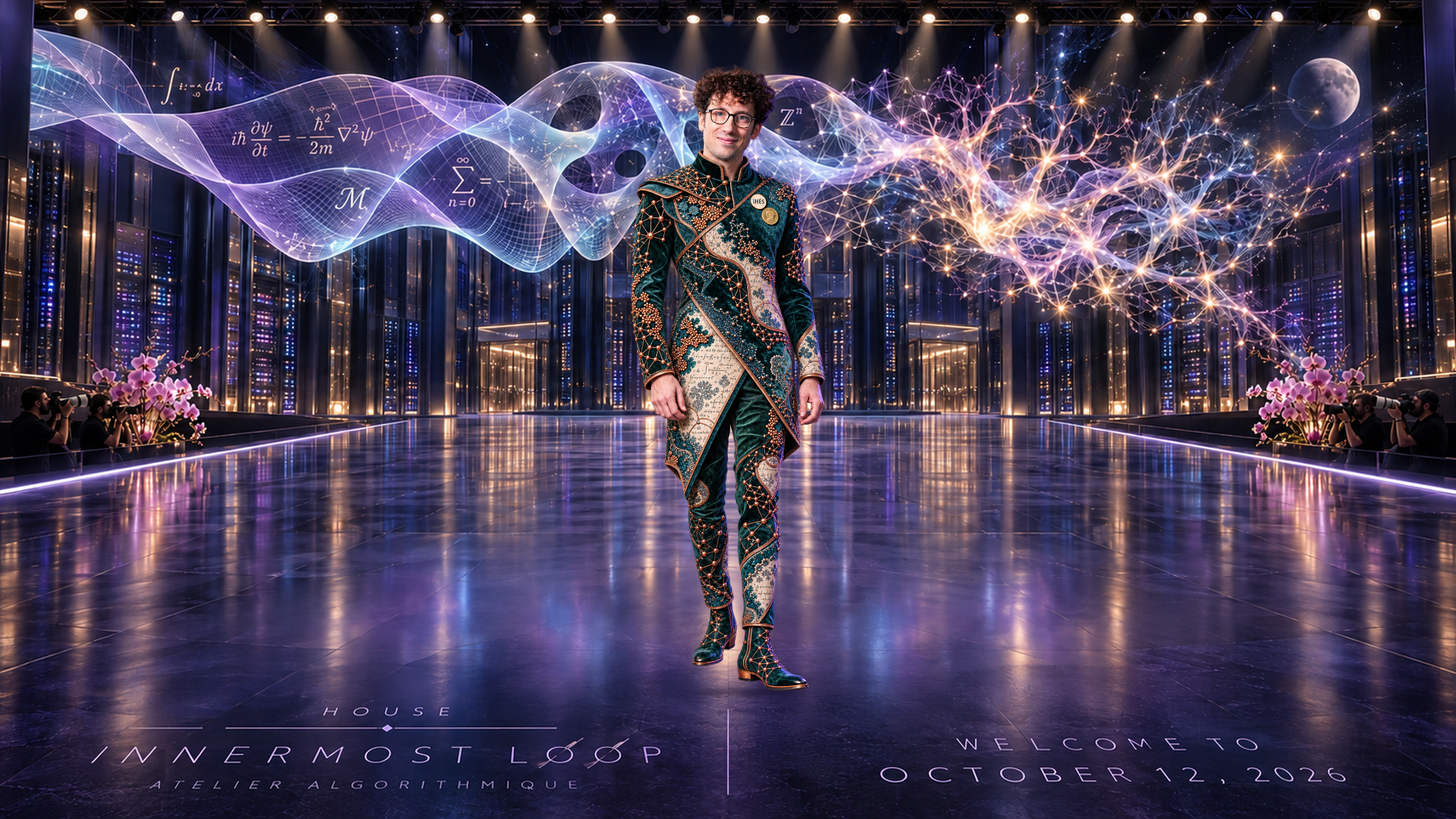
The Siouid142 X account created this portrait in response to Doctor Alex Wissner-Gross’s Welcome to October 12, 2026 dispatch on the Innermost Loop. Hugo Duminil-Copin steps out of an eleven-person composite and occupies the runway alone, allowing the small networks and manuscript-like panels of his clothing to become the principal subject.
Read the narration
Maison de la Boucle intérieure — Hugo Duminil-Copin défile
House Innermost Loop — Hugo Duminil-Copin Walks
October 12, 2026
The Siouid142 X account created this portrait in response to Doctor Alex Wissner-Gross’s Welcome to October 12, 2026 dispatch on the Innermost Loop. Hugo Duminil-Copin steps out of an eleven-person composite and occupies the runway alone, allowing the small networks and manuscript-like panels of his clothing to become the principal subject.
The setting belongs to House Innermost Loop, Atelier Algorithmique, the artist’s imagined fashion house for a proposed sixteenth moonshot called Drip Abundance. Here, technological change is something to wear and interpret. Pink orchids at the sides recall Wissner-Gross’s podcast presence, linking this fantastical venue to the feed that inspired it.
Duminil-Copin is a probabilist associated with the Institute of Advanced Scientific Studies in France. A Fields Medalist, he investigates how large-scale behavior emerges from systems of interacting parts. Percolation provides an intuitive example: individual connections can eventually produce a route across an entire network. A small change in local conditions may transform the behavior of the whole.
That background explains the copper-colored lines and nodes traveling across his deep green ensemble. The ornament has a subject. It suggests connections becoming structure, spreading across a shoulder and continuing down the legs. The body supplies a landscape over which those paths can develop.
The dispatch gives the portrait a more unsettled context. Wissner-Gross reports Duminil-Copin’s distress following OpenAI’s release of hundreds of mathematical manuscripts. The narration of that event concerns the experience of a discipline confronting machine-scale output; the embroidered pages do not certify every claim within the reported release. They make the accumulated human practice of mathematics visible.
Pale manuscript-like panels cut diagonally across the velvet-looking emerald and petrol fabric. The asymmetry matters. A conventional academic robe would present an established order; these sharply angled sections make that order appear to be rearranging itself. Yet the high collar, precise borders, and composed bearing preserve authority. He has not been dressed as a defeated scholar. He has been given a look capable of holding its ground.
The small institutional badge and round ornament reinforce that sense of earned standing. Copper networks shimmer against the dark material, while the pale inserts resemble work brought out of a study and placed under theatrical lights. The pointed boots continue the visual argument. Nothing stops at the jacket hem; even the final step belongs to the same connected system.
Behind him, a translucent mathematical surface curls through the data center. Its holes, grids, and suspended notation amplify the scale of the discussion. Mathematics is no longer contained by a page. It becomes an environment surrounding its practitioners. Across the upper right, a branching network recalls the dispatch’s research into learning mechanisms arising from local rules. The backdrop and the clothing therefore speak to each other: both are concerned with how small relationships become a larger order.
The enlargement gives this portrait an intimacy the full lineup cannot supply. His expression remains approachable, and the silhouette is quietly fierce. There is no need for theatrical anguish when the contrast between patient manuscript and proliferating network already tells the story.
What the garment preserves is the mathematician’s relationship to understanding. A result can arrive quickly; a life devoted to asking why it is true has another kind of duration. The pale pages, caught inside the dark green structure, give that duration a visible place. As the surrounding world accelerates, this portrait allows intellectual craftsmanship to remain beautifully, stubbornly present.
Opening the gallery…