70 Clock Galerie / The Innermost Loop Reply Tableaux
TABLEAU 517
Maison de la Boucle intérieure — Hugo Duminil-Copin, Noah Giansiracusa, Jacob Tsimerman, Terence Tao, Andrew Curran, Tom Brown, Satya Nadella, Andrej Karpathy, Elon Musk, Shyam Sankar et Mark Carney défilent
House Innermost Loop — Hugo Duminil-Copin, Noah Giansiracusa, Jacob Tsimerman, Terence Tao, Andrew Curran, Tom Brown, Satya Nadella, Andrej Karpathy, Elon Musk, Shyam Sankar, and Mark Carney Walk
October 12, 2026
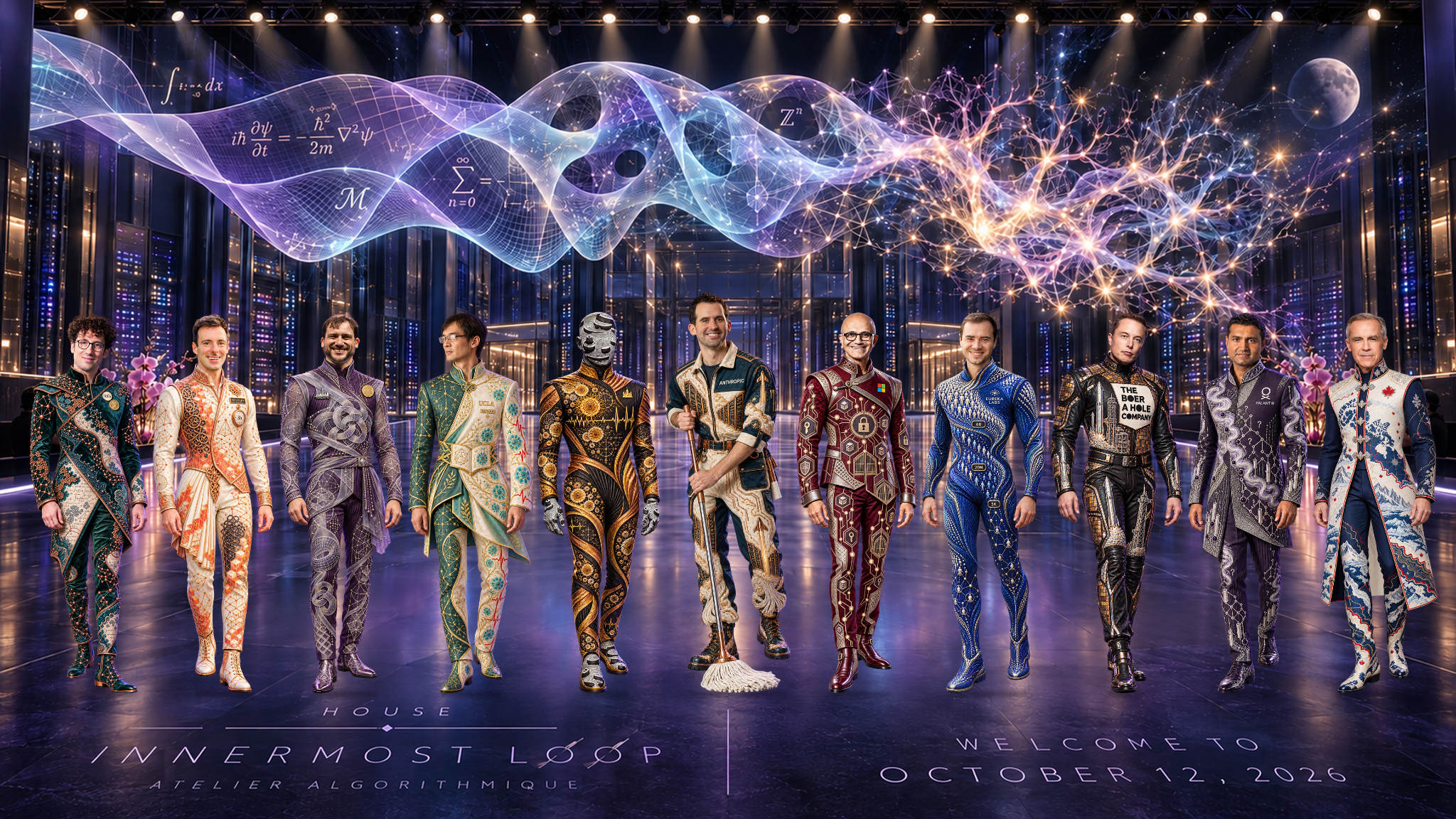
In response to Doctor Alex Wissner-Gross’s Welcome to October 12, 2026 dispatch on the Innermost Loop, the Siouid142 X account turns a day of scientific upheaval into a fashion collection. Eleven figures enter House Innermost Loop, Atelier Algorithmique. Mathematicians appear alongside the people building, financing, securing, and governing the machinery that is changing their work. Their clothes carry the stories that brought them here.
Read the narration
Maison de la Boucle intérieure — Hugo Duminil-Copin, Noah Giansiracusa, Jacob Tsimerman, Terence Tao, Andrew Curran, Tom Brown, Satya Nadella, Andrej Karpathy, Elon Musk, Shyam Sankar et Mark Carney défilent
House Innermost Loop — Hugo Duminil-Copin, Noah Giansiracusa, Jacob Tsimerman, Terence Tao, Andrew Curran, Tom Brown, Satya Nadella, Andrej Karpathy, Elon Musk, Shyam Sankar, and Mark Carney Walk
October 12, 2026
In response to Doctor Alex Wissner-Gross’s Welcome to October 12, 2026 dispatch on the Innermost Loop, the Siouid142 X account turns a day of scientific upheaval into a fashion collection. Eleven figures enter House Innermost Loop, Atelier Algorithmique. Mathematicians appear alongside the people building, financing, securing, and governing the machinery that is changing their work. Their clothes carry the stories that brought them here.
This is the artist’s proposed sixteenth moonshot, Drip Abundance: the proposition that a technologically abundant future should be something we can imagine wearing. Research becomes ornament, infrastructure becomes embroidery, and an argument can acquire a rather excellent pair of boots. The pink orchids beside the runway connect this invented house to Wissner-Gross’s familiar podcast presence. They provide a personal signature within a setting whose scale otherwise threatens to swallow the individual.
The style combines recognizable portraiture with extravagantly imagined couture and a luminous science-fiction stage. These are editorial portraits arranged as a runway presentation. Crisp faces and sharply defined tailoring occupy the foreground; behind them, a data center opens into something approaching a cathedral of computation. Vertical server racks replace columns. Their small blue and amber lights establish a patient, repetitive architecture beneath a spectacle of apparently weightless thought.
Across the upper left, a vast translucent mathematical surface twists through space. Its grids stretch, fold, and open into holes. Equations hover along its contours, suggesting the symbolic language through which mathematics and physics describe a world larger than ordinary intuition can manage. The inscriptions function as visual references rather than a single readable proof. What matters is that abstraction has acquired volume. It is almost fabric already, a celestial textile awaiting the tailor’s scissors.
That choice answers the opening of the dispatch, where Wissner-Gross describes a mathematics community reacting to a flood of AI-generated work. His account moves through distress, adjustment, and the unsettling possibility that useful proofs might exceed any individual’s understanding. The enormous surface makes that intellectual scale visible. The people below can stand beneath it, but no one body could encompass it.
On the right, the surface meets a branching web of pink, gold, and lavender light. It evokes neural connections and the newsletter’s report of MIT research into learning mechanisms emerging from local connection rules. In accessible terms, the question is whether the organization needed for learning can arise through interactions among parts, instead of requiring every part of the learning procedure to be imposed from above. The branching image gives that question a living rhythm. The resemblance to nerve tissue also anticipates the garments that move from mathematics toward medicine.
A small Moon occupies the upper corner. It recalls the dispatch’s account of Artemis II astronauts observing five faint flashes on the lunar far side. Its quiet presence widens the stage from computation to exploration. The bright neural junctions remain part of the network; the Moon supplies its own distinct reference. Below, photographers gather at the edges, making this cosmic laboratory unmistakably a runway. The spectacle has an audience, and these ideas are being presented for public inspection.
Hugo Duminil-Copin opens the lineup in deep emerald and petrol tones, with copper networks crossing an asymmetric tunic. The probabilist and Fields Medalist studies the behavior of connected systems, including percolation and phase transitions. His clothes translate that work into linked points and branching paths. Pale panels resemble mathematical manuscripts, setting the patient culture of proof against the speed of machine production. The dispatch reports his distress at OpenAI’s enormous release of manuscripts. Here, however, he retains the composure of a scholar whose intellectual life cannot be reduced to a production count. The dark velvet-like surface gives that composure weight.
Noah Giansiracusa follows in ivory, coral, and gold. The Bentley mathematician is also a public interpreter of algorithms and their effects on everyday life. His circular ornaments resemble intricate mechanisms, while triangular patterns carry a brighter, quicker energy down the legs. The small three-hour emblem refers to the dispatch’s report of problems yielding to a few hours of computation. Time has become jewelry. Where Hugo’s manuscript panels suggest the accumulated labor of a discipline, Noah’s timing ornament asks how that discipline adapts when its working rhythm changes. The sharp waistcoat and pleated panel are giving mathematical dandy, with the clock already running.
Jacob Tsimerman wears violet and silver, with interlocking loops crossing layered tailoring. His work in number theory and arithmetic geometry makes abstract structure an appropriate vocabulary. The newsletter connects him to the prospect of mathematics resting on proofs that no person fully understands. The garment stages that difficulty through overlap: a line disappears behind one fold and reappears elsewhere, inviting the eye to reconstruct the connection. The Toronto badge locates the portrait’s academic identity, while the shimmering layers make comprehension feel like an activity rather than a possession.
Terence Tao’s green-and-ivory wrap introduces a more immediate human question. Gold geometry occupies one side; blue-green cellular rosettes and red pulse-like marks inhabit the other. The UCLA mathematician appears in the dispatch through a hypothetical about understanding an AI-generated cancer cure. Must the person who benefits be able to follow the reasoning that produced it? The clothes hold mathematical explanation and bodily survival beside one another. Their joined borders suggest a relationship worth working out, without pretending the hypothetical treatment has already been discovered. The silhouette is exacting, but the argument inside it is compassionate.
Andrew Curran carries that discussion forward in black and gold. His sculpted grayscale head and similarly treated hands reproduce an account persona rather than inventing a private face. Across his chest, a heartbeat trace interrupts elaborate golden circles. In the newsletter, his response to Tao puts the severely ill patient’s desire for an effective outcome at the center. The avatar makes the contrast especially pointed: identity is stylized, while the pulse remains immediately recognizable. The figure’s most human concern is legible even without a naturalistic face. Those sweeping gold bands also produce one of the collection’s fiercest silhouettes.
At the exact center stands Tom Brown, smiling and holding a mop. His Anthropic workwear has rolled sleeves, practical pockets, substantial boots, and cream panels filled with computing architecture and circuitry. The dispatch recalls his offer to mop floors at OpenAI to get involved, then describes his role in securing enormous computing resources for Anthropic. The outfit keeps both parts of that history in view: the old offer becomes the tool, while the present affiliation appears on the chest.
Brown’s position is the composition’s best joke and its strongest structural decision. Five people stand on either side of someone doing a task that keeps the shared surface usable. Knee tassels echo the mop fibers, turning maintenance into couture detail. Above him, thought expands beyond human scale; below him, the floor still needs attention. His willingness to contribute becomes the modest origin of a much larger infrastructure story. He serves the look while quite literally servicing the runway.
Satya Nadella introduces boundaries in oxblood and burgundy. Microsoft’s colored squares sit among locks, keyholes, and neatly separated compartments. The dispatch attributes to him the argument that AI models should be treated as insider risks. A system admitted to useful work may also receive access to consequential information and actions. The garment makes that problem visible through permission-shaped ornament. It is almost armor, but its defenses are administrative: doors, keys, and distinctions between one area and another. Greater intelligence does not automatically confer unrestricted authority.
Andrej Karpathy’s sapphire ensemble turns unequal exposure to AI into a population diagram. Tiny human figures crowd the shoulders, then flow toward smaller linked groups. Three plaques mark six billion, twenty million, and five thousand, following his schematic comparison in the dispatch between people barely exposed to the technology, programmers using frontier models, and a small group watching agent swarms. These are the terms of his illustration, not a census certified by the garment. The Eureka Labs identity connects the portrait to his educational work. Learning becomes a way to cross the distance between those experiences.
Elon Musk arrives in black, copper, and silver, with chip-like mosaics and rocket forms running down an industrially compact suit. The dispatch juxtaposes his acknowledged need to learn chipmaking with his history of learning to build rockets. His clothes make the comparison continuous, carrying manufacturing and launch machinery across the same body. Then the chest patch punctures the grandeur: The Boer A Hole Company. The artist’s recurring parody folds the South African word Boer into bore-a-hole and an unmistakably juvenile insult, borrowing the corporate presentation of The Boring Company. The tailoring is expensive; the joke has absolutely no intention of behaving.
Shyam Sankar brings a different kind of interruption. Silver smoke curls across purple fabric, threaded with question marks beneath the Palantir name. The company’s chief technology officer appears in the dispatch criticizing researchers reported to be smoking in anticipation of a future AI cure for cancer. He is not depicted smoking. He wears the argument against treating a hoped-for breakthrough as permission to ignore a present consequence. The vapor escapes the rigid network patterns around it, a particularly effective image of certainty dissolving.
Mark Carney closes the runway in a long ivory vest over navy, with maple-leaf clasps, Canadian geography, mountains, ice, and polar wildlife. The dispatch presents the Canadian prime minister discussing contingency planning for a possible American invasion. The image keeps that in the register of responsibility and preparation. No battle takes place. Instead, territory becomes a garment: a country’s outlines, routes, and vulnerable distances are carried on a human body. The ceremonial silhouette brings the collection from individual understanding to national stewardship.
Together, these clothes ask what remains necessary when producing intelligence becomes easier. Someone must examine the proof, consider the patient, obtain the machines, manage their permissions, teach their use, and prepare for consequences. The newsletter’s accelerating discoveries become eleven different forms of attention.
The closing line of the dispatch calls on thinkers to unite, playing on chains of thought. Here, the response gives those thinkers a shared stage without giving them identical positions. Their garments preserve disagreement, uncertainty, humor, and ambition. Overhead, the mathematical fabric keeps unfolding. At the center, a mop rests on the polished floor. The future may be dazzling, but House Innermost Loop has dressed the people who will still have to make it work.
Opening the gallery…