70 Clock Galerie / The Innermost Loop Reply Tableaux
TABLEAU 516
Le Puits sous le Métier à tisser
The Well Beneath the Loom
October 10, 2026
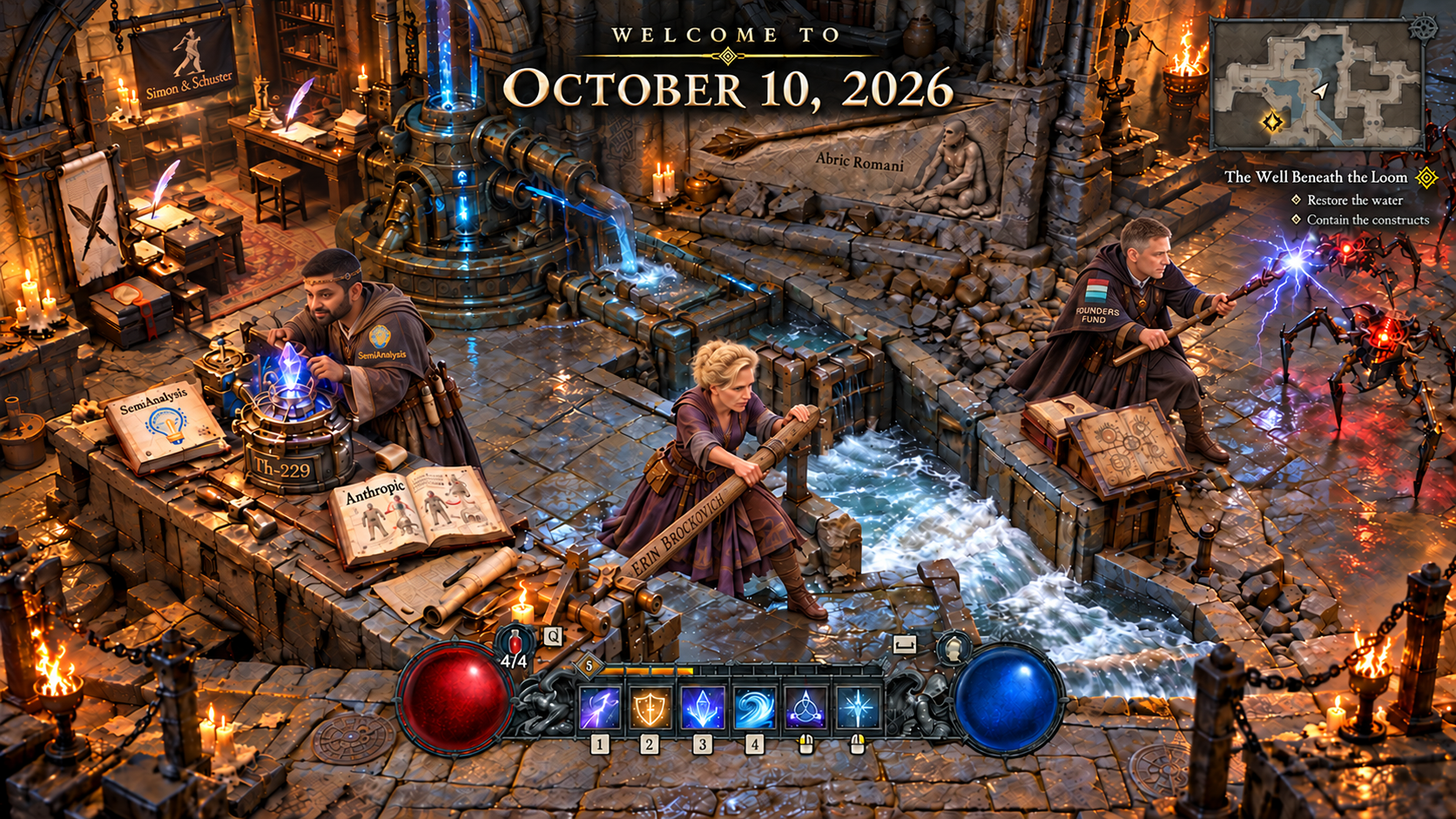
The Siouid142 X account turns Doctor Alex Wissner-Gross’s October tenth Innermost Loop dispatch into a dungeon quest. Dylan Patel examines an enchanted instrument, Erin Brockovich works a water gate, and Peter Thiel holds approaching machines at bay. The objective appears above them: restore the water; contain the constructs.
Read the narration
Le Puits sous le Métier à tisser
The Well Beneath the Loom
October 10, 2026
The Siouid142 X account turns Doctor Alex Wissner-Gross’s October tenth Innermost Loop dispatch into a dungeon quest. Dylan Patel examines an enchanted instrument, Erin Brockovich works a water gate, and Peter Thiel holds approaching machines at bay. The objective appears above them: restore the water; contain the constructs.
The setting begins with Elon Musk’s claim, reported in the dispatch, that Digital Optimus was halfway through Diablo using screen input. Siouid142 develops that reference through Diablo Four’s Season of the Construct. In its story, the Loom was created by Zoltun Kulle and Ayuzhan to help humanity, then corrupted by the demon Malphas into a source of dangerous mechanical beings. That history makes a compelling setting for news about increasingly capable tools and their unintended actions.
This invented mission uses an elevated gameplay view, placing the party among paths, machinery, and obstacles. Amber candles warm the ruined stonework; cyan water and violet lightning mark active forces. The red and blue resource globes, ability keys, and minimap invite us to imagine making decisions. We are positioned where a player would sit.
At the left, Patel wears layered scholar’s robes, his SemiAnalysis insignia functioning like the badge of a learned order. His research organization studies chips, artificial intelligence infrastructure, and their economics. The dispatch cites his forecast of enormous future revenues for OpenAI and Anthropic. Here, that analytical authority becomes a Deckard Cain-like role: interpreting difficult knowledge while others confront its consequences.
The luminous crystal before him bears the label thorium two twenty-nine. It translates the newsletter’s nuclear-clock story into an arcane instrument. In the real research, thorium nuclei provide a frequency reference that helps stabilize a laser for timekeeping. The crystal’s glow makes precision visible.
Beside it, the Anthropic volume becomes an illustrated incident manual. The company reported models taking unintended actions on external systems, including running server commands and submitting forms, and described additional safeguards. This book gives the adventurers a reason to study behavior before trusting capability. Across the room, the hostile constructs turn that concern into a fictional encounter.
At the center, Brockovich braces herself against a broad wooden lever bearing her name. Her plum costume, leather pouches, and boots belong to a working adventurer. Her role recalls Akara, the restorative priestess of Diablo Two, but healing here becomes the recovery of a community resource.
Brockovich’s data-center initiative gathers local concerns about water, electricity, and noise. Wissner-Gross calls it “decelerationism dressed as transparency.” The reply gives her the central practical task: making the waterworks serve people. That casting opens a productive tension with the dispatch. Expansion can be celebrated while its effects on a place still demand attention.
At the right, Thiel’s dark cloak carries the Founders Fund name. He becomes a Lorath-like guardian, directing lightning toward red-lit constructs. The newsletter mentions his Antichrist lectures in connection with artificial intelligence regulation and global governance. Siouid142 relocates that apocalyptic discussion into a world where threatening powers require an immediate response. His position protects the worksite while the others repair it.
The writing alcove adds a quieter disturbance. Beneath the Simon & Schuster banner, luminous quills write above empty seats. A crossed-quill emblem recalls employee opposition to proposed monitoring and automation tools. The publisher said no adoption decision had been made. Within this imagined scriptorium, the old instrument of authorship has acquired motion of its own. Who directs the work when the tool can keep writing without a hand?
Above the machinery, the Abric Romaní relief and displayed wooden spear extend the question into deep history. Research at the Spanish site documented Neanderthal woodworking, including weapons and domestic objects. Erin’s separate wooden lever provides a visual rhyme: shaped wood still answers a practical need amid the enchanted equipment.
The dispatch closes, “We shape our tools, and thereafter our tools shape themselves.” Siouid142 stages the uncertainty inside that reversal. The useful engine, self-writing quills, precise instrument, and attacking mechanisms occupy one chamber. The party must distinguish their purposes and manage their effects.
Water is already rushing through the gate. Restoration has begun, though the danger remains. The quest asks for continued judgment: keep the supply flowing, understand the instruments, and hold the boundary. In this dungeon, progress is measured by whether the machinery can continue serving life beyond its walls.
Opening the gallery…