70 Clock Galerie / The Innermost Loop Reply Tableaux
TABLEAU 515
L’Âge de diamant de la singularité
The Diamond Singularity Age
October 9, 2026
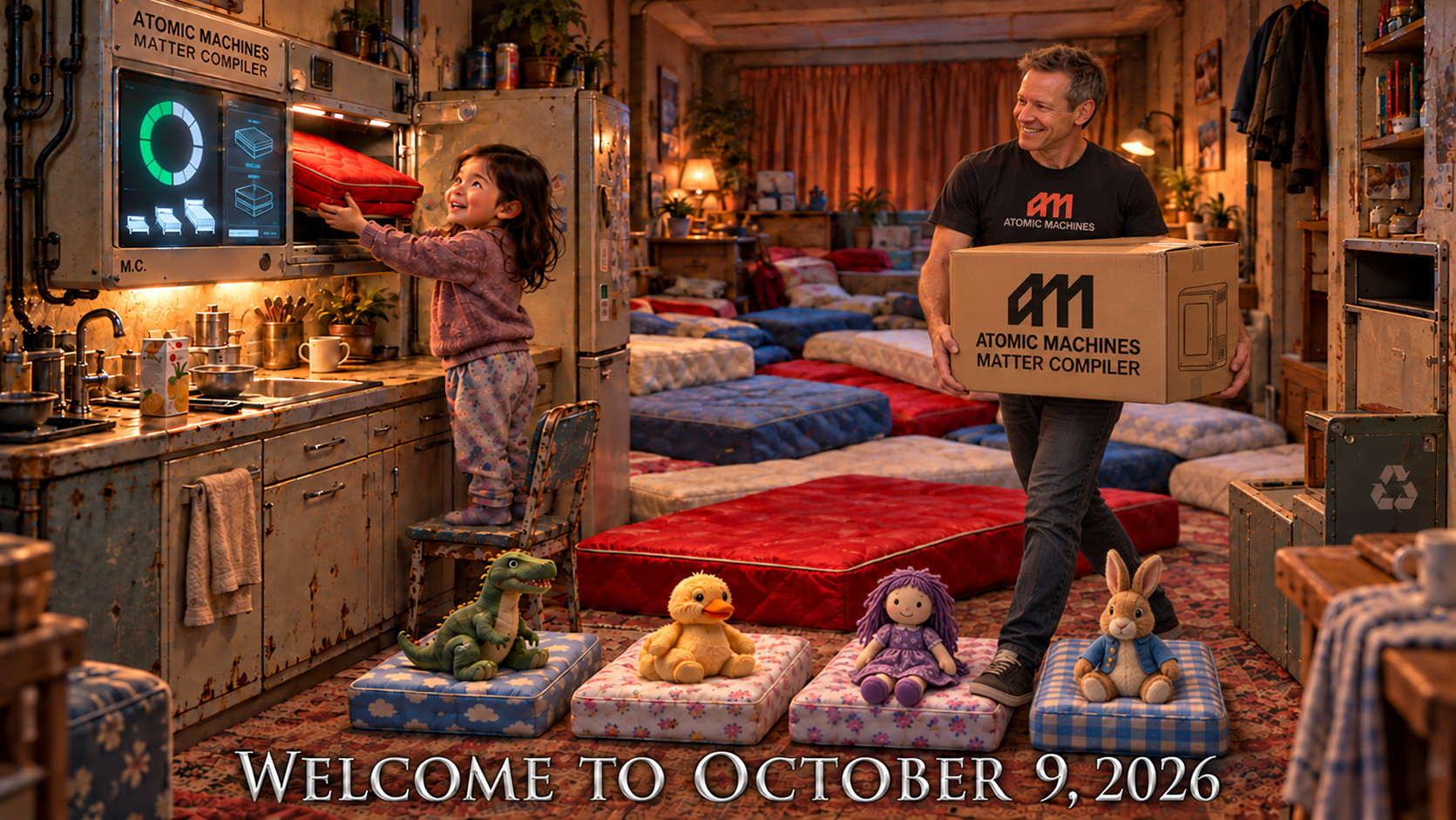
In his October ninth, twenty twenty-six dispatch to the Innermost Loop, Doctor Alex Wissner-Gross reported that Atomic Machines had built a matter compiler for microdevices. The Siouid142 account answered that brief announcement by taking the machine back to its literary home: Neal Stephenson’s The Diamond Age. Here is Nell, a little girl who discovers that an extraordinary manufacturing technology can answer a very ordinary wish. She needs a comfortable bed. Then she decides that everyone she loves should have one too.
Read the narration
L’Âge de diamant de la singularité
The Diamond Singularity Age
October 9, 2026
In his October ninth, twenty twenty-six dispatch to the Innermost Loop, Doctor Alex Wissner-Gross reported that Atomic Machines had built a matter compiler for microdevices. The Siouid142 account answered that brief announcement by taking the machine back to its literary home: Neal Stephenson’s The Diamond Age. Here is Nell, a little girl who discovers that an extraordinary manufacturing technology can answer a very ordinary wish. She needs a comfortable bed. Then she decides that everyone she loves should have one too.
At the kitchen counter, a folded red mattress emerges from the machine. Across the apartment, mattresses have already spread into a luxuriant obstacle course. Four treasured companions sit on their own small beds in the foreground. And arriving with an Atomic Machines delivery box is Jeff Holden, the company’s founder and chief executive, stepping into the fictional household that helped inspire his technology’s name.
The connection is unusually direct. Atomic Machines explicitly acknowledges Stephenson’s novel as the source of the name Matter Compiler. The artwork completes a circle: fiction inspires an engineering project, that project enters the newsletter, and the artistic reply returns its founder to the fiction. Holden has become a visitor from the future of the book’s own readership.
Published in nineteen ninety-five, The Diamond Age imagines a world in which advanced nanotechnology has made astonishing fabrication commonplace. Yet the novel remains deeply concerned with childhood, education, belonging, and unequal power. Nell’s encounter with the kitchen appliance makes those concerns wonderfully tangible. An entire technological civilization becomes comprehensible through a child trying to improve her sleeping arrangements.
In the book, her older brother Harv first shows her how to obtain a larger mattress after she outgrows her crib mattress. Nell watches, remembers, and later experiments for herself. The chair beneath her feet is therefore a crucial detail. Before she can reach the future, she has to reach the countertop. The scale of the room belongs to adults; the intelligence required to use its most remarkable object is already developing in the child.
The screen’s little beds and circular progress indicator give that learning process a visible form. She can recognize a result before she can fully explain the machinery producing it. Observation becomes experimentation, and experimentation becomes confidence. Her outstretched hands mark the moment when an image selected on a screen acquires weight, texture, and usefulness.
This is a particularly apt episode for the newsletter’s movement from artificial intelligence toward physical manufacture. So much technological news arrives as language about models, performance, or capacity. A mattress makes the consequence bodily. Someone can lie down on it. Someone can sleep better. Nell gives the grand proposition of programmable matter an immediate, intimate purpose.
The four toys sharpen that purpose. From left to right, the image presents Dinosaur, a green plush creature on a blue cloud-patterned mattress; Duck, bright yellow against pale floral bedding; Purple, the cloth doll with purple yarn hair and a matching dress; and Peter Rabbit, upright in his blue jacket on a gingham bed. Their separate patterns and carefully allotted spaces turn the foreground into a tiny household within the household.
These are existing companions for whom Nell makes beds. She is extending the comfort she has just discovered to her imaginative family. The repetition becomes funny because her reasoning is so generous and so literal. If a bed is good, more beds must spread the good around. Soon the room itself begins to resemble one enormous invitation to bounce.
Their importance extends beyond this comic episode. The novel tells us that these four handmade toys survived an adult’s attempt to destroy her possessions: the decompiler rejected objects that had not originated in a matter compiler. They carry continuity through an unstable childhood. Later, their familiar identities enter the educational adventures of the interactive Primer that becomes central to Nell’s life.
The companions also allow Nell to give different shapes to her own responses. Elsewhere in the novel, Dinosaur urges courage, Peter proposes escape, and Purple imagines magical protection. Their little council gives a frightened child ways to think through what is happening to her. Their beds here feel like an act of reciprocity: Nell is making a shelter for the figures through whom she has begun to imagine shelter for herself.
The image’s cinematic realism makes that measure persuasive. Amber light catches the mattress piping, the scratched metal of the appliance, and the child’s delighted face. Chipped cupboards, exposed pipes, a crowded draining area, mugs, and cooking utensils give the room a history of ordinary use. The marvelous machine has joined the kitchen’s accumulated clutter. Domestic life has absorbed the extraordinary.
There is a gentle visual comedy in the contrast of scales. The imposing apparatus commands the upper left; its beneficiaries form a modest seated audience below. Holden’s large branded box occupies the other side of the composition. Between those two representations of industrial capability, Nell conducts her own small experiment in distributing abundance.
But the worn apartment also preserves something essential about Stephenson’s world. Access to fabrication has not erased insecurity. In the mattress episode, the household’s inexpensive Feed makes production slow. Harv later helps Nell recycle the excess because he fears punishment when the adults return. The recycling container at the right recalls that decompiling process, and the possibility that the joyous multiplication of objects will have to be undone.
Material comfort and emotional safety have different requirements. A machine can produce the bed; the surrounding household must still allow the child to enjoy it. That tension gives this choice of scene more substance than a simple illustration of unlimited shopping. It asks what abundance becomes when it reaches people whose lives are still constrained by dependence, fear, or poverty.
The artist changes the emotional weather by placing a smiling Holden in the apartment. In the novel, Harv is Nell’s teacher and protector. Here, the contemporary manufacturer enters as a friendly delivery visitor, looking toward her discovery with evident pleasure. The tableau gathers the lesson, the multiplying mattresses, and this imagined visit into one hospitable moment.
Holden’s presence also brings a particular professional history with it. An early Amazon engineer who helped develop Amazon Prime, and later Uber’s first chief product officer, he has worked on systems that change how people obtain things and move through the world. Giving him a delivery box is a neatly chosen visual joke. The person associated with making access more convenient now arrives carrying a fictional appliance that could transform what delivery itself means.
Atomic Machines’ actual work begins at a different scale from this kitchen fantasy. The company describes its Matter Compiler as a manufacturing platform that turns digital designs into working microdevices. Its ambition is to make intricate structures and moving mechanisms through a reusable system whose instructions can change with the design. Manufacturing would become more responsive to software, with less dependence on dedicated tooling for each new object.
The word compiler carries that idea across domains. In computing, a compiler translates a program into a form a machine can execute. Here, the desired destination is a physical device. Atomic Machines describes a cycle of building, measuring, and learning, with artificial intelligence helping connect design intent to fabrication. Its proposed destination is an increasingly direct journey from a requested function to a manufactured result.
Its first announced device, PrimeSwitch, gives that ambition a practical starting point. It is an electromechanical relay, a switch with moving contacts that can open an electrical connection. The company presents its very small mechanism as a way to combine efficient conduction with rapid opening, relevant to demanding power systems, including artificial intelligence infrastructure. The real demonstration concerns the machinery supporting computation; the artwork stretches the horizon toward the comforts computation might eventually help provide.
The household appliance and its mattresses belong to that imaginative extension. Holden himself describes the company’s beginning as bounded and focused on the microscale. The image takes the longer view invited by its literary reference, allowing the inventor to encounter a possible human meaning of the ambition before the engineering has reached anything resembling Nell’s kitchen.
Across the bottom, the large pale serif lettering places October ninth, twenty twenty-six beneath this borrowed future. It brings the dispatch’s date into the visual register of a novel’s cover. The announcement becomes an episode in a longer exchange between people who imagine technologies, people who attempt to build them, and people who decide what to do with their possibilities.
Nell’s decision remains the most affecting part of that exchange. Given access to astonishing productive power, she begins with a need she understands and extends her solution to companions who cannot ask for it themselves. Dinosaur, Duck, Purple, and Peter have each been given a place. The small beds offer a wonderfully concrete standard for the larger promise: abundance becomes meaningful when someone notices who still needs comfort.
Opening the gallery…