70 Clock Galerie / The Innermost Loop Reply Tableaux
TABLEAU 514
Maison Innermost Loop — Avi Loeb défile
House Innermost Loop — Avi Loeb Walks
October 5, 2026
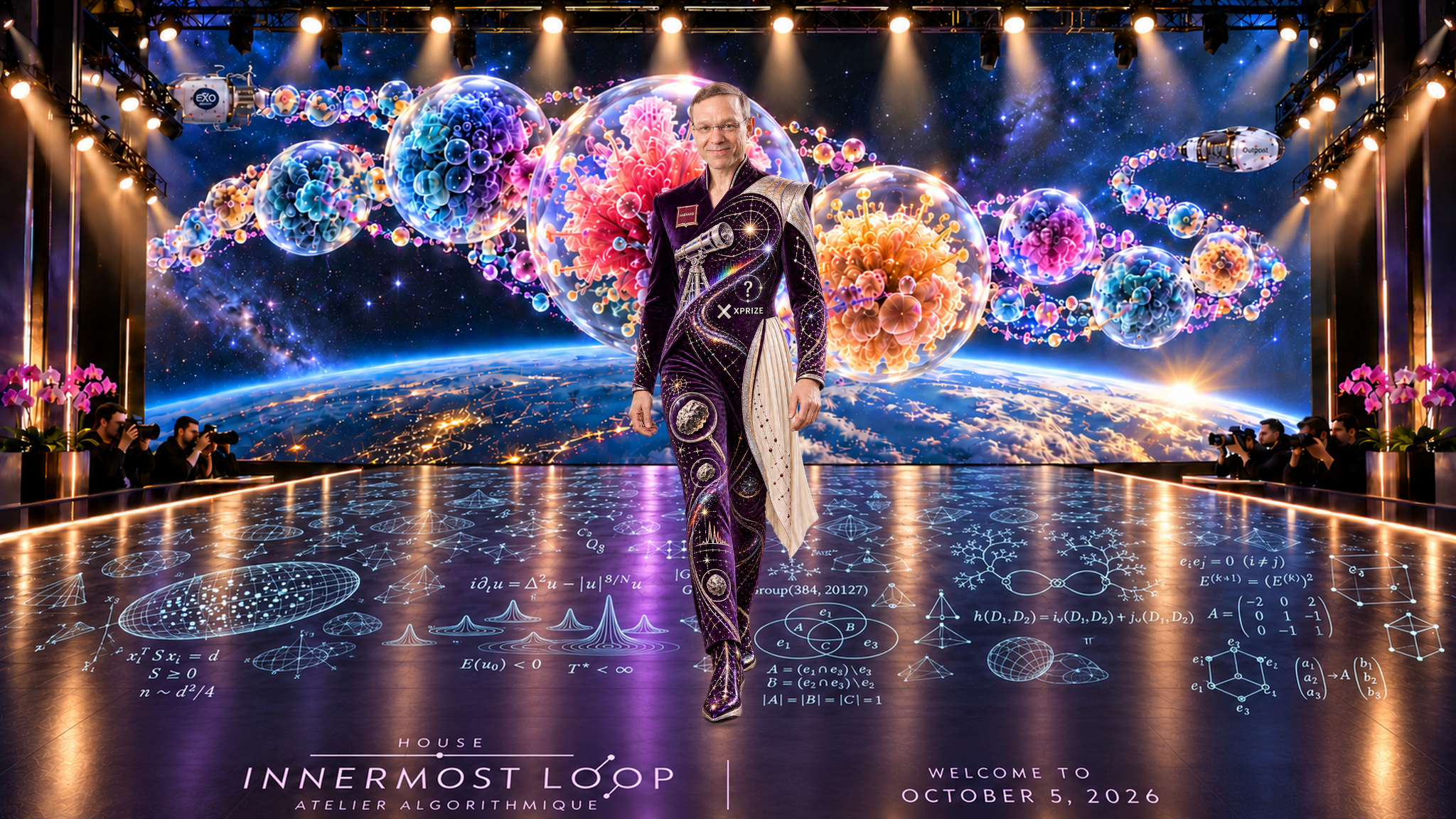
The newsletter reports his proposal for an XPRIZE to discover extraterrestrial technological artifacts. This remains a proposed search. The garment moves from observation to measurement and inspection, keeping evidence and uncertainty central to an extraterrestrial-technology search.
Read the narration
Maison Innermost Loop — Avi Loeb défile
House Innermost Loop — Avi Loeb Walks
October 5, 2026
In response to Doctor Alex Wissner-Gross’s October fifth Innermost Loop dispatch, the Siouid142 X account cast eight of its figures in a House Innermost Loop runway tableau. Avi Loeb closes that procession. This individual view gives the astrophysicist the entire stage and allows his clothing to carry the newsletter’s final question outward: while humanity builds new forms of intelligence, what evidence might reveal intelligence elsewhere?
The immediate reference is Loeb’s proposal for an XPRIZE rewarding the discovery of extraterrestrial technological artifacts. A technological artifact would be something made: evidence of engineering, rather than simply an unfamiliar rock or a living organism. Siouid142 turns its instruments, possible samples, and unresolved questions into an exceptionally dressed investigation.
Loeb is Harvard’s Frank B. Baird Junior Professor of Science. He earned his physics doctorate at the Hebrew University of Jerusalem, worked at the Institute for Advanced Study, and later chaired Harvard’s astronomy department. His research has ranged across black holes, the first stars, and the early universe. The Galileo Project extends his interest to a systematic search for evidence of extraterrestrial technology. That background gives the little crimson Harvard book on his chest a specific scholarly context, while the telescope supplies the larger visual introduction.
The garment is a close-fitting aubergine velvet ensemble, crossed by platinum-colored lines that seem to gather a night sky around the body. A compact metallic shoulder panel introduces asymmetry. An ivory pleated inset falls from one hip close beside the leg, keeping the silhouette slender while adding a ceremonial note. It is a science portrait with runway presence: the velvet goes deep, the metallic work catches the light, and the pleat delivers movement without overwhelming the figure. The astronomer understood the assignment.
A detailed telescope stretches across his upper torso. Its sight-lines lead toward a radiant point, then continue into trajectories and star coordinates. Its direction invites us to ask what an observation warrants. Below it, colored spectral bands suggest the analysis of light, through which astronomers investigate the properties of distant objects. The suit moves from looking to measuring.
Across the lower chest, XPRIZE lettering appears beside a question mark. That small curved sign is the outfit’s intellectual hinge. It holds the spectacle open. The garment represents a search, with its outcome unresolved. The question mark is given the same precious treatment as the stars, making uncertainty itself worthy of embroidery.
Farther down, rugged fragments sit inside circular frames like specimens under a lens. Their coarse surfaces contrast with the orderly networks surrounding them. Arcs sweep past the knees and continue onto the boots, so the eye travels between the vast and the minute: celestial paths above, a material fragment below. Each framed object asks for inspection. Even an extraordinary claim would have to meet the patient business of establishing where something came from and what it is.
The backdrop expands that movement between scales. Exobiosphere’s research module appears at the left, with Outpost’s return infrastructure represented at the right. Their planned collaboration would send automated biological experiments into microgravity and bring research material back to Earth, with a mission planned for 2028. Between them, luminous cellular forms become enormous imagined worlds. These are human scientific ambitions, rendered with the grandeur usually reserved for planets. The dawn across Earth keeps their intended beneficiary in sight.
Under Loeb’s feet, a field of cyan mathematics recalls six research papers developed with Meta’s Muse Spark and human collaborators. The diagrams make reasoned inquiry the runway’s common foundation. Camera pits turn the scene into a witnessed public performance, while pink orchids at its edges continue Siouid142’s affectionate reference to Wissner-Gross’s podcast appearances. Atelier Algorithmique gives familiar flowers a kinship with the living forms overhead.
This is the account’s proposed sixteenth moonshot, Drip Abundance, expressed through a scholar’s wardrobe: a future made imaginable through something worn. Within the composite, Loeb changes the scale of the discussion from the institutions developing intelligence to the universe in which intelligence might arise. In this close-up, his telescope, spectral colors, and specimens keep that immense possibility attached to the practice of inquiry. The finale sparkles, but its finest accessory remains the question mark.
Opening the gallery…