70 Clock Galerie / The Innermost Loop Reply Tableaux
TABLEAU 513
Maison Innermost Loop — Steven Rattner défile
House Innermost Loop — Steven Rattner Walks
October 5, 2026
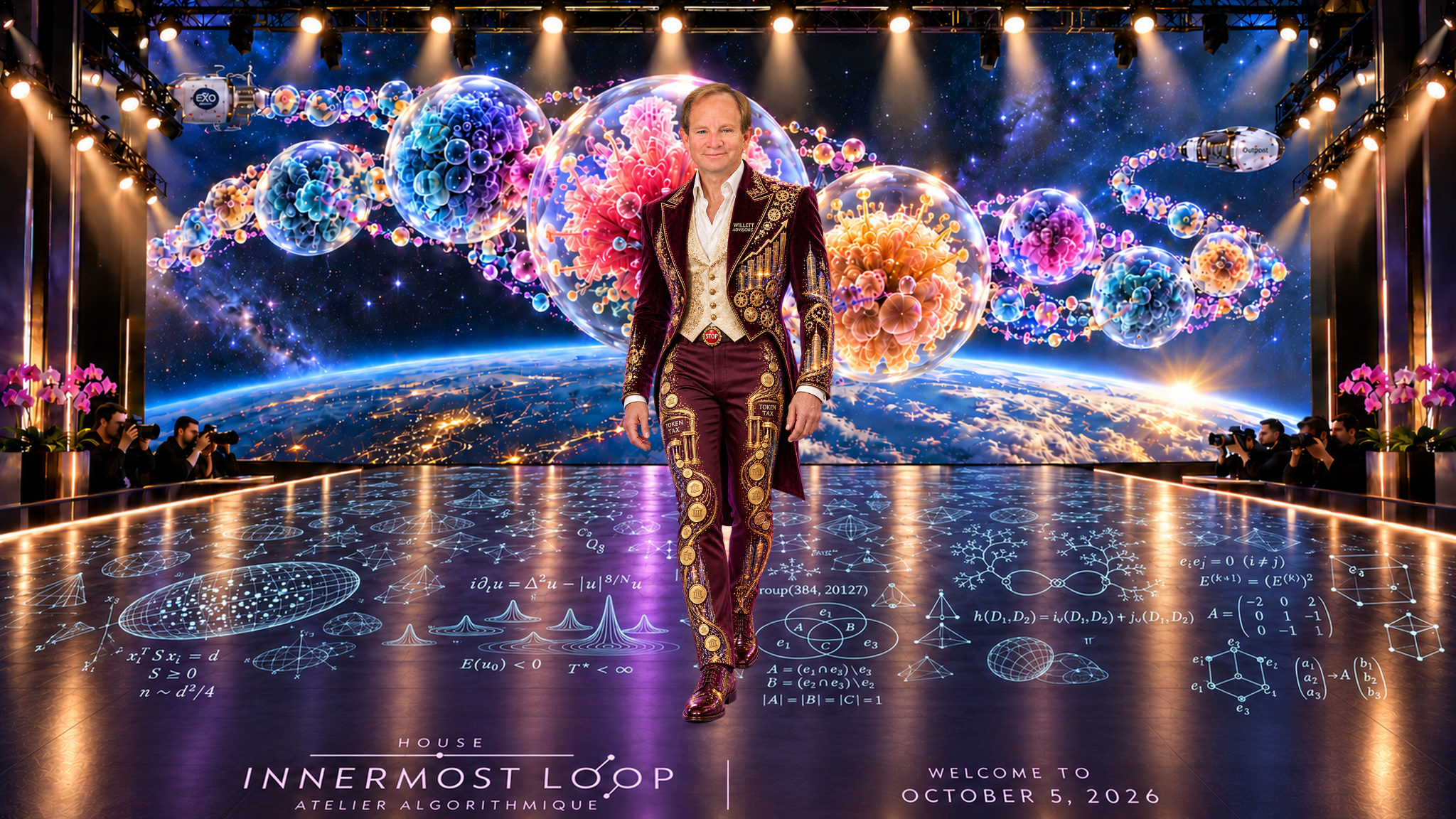
Rattner advocates productivity growth from AI while discussing distribution, a token-tax suggestion and possible government testing or emergency stops. Productivity, redistribution and proposed safeguards become an economic mechanism worn on the body. Tokens are not automatically cryptocurrency.
Read the narration
Maison Innermost Loop — Steven Rattner défile
House Innermost Loop — Steven Rattner Walks
October 5, 2026
The Siouid142 X account answered Doctor Alex Wissner-Gross’s October fifth Innermost Loop dispatch with eight newsmakers walking an imaginary couture runway. This individual portrait brings Steven Rattner forward from that ensemble, dressed in an argument about what artificial intelligence could produce, who should benefit, and how its risks might be managed. House Innermost Loop, Atelier Algorithmique, makes economic policy wearable through the account’s proposed sixteenth moonshot: Drip Abundance.
Rattner brings several careers to the fitting. A Brown University economics graduate, he reported for The New York Times before entering investment banking. He later led the Obama administration’s automobile industry restructuring as a Treasury counselor. Today he chairs Willett Advisors, which manages Michael Bloomberg’s personal and philanthropic investments, while continuing to explain the economy in public. The small Willett Advisors label on his chest identifies that financial affiliation; the garment’s larger imagery carries the argument that placed him in this newsletter.
His contribution was a case for artificial intelligence as a source of badly needed productivity growth. Productivity means obtaining more useful output from the same work and resources. In Rattner’s account, technological progress can help raise living standards, support public services, and create room to share prosperity. Siouid142 gives that proposition a working mechanism: golden gears, miniature architecture, and rising bars spread across a burgundy velvet opera coat.
Curved lapels frame an ivory waistcoat embroidered almost to the density of brocade. The open collar relaxes the institutional bearing; the narrow coat tails extend the line behind his legs. Wine-colored boots complete a continuous figure, with gold traveling from shoulder to toe. He is serving fiscal-policy finery, and the fit has a surprisingly persuasive case.
Look closely at the machinery. Wheels gather at the waist and cuffs, while columns climb across the chest like an illuminated city whose buildings have become a chart. The embroidery makes an economic abstraction tangible. Growth acquires moving parts, labor, construction, and interdependence. The gold is doing more than announcing wealth: it makes the systems that produce wealth visible on the surface of the cloth.
Down both legs, streams of token-like medallions pass through architectural gates marked Token Tax. Rattner discussed such a levy as an idea proposed by others, within a broader argument that AI’s beneficiaries should help support people affected by economic change. Here the gate supplies an almost literal picture of collection. AI usage becomes a procession of coins, making an unfamiliar unit readable as a toll.
At the waist, a red clasp marked Stop interrupts that golden circulation. It translates his suggestion that governments consider emergency stopping mechanisms, alongside testing, into a tiny piece of statement hardware. Its placement is exact: where tailoring holds the outfit together, a policy question asks how a powerful system might be restrained. The jewel makes the proposal legible without solving the engineering problem. A button on a costume is much easier to design than a reliable safeguard for an interconnected technology.
Behind him, the scale suddenly changes. Enormous translucent biological worlds float above Earth between two modest spacecraft. Exobiosphere and Outpost belong here because their partnership proposes automated drug research in microgravity, with experiments transported to orbit and material returned home. A mission was planned for 2028. The glowing cellular forms imagine the research possibilities; their exuberant beauty gives the financial discussion a potential human purpose. What might greater productive capacity make possible for health?
The floor adds another kind of work. Cyan diagrams and equations refer to six mathematical papers developed through collaboration between researchers and Meta’s Muse Spark. Curved surfaces, tightening waveforms, overlapping sets, and networks turn abstract reasoning into the surface beneath his feet. Photographers bring the argument into public view; pink orchids recall Wissner-Gross’s podcast setting.
Seen alone, Rattner’s outfit becomes a compact economic theatre. The gears generate, the gates collect, and the red clasp asks when intervention might be necessary. Burgundy velvet gives the arrangement composure; extravagant gold refuses to make governance look drab. The walk carries an ambitious proposition into the lights: abundance needs productive engines, and its public meaning emerges in the choices made about what those engines deliver.
Opening the gallery…