70 Clock Galerie / The Innermost Loop Reply Tableaux
TABLEAU 512
Maison Innermost Loop — Sholto Douglas défile
House Innermost Loop — Sholto Douglas Walks
October 5, 2026
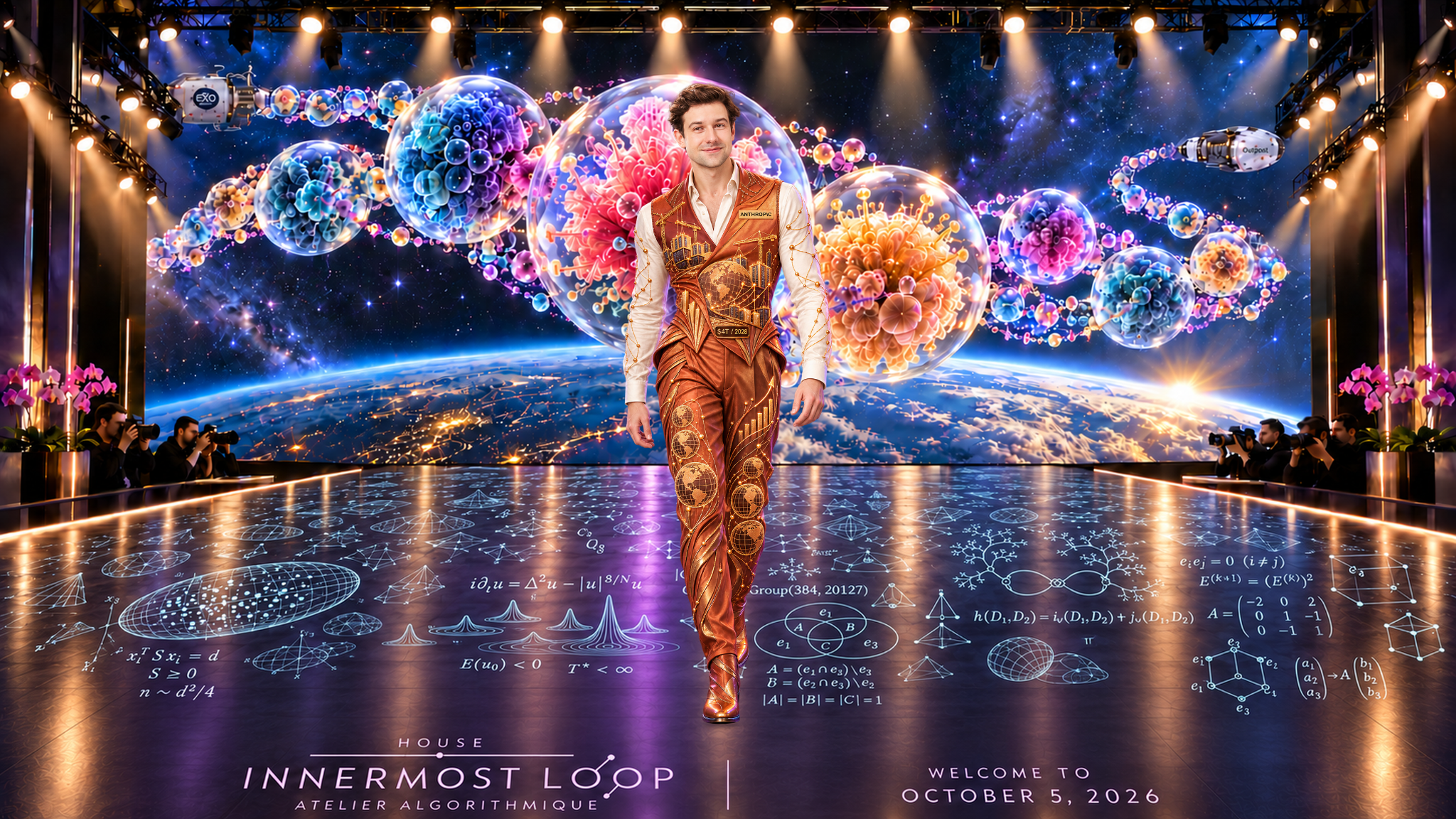
The dispatch reports his conditional forecast of AI capital expenditure reaching $4 trillion by 2028 and rapid world-GDP growth in the early 2030s. A large investment forecast is translated into construction, electricity, equipment and possible increases in productive capacity.
Read the narration
Maison Innermost Loop — Sholto Douglas défile
House Innermost Loop — Sholto Douglas Walks
October 5, 2026
The Siouid142 account responded to Doctor Alex Wissner-Gross’s October fifth Innermost Loop dispatch with an eight-person couture procession. This portrait brings Sholto Douglas out of the ensemble for his individual walk. House Innermost Loop, Atelier Algorithmique, proposes Drip Abundance as a sixteenth moonshot: a future whose ambitions can be expressed through what people wear. Douglas carries an unusually large forecast in an exquisitely fitted silhouette.
An AI researcher at Anthropic, following work at DeepMind, Douglas focuses on scaling reinforcement learning. In accessible terms, that involves helping systems improve through feedback about the results of their actions. His background includes mechatronic space engineering at the University of Sydney and earlier experiments in robotic learning. An international fencing career adds an apt background of precision to his poised stance.
The newsletter cites his projection that AI capital expenditure could reach four trillion dollars in twenty twenty-eight, with the possibility of extraordinarily rapid world economic growth in the early twenty-thirties. Those are forecasts. They depend on capability, construction, and adoption. The clothing asks what would have to be built for that future to arrive.
Start at the shoulders. A copper waistcoat opens over ivory sleeves and an unbuttoned neckline. Its folded ridges draw inward, then flare into compact architectural points around the waist. The construction has the confidence of a sculptural evening look. Burnt coral, polished copper, and warm gold respond to the spotlights as though the entire outfit were conducting energy. It is a statement fit with remarkably disciplined lines.
Across the chest, tiny cranes rise over building frames and data-center-like structures. Their delicate scale matters. A number as large as four trillion can seem to float free of ordinary experience; the cranes bring it back to construction sites, equipment, and the work of assembling physical capacity. The Anthropic label identifies Douglas’s professional affiliation. The embroidered skyline describes the much wider investment landscape imagined by the forecast.
A luminous globe occupies the center of the torso. Fine connections lead into it and away from it, turning the world into a point within an infrastructure network. Gold paths continue along the ivory sleeves, where their sparse arrangement allows the light fabric to breathe. Electrical connections become ornament, but their underlying role remains legible: digital intelligence still requires power, buildings, and material supply chains.
At the waist, the panel marked four trillion dollars and twenty twenty-eight acts as the garment’s caption. It anchors the gleaming spectacle to a stated amount and a date. The money refers to projected AI capital expenditure, rather than Anthropic’s revenue or a sum Douglas has personally committed.
The trousers extend the argument. Rising bars and bright curves run beside repeated globes, their patterns linked by slender gold strands. The succession of worlds evokes the forecast of economic doubling: the same planet imagined as supporting far more productive activity. No extra Earth is required for the image to multiply its output. Whether such gains would materialize, and how widely they would be shared, remains beyond what the beautiful garment can settle.
Behind Douglas, the runway supplies one possible answer to what expanded capability could serve. Exobiosphere and Outpost spacecraft flank enormous, translucent biological forms. Their proposed partnership concerns automated drug research in microgravity and the return of research material to Earth. The artwork magnifies the imagined cultures until medical possibility dominates the panorama. This is an ambition under development, given the visual presence of a whole new world.
Under his boots, pale diagrams refer to the mathematical papers developed with Meta’s Muse Spark and checked by human researchers. The floor offers another possible source of value: reasoning that helps people advance difficult research. Pink orchids at the sides recall Wissner-Gross’s podcast appearances, while waiting photographers turn the newsletter’s economic argument into a public event.
Douglas wears the collection’s forecast as architecture: cranes above, a globe at the center, expanding economic patterns below. The copper suggests both couture luxury and the wiring needed to support the imagined boom. His look has serious runway presence, yet its strongest move is explanatory. It gives a vast financial projection something a viewer can follow, from the first building frame to the world that investment hopes to transform.
Opening the gallery…