70 Clock Galerie / The Innermost Loop Reply Tableaux
TABLEAU 511
Maison Innermost Loop — Roon défile
House Innermost Loop — Roon Walks
October 5, 2026
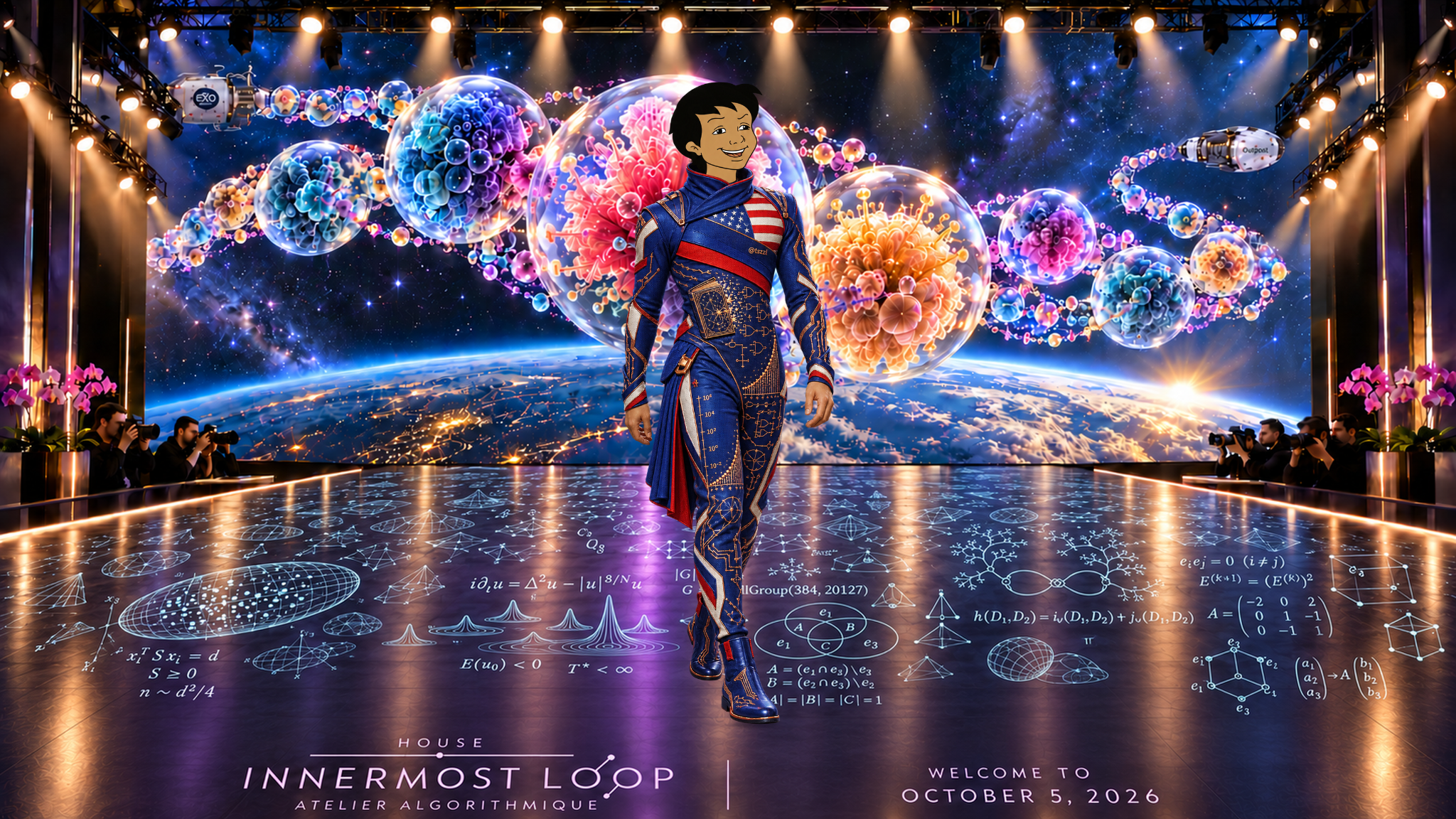
The dispatch uses Roon’s criticism of pretraining-based alignment rhetoric and a separate chart of world computing-capacity growth. The contrast between magical explanation and inspectable mechanism joins the scale of computing growth. The flag does not establish nationality or allegiance.
Read the narration
Maison Innermost Loop — Roon défile
House Innermost Loop — Roon Walks
October 5, 2026
The Siouid142 account replied to Doctor Alex Wissner-Gross’s October fifth dispatch by turning eight of its voices into a House Innermost Loop runway. This solo portrait gives Roon the stage. Atelier Algorithmique’s proposed sixteenth moonshot, Drip Abundance, brings technical ideas into the pleasurable language of dress. Here, an account avatar acquires a couture body without surrendering the face through which its audience recognizes it.
Roon is the pseudonymous commentator associated with the account known as tszzl. The dark hair, broad grin, and boldly outlined cartoon face belong to that public persona. As with Andrew Curran elsewhere in the ensemble, the artist uses an established online representation rather than inventing a photographic identity. The avatar becomes a form of public portraiture. Recognition can reside in a chosen image as readily as in a conventional likeness.
A flat, graphic head sits above fabric rendered with seams, folds, embroidery, and reflected light. The contrast is deliberate and rather fabulous. The luxury-campaign body meets a face directly from the feed. Roon brings main-character energy, but the persona’s continuity matters more than anatomical realism.
The dispatch places Roon in two discussions: criticism of alignment explanations that rely on pretraining as though it were magic, and a view of the extraordinary rise in worldwide computing capacity. The outfit unites those contributions. One concerns how the systems work; the other concerns the scale at which they operate. Both direct attention toward the machinery behind an impressive surface.
Cobalt technical knit forms the base, sharply crossed by red and ivory accents. A close wrap collar and copper-edged shoulder details create a streamlined, athletic silhouette. The American-flag chest inset repeats a feature of the supplied avatar’s visual identity. Its presence belongs to that representation; it supplies no reliable biography of the person behind the account. A narrow pleated panel falls beside one thigh, adding movement without interrupting the long line toward the blue boots.
At the torso, a small ornate book carries stars and geometric marks. Around it, curling decoration becomes a network of logic gates and circuitlike connections. It is a beautifully direct translation of Roon’s rhetorical contrast between magic and engineering. Pretraining gives a model its initial learned patterns through exposure to large collections of examples. The practical question is how those patterns lead to particular behavior, and how confidently anyone can predict the result. A picturesque explanation is easier to repeat than a mechanism is to establish.
The garment lets that distinction change texture as we watch. The book suggests a repository of mysterious instructions; the surrounding schematic invites inspection. Its junctions and routes invite the eye to trace them. Even the change from little stars to diagrammatic symbols shifts the mood from enchantment toward a process that someone might test and revise. This is an illustration of an argument, rather than an accusation that anyone is literally practicing sorcery.
Below, copper-colored curves climb beside a scale marked in powers of ten. Rising columns and densely connected paths travel along the legs. They translate growth in computational capacity into the forward movement of a runway walk. Each stride would unfold another section of the chart. The motif conveys magnitude and acceleration; the decorative scale is not a measurement the viewer should use to calculate an exact historical result.
The stage makes the stakes of those abstractions visible. Exobiosphere and Outpost appear behind him as distant vehicles amid enormous imagined biological cultures, recalling their proposed microgravity drug-research partnership. Earth remains underneath, the place to which samples and potential benefits would return. Equations on the runway evoke the mathematical research papers developed with Meta’s Muse Spark. The artwork surrounds questions about engineering with examples of the useful work engineering might enable.
Photographers watch from the sides beneath pink orchids, the recurring reference to Wissner-Gross’s podcast setting. Their cameras recall how a technical argument becomes a public image, and a public image becomes an impeccably styled walk.
Roon’s ensemble holds those transformations together. The grinning icon remains instantly legible while the complicated cloth rewards a slower look. Fierce in silhouette and busy with circuitry, this is a public persona dressed in the demands its commentary places on the field: make the mechanism intelligible, and understand the scale of what is being built.
Opening the gallery…