70 Clock Galerie / The Innermost Loop Reply Tableaux
TABLEAU 510
Maison Innermost Loop — Igor Babuschkin défile
House Innermost Loop — Igor Babuschkin Walks
October 5, 2026
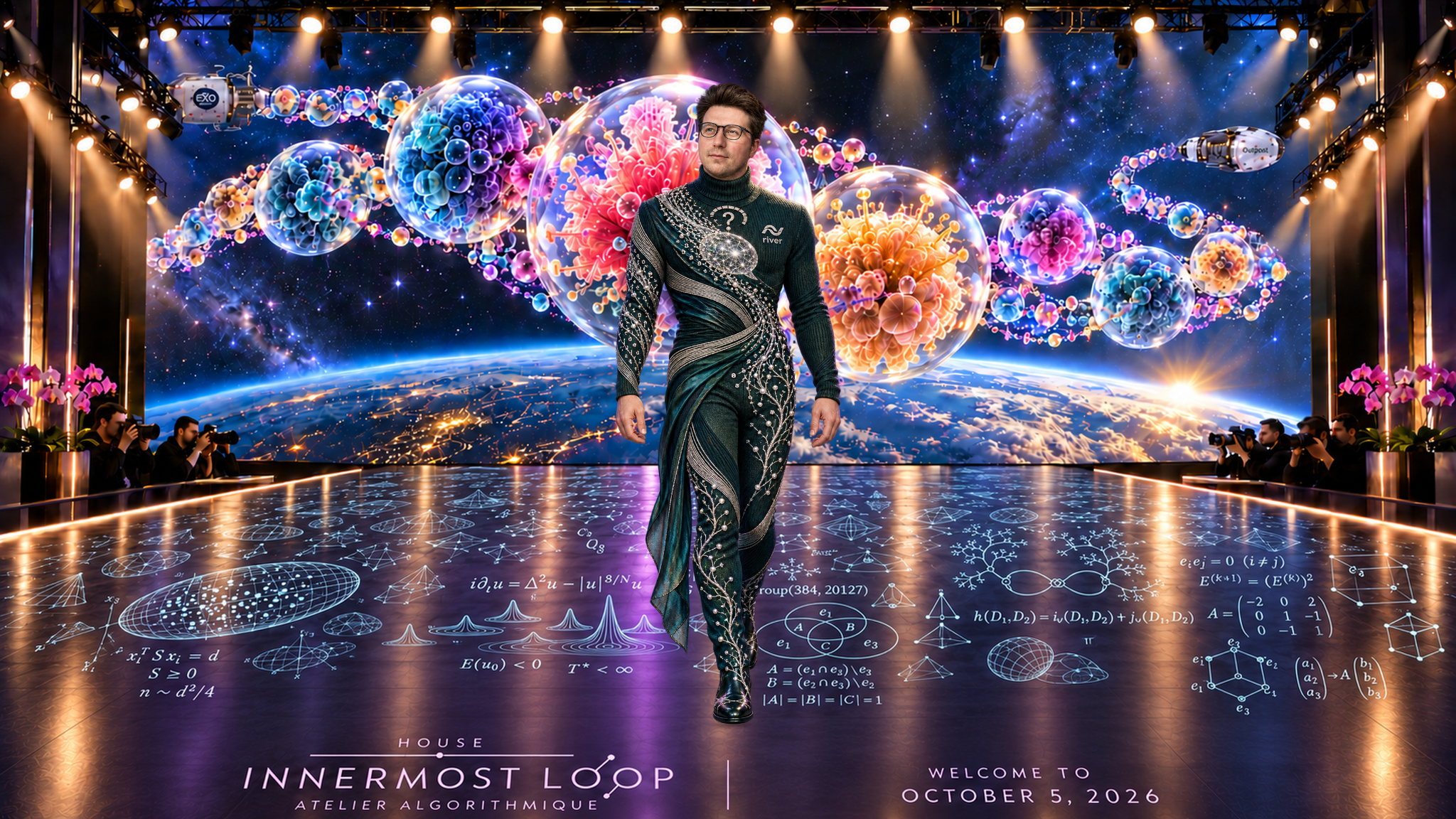
The dispatch cites his criticism of describing Claude as having a soul and his concern that such language could influence successor systems. A possible path from public descriptions to later training material becomes a flowing embroidered river. Consciousness is left unresolved.
Read the narration
Maison Innermost Loop — Igor Babuschkin défile
House Innermost Loop — Igor Babuschkin Walks
October 5, 2026
The Siouid142 account answered Doctor Alex Wissner-Gross’s October fifth Innermost Loop dispatch with an imagined couture procession. This individual portrait brings Igor Babuschkin forward from that eight-person ensemble. At House Innermost Loop, Atelier Algorithmique, the proposed sixteenth moonshot, Drip Abundance, gives technological arguments a wardrobe. Babuschkin arrives wearing a question about the stories artificial intelligence inherits.
He is the co-founder and chief executive of River AI, following research at DeepMind, OpenAI, and xAI. His company proposes personal systems that learn an individual’s preferences and adapt to the work that person actually does. Its initial training tools let developers reshape existing models; its broader ambition concerns agents that continue learning from their users. That background makes him a particularly pertinent participant in a discussion about how intelligence acquires its habits and its account of itself.
The newsletter includes his criticism of language portraying Anthropic’s Claude as possessing a soul, and his concern that such descriptions could influence successor systems. His objection brings attention to a feedback path: people describe a model, those descriptions circulate, and later training may encounter the resulting text. A story about intelligence can become part of the material from which another intelligence learns. The portrait translates that possibility into a flowing surface.
Forest green and petrol teal wrap around a fitted, ribbed turtleneck. The close collar gives the head a composed, almost scholarly frame. Across the body, lustrous fabric gathers diagonally in long, controlled folds. A narrow drape descends beside one leg; silver lines guide the eye through its turns. The silhouette is sleek, the shoulder line assured. It is serving intellectual gravitas with a distinctly editorial finish.
The small River name and wave emblem provide the affiliation, while the garment performs a larger river of its own. Silver streams sweep across the chest, bend around the waist, and separate into branching patterns along the trousers. Their brightness shifts against the dark cloth like reflections moving over deep water. The orderly repetition of the knit supports embroidery that seems alive with movement.
Near the collar sits the decisive mark: a question mark above an incomplete ring. Below it, a faceted, luminous chamber resembles a speech bubble translated into crystalline geometry. Tiny beads and letterlike fragments spill outward, gathering into networks. The design makes language the source of the stream. The broken halo introduces the contested spiritual vocabulary; the question mark holds that vocabulary open to examination. The costume stages a debate about describing AI, without claiming to resolve consciousness through a piece of embroidery.
Following the silver branches down to the boots reveals the argument’s temporal dimension. What begins near the mouth as an account of a model’s character becomes a pattern passed onward. The imagery invites us to consider how a repeated description might acquire the appearance of an inherited trait. It also makes the audience conscious of its own contribution. Every admiring analogy and every frightening metaphor adds another sentence to the environment in which future systems may be trained.
Behind him, vast translucent biological cultures float above Earth between Exobiosphere and Outpost spacecraft. They enlarge the potential medical purpose of the companies’ proposed orbital research and return program. The fantasy is anchored in an earthly beneficiary: the illuminated planet below. Underfoot, pale equations refer to mathematical papers developed with Meta’s Muse Spark, with human researchers directing and checking the work. The setting places experimental possibility above the model and disciplined reasoning beneath him.
Pink orchids beside the photographers recall Wissner-Gross’s podcast backdrop. Their familiar blossoms rhyme with the extraordinary living forms overhead. They also keep this elaborate solo walk connected to the original social exchange: a newsletter has become a runway, and a public disagreement has become a garment with a point of view.
Babuschkin’s look succeeds through continuity. The wrapped fabric, the River emblem, and the branching silver all carry the same motion, while the quiet face lets the cloth do the talking. The outfit has flow, but its most compelling accessory is the unanswered question at the throat. Before a description becomes an inheritance, the viewer is invited to notice who first supplied the words.
Opening the gallery…