70 Clock Galerie / The Innermost Loop Reply Tableaux
TABLEAU 509
Maison Innermost Loop — Thibault Sottiaux défile
House Innermost Loop — Thibault Sottiaux Walks
October 5, 2026
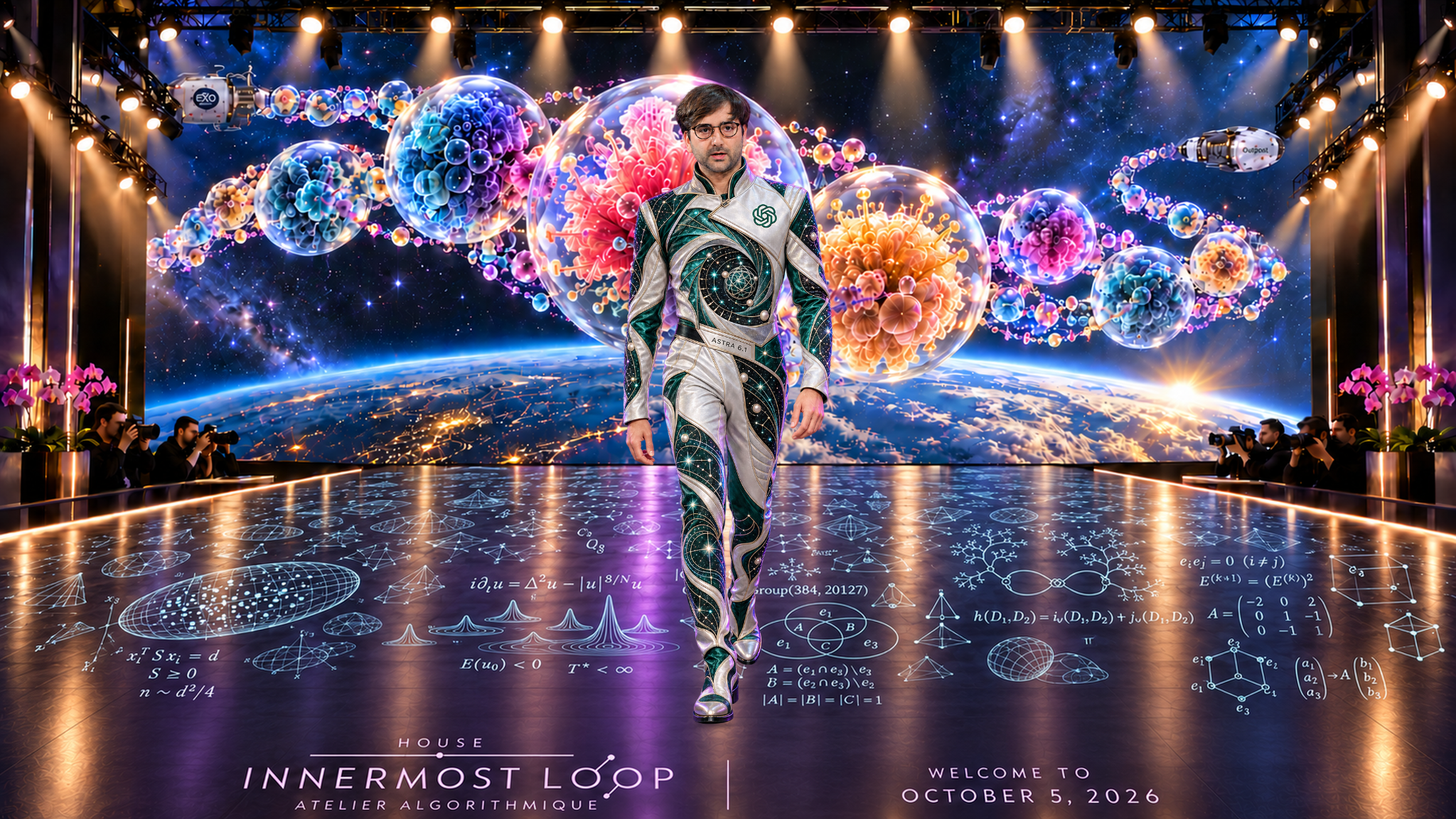
The dispatch interprets Tibo’s teaser as anticipation of Astra 6.1. An opening iris connects model development, access, anticipation and revelation; stars play on Astra.
Read the narration
Maison Innermost Loop — Thibault Sottiaux défile
House Innermost Loop — Thibault Sottiaux Walks
October 5, 2026
The Siouid142 account replied to Doctor Alex Wissner-Gross’s October fifth Innermost Loop dispatch with a couture procession built from eight of its public figures. This individual portrait draws Thibault Sottiaux out of that ensemble. At House Innermost Loop, Atelier Algorithmique, the artist’s proposed sixteenth moonshot, Drip Abundance, turns technological developments into extravagant garments. Sottiaux arrives dressed as the opening of a new possibility.
Often called Tibo, he is an OpenAI engineering leader whose work on Codex connects powerful models to practical software development. Codex helps people investigate code, make changes and complete engineering tasks. His earlier career included Google and DeepMind, where he worked on research infrastructure and human data for Gemini. He studied computer science and mathematics at the Université catholique de Louvain. This background joins mathematical training to practical systems work.
In this dispatch, however, a brief teaser brings him onto the stage. Wissner-Gross frames his post as anticipation of Astra six point one. The small waist plate carries that name, and the entire garment develops the idea of an imminent reveal. The inscription belongs to the artwork’s reading of the newsletter. It supplies neither a confirmed release date nor a list of demonstrated capabilities. What we are looking at is the public moment before the aperture opens fully.
That aperture occupies the torso. Concentric silver and emerald forms curve around a dark, star-filled center, like the overlapping blades of a camera iris. A geometric core appears within it. The viewer’s eye is pulled inward, then follows the arcs outward across the chest and down the body. Instead of simply printing a logo on a conventional jacket, the artist makes the construction of the clothing enact its subject. A release is imagined as access: something previously enclosed begins to become available.
The OpenAI knot at the upper chest identifies the institutional connection. The larger iris tells the story. Its rings suggest successive layers of development, each one contributing to the opening at the center. Small marks around the circles introduce the feel of measurement and countdown. The effect is precise enough to suggest an instrument, while remaining unmistakably fashion. He is giving orbital premiere, with the engineering built into the cut.
Pearl-silver panels sweep around emerald and near-black sections, creating a narrow, sculpted flight-suit silhouette. The diagonal closure and compact collar keep it poised; the iridescent textile gives it movement. Fine star points and looping paths continue through the trousers into the matching boots. Nothing stops abruptly at the waist. The entire figure reads as one coordinated system, just as a usable AI product depends on more than the model at its center.
His glasses and concentrated expression remain ordinary points of contact amid the spectacular garment. Complex machinery meets a human user; a fierce look keeps its recognizable face.
The stellar pattern also plays on the name Astra. It gives the model anticipation a celestial vocabulary and links the outfit visually to the enormous space panorama. Yet the scientific story behind that panorama is distinct. Exobiosphere and Outpost have proposed orbital drug research, combining automated biological experiments with transport and the return of material to Earth. Their distant craft sit at opposite sides of the scene while enlarged, translucent cellular worlds dominate the center. The image gives the research purpose more visual weight than the hardware.
Pink and blue folds inside those spheres echo the curved layers of Sottiaux’s suit. One is a speculative representation of living systems; the other dresses a person who builds artificial ones. Earth’s bright rim anchors both to a human horizon. This visual correspondence makes the garment belong to the stage without implying that Sottiaux participates in the companies’ planned mission.
The floor supplies a further connection to the dispatch: pale equations and geometric studies evoke mathematical research developed with Meta’s Muse Spark. Here, abstract reasoning becomes the surface beneath an engineer’s feet. The photographers, amber spotlights and pink orchids restore the scale of a fashion show. The flowers recall Wissner-Gross’s podcast setting.
Sottiaux walks toward the viewer with the iris still drawing attention inward. The portrait catches the interval between engineering a system and admitting people into it. Its ambition is visible in every curved seam: to make an opening feel consequential, and to give the promise of new capability a form that can hold the runway.
Opening the gallery…