70 Clock Galerie / The Innermost Loop Reply Tableaux
TABLEAU 507
Maison Innermost Loop — Jay Clayton défile
House Innermost Loop — Jay Clayton Walks
October 5, 2026
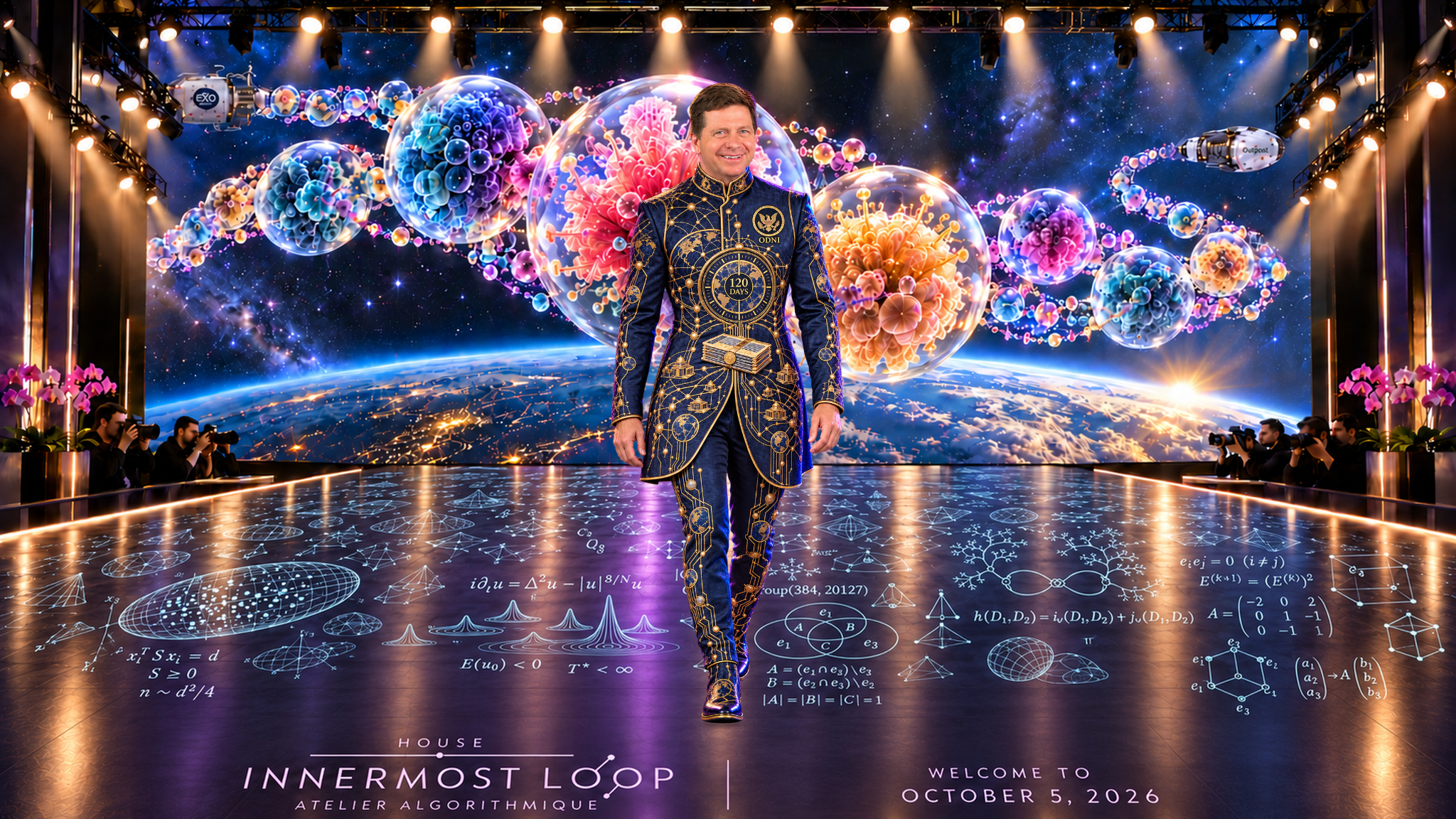
The dispatch places Clayton at the head of the Super Intelligence Force, opposing an industrywide slowdown while overseeing a 120-day risk report. Deadline, evidence collection, institutional coordination and risk assessment become a ceremonial wardrobe.
Read the narration
Maison Innermost Loop — Jay Clayton défile
House Innermost Loop — Jay Clayton Walks
October 5, 2026
The Siouid142 account answered Doctor Alex Wissner-Gross’s October fifth Innermost Loop dispatch with eight figures walking an imaginary couture runway. This individual portrait brings Jay Clayton, the procession’s opening figure, into focus. House Innermost Loop, Atelier Algorithmique, makes the artist’s proposed sixteenth moonshot, Drip Abundance, tangible: technological arguments become clothes, and the people making them become models.
Clayton enters because the dispatch places him at the head of the new Super Intelligence Force. It describes an official opposed to an industrywide slowdown, yet charged with overseeing a risk assessment on a one-hundred-and-twenty-day timetable. That combination gives the portrait its governing tension. How does an institution examine a fast-moving technology without treating examination as a reason to stop everything?
His background crosses several of the worlds involved. Clayton studied engineering at the University of Pennsylvania, economics at Cambridge, and law back at Penn. He chaired the Securities and Exchange Commission from twenty seventeen to twenty twenty, later served as United States Attorney for the Southern District of New York, and became Director of National Intelligence in August twenty twenty-six. The small eagle and ODNI lettering on his chest locate this costume in the intelligence role.
But it is the clock that catches the eye. A golden dial occupies his abdomen, with one hundred and twenty days inscribed at its center. The deadline becomes something he must physically carry down the runway. Below it sits an embroidered dossier, bound shut and secured by a medallion. We can see the obligation to produce an assessment; its conclusions remain inside the closed cover. An administrative process has acquired the dramatic clarity of a ceremonial object.
Fine gold paths spread around that dossier. They connect globes, points and little architectural forms, climb the sleeves, and descend along both legs. Information appears to arrive from many directions before gathering around the report. The geometry makes the work of coordination visible: observations have to be collected, compared and turned into a judgment. As couture, it also rewards the closer view. What glitters in the ensemble becomes an unusually elaborate brief.
The midnight-blue tunic has a narrow standing collar, a fitted waist and curved panels that extend over the thighs. Its lustrous, brocade-like surface takes the light differently from the raised metallic stitching. Gold piping sharpens the seams, while patterned trousers and polished boots complete a continuous silhouette. The look borrows the authority of state ceremony and gives it a full editorial finish. Clayton is serving diplomatic gala with a deadline. The smile supplies ease; the tailoring supplies discipline.
That poised figure stands against a much less orderly spectacle. Huge translucent biological worlds stream across the space panorama, their folded interiors glowing blue, pink and amber. Two distant vehicles provide the clues: Exobiosphere and Outpost. Their partnership proposes automated drug research in microgravity, with Outpost transporting experiments and bringing research material back to Earth. The planned mission remains a future undertaking. The artwork magnifies its possible medical purpose until the cultures eclipse the spacecraft that would carry them.
Earth glows below, making the destination of that ambition unmistakable. The composition puts Clayton’s institutional task before an imagined public benefit. Decisions about capability, risk and deployment ultimately concern what technology might make possible for people living on that planet. The embroidery asks how information reaches a decision; the backdrop asks what those decisions might enable.
Under his boots, pale equations and geometric diagrams recall the dispatch’s account of mathematical research developed with Meta’s Muse Spark. Ellipsoids, peaked waves, intersecting sets and branching structures create a floor of investigation. Above him, experimental biology expands; beneath him, abstract reasoning supplies the stage. These separate newsletter stories give his portrait a setting larger than the affairs of one office.
Warm spotlights, photographers and pink orchids bring that vast scene back to runway scale. The orchids recall Wissner-Gross’s familiar podcast setting. The cameras turn a technical policy story into a public appearance. Clayton advances between them wearing the central paradox of the edition: the future may arrive at extraordinary speed, but someone still has to open the dossier, examine the evidence and meet the deadline.
Opening the gallery…