70 Clock Galerie / The Innermost Loop Reply Tableaux
TABLEAU 506
Maison Innermost Loop — Jay Clayton, Andrew Curran, Thibault Sottiaux, Igor Babuschkin, Roon, Sholto Douglas, Steven Rattner et Avi Loeb défilent
House Innermost Loop — Jay Clayton, Andrew Curran, Thibault Sottiaux, Igor Babuschkin, Roon, Sholto Douglas, Steven Rattner, and Avi Loeb Walk
October 5, 2026
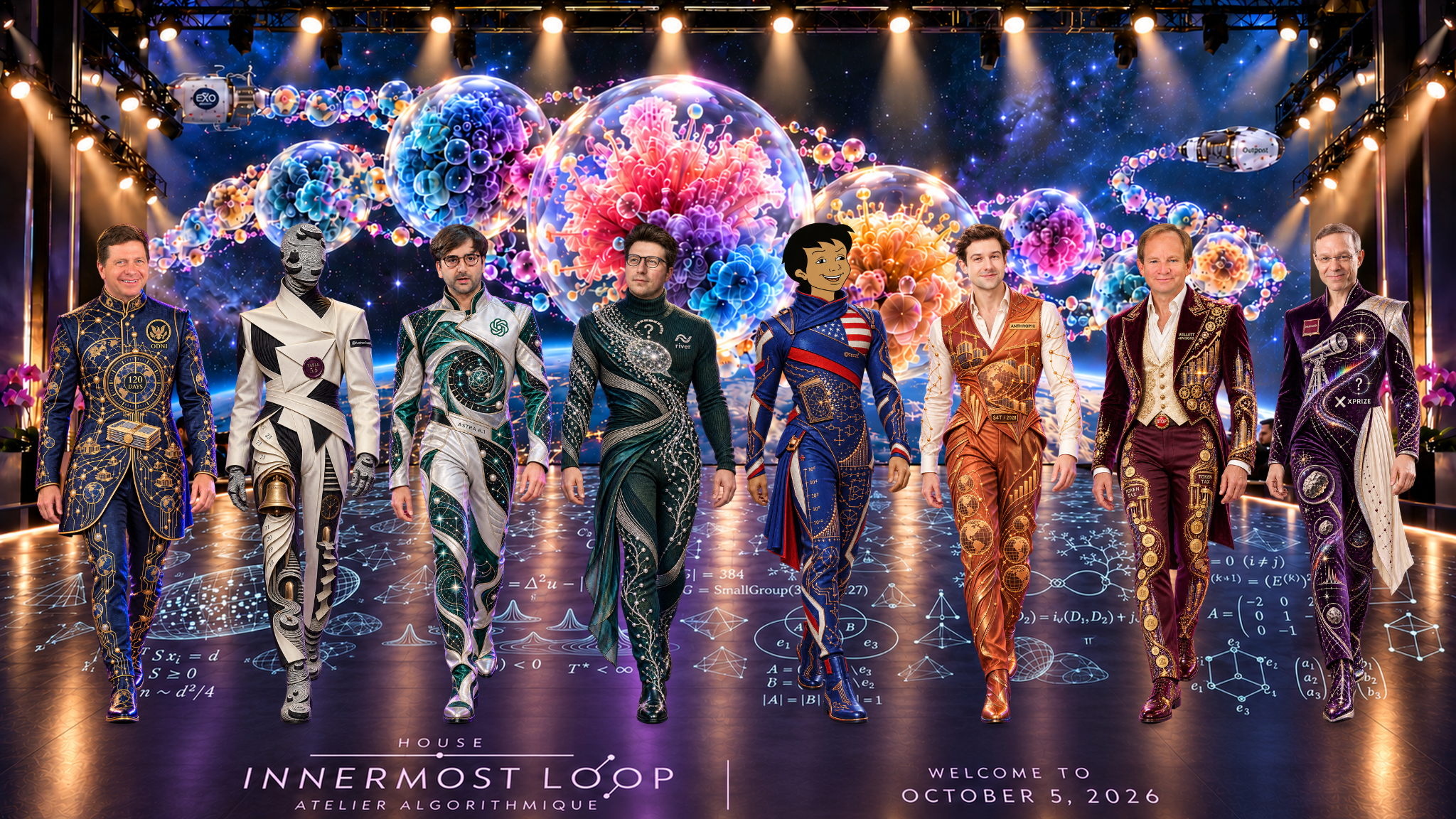
Eight figures from the October 5 dispatch walk a shared runway. Couture translates their public roles and arguments into clocks, sealed messages, optical apertures, branching language, circuitry, economic infrastructure and astronomical inquiry. Exobiosphere–Outpost medicine in orbit dominates the backdrop; six Meta-assisted mathematical papers supply the floor’s imagery.
Read the narration
Maison Innermost Loop — Jay Clayton, Andrew Curran, Thibault Sottiaux, Igor Babuschkin, Roon, Sholto Douglas, Steven Rattner et Avi Loeb défilent
House Innermost Loop — Jay Clayton, Andrew Curran, Thibault Sottiaux, Igor Babuschkin, Roon, Sholto Douglas, Steven Rattner, and Avi Loeb Walk
October 5, 2026
The Siouid142 X account responded to Doctor Alex Wissner-Gross’s Welcome to October fifth, twenty twenty-six dispatch by bringing eight of its voices onto the House Innermost Loop runway. Government, frontier research, online commentary, economics, and astrophysics acquire wardrobes at the Atelier Algorithmique. Each outfit makes its wearer’s place in the newsletter visible. Above them, enormous biological forms drift through space; beneath their feet, mathematical research becomes a luminous floor. The question joining these levels is what expanding intelligence might enable, and how people imagine, organize, and direct that possibility.
This is Drip Abundance, the artist’s proposed sixteenth moonshot: a future that can be worn, enjoyed, and recognized in the textures of ordinary life. Here its couture is gloriously extraordinary. Gold deadlines, sealed announcements, astronomical apertures, and embroidered economic forecasts replace the familiar suit and conference badge. The cast has entered full editorial mode. The garments invite us to read a technical dispatch with the same attention we might give an exceptional collection.
The setting supplies a particularly generous account of what all this capability could be for. Exobiosphere and Outpost appear in the newsletter through their partnership for drug discovery in microgravity. Exobiosphere develops an automated orbital laboratory for biological experiments and drug screening. Outpost’s CarryAll vehicles and Space Factories infrastructure are intended to carry such research into orbit and return samples to Earth. Their announcement looks ahead to a planned mission in twenty twenty-eight. The stage enlarges that proposal into an imagined medical cosmos.
At upper left, a small research module carries the Exobiosphere cue. Far across the panorama, an Outpost capsule marks the other end of a sweeping procession of transparent spheres. Between them, experimental life has become monumental. Violet folds, blue clusters, coral branches, and orange cellular masses bloom inside glasslike skins. Their highlights recall jewels and laboratory vessels; their scale recalls planets. These are speculative biological worlds, with the suggestiveness of tissue cultures and organoids, rather than illustrations identifying a particular organism or a completed cure.
There is a scientific reason to place biology in orbit. Microgravity changes the conditions under which cells develop and interact, allowing researchers to investigate tissue behavior and disease in ways that complement work on Earth. Returning samples makes further analysis possible. The artwork translates that research cycle into a curving visual current. The spacecraft remain modest at its edges while the potential medical payload commands the view. Infrastructure has become the supporting actor; living matter receives the close-up.
Earth curves beneath the experiments, its city lights spread across the dark surface and a sunrise breaking at the right. This keeps the potential beneficiaries of orbital research in the picture. The journey reaches outward and then points home. The pink orchids beside the runway repeat that thought at a familiar scale: recognizable living flowers below, extravagant cellular imaginings above. They also carry the house’s affectionate reference to the pink orchids associated with Wissner-Gross’s podcast appearances.
Warm spotlights and black lighting trusses frame the panorama as a fashion venue. Amber rails draw the eye toward the back; violet reflections pull its colors across the floor. Photographers wait at either side, their lenses turned toward the procession. Their presence makes the transformation complete: ideas usually encountered as posts, papers, or forecasts are now public appearances, ready to be photographed and circulated. The digital rendering gives velvet, ribbed knit, metallic thread, and folded cloth a persuasive tactile presence, even as the surroundings belong to speculative illustration.
Underfoot is another story from the dispatch. The blue equations and geometric drawings refer to six mathematical papers developed by researchers working with Meta’s Muse Spark. Meta’s account distinguishes six papers from five answers to previously open questions, and describes human direction and review throughout. That distinction gives the floor its real interest. It shows collaboration becoming research, with mathematical checking still part of the achievement.
The ellipsoids at the left surround clouds of points, recalling a result about when randomly sampled points can be fitted by a particular curved surface in many dimensions. Nearby, a sequence of waves grows taller and narrower, suggesting the finite-time concentration studied in a nonlinear wave equation. One motif asks where fitting becomes possible; the other asks when concentration must become singular. The artist gives both questions a shape that the eye can follow.
The number three hundred eighty-four anchors the angular networks near the center. It refers to a counterexample in group theory, the mathematics of symmetry: a structure that shows two properties do not always travel together. Overlapping ovals farther forward recall an optimization result identifying when a particular simplification exactly captures the underlying problem. Branching curves suggest a correspondence between a calculation in string theory and one in arithmetic geometry. At the right, matrices and small networks evoke a revised understanding of evolution algebras. The name is mathematical; its proximity to the biological panorama creates an additional visual rhyme.
These drawings give research the status of architecture. The runway is literally supported by ideas, while the possible application to living systems expands overhead. The tableau does not claim that these papers built the spacecraft or that the models walking over them wrote the proofs. It makes a broader connection between the ability to reason, the ability to experiment, and the institutions that turn those abilities into a shared future.
Jay Clayton opens the procession in midnight navy and antique gold. The dispatch presents the intelligence chief as chair of the Super Intelligence Force, facing a hundred-and-twenty-day risk assessment while opposing an industrywide slowdown. His earlier career as chairman of the Securities and Exchange Commission gives this appearance a longer background in the governance of powerful institutions.
His fitted ceremonial tunic turns the deadline into a magnificent clock across the abdomen. Below it sits an embroidered dossier, still closed. Fine networks connect globes, nodes, and architectural forms across the sleeves and down into the boots. The eagle and ODNI lettering identify the office represented here. The outfit gives administrative procedure the finish of state ceremony: information must be gathered, judgment must be formed, and the clock keeps running. Its sharp collar and disciplined gold seams give Clayton an unexpectedly fierce opening look.
Andrew Curran follows in ivory folds and ink-black pleats. His portrait uses the public account avatar chosen for this design, rather than inventing a photographic likeness. Engraved terraces and circular hollows wrap the entire head, with matching patterns on the hands. The online commentator is recognizable through the image used to speak in public.
The dispatch attributes to Curran a claim that Anthropic is holding Fable five point five until shortly before its initial public offering. His costume makes anticipation almost architectural. An envelope crosses the chest, sealed by a plum medallion bearing the model’s name. A bronze opening bell rests among calendar leaves along one leg; clocks and small doorways continue below. Paper seems to become tailoring, and tailoring becomes a room whose door has not yet opened. The release timing remains a reported claim. What the garment captures with precision is the culture of waiting around it.
Beside him, Thibault Sottiaux, known as Tibo, wears pearl silver and deep emerald. The OpenAI engineer appears in the edition through a teaser that Wissner-Gross connects to Astra six point one. A slim label at the waist names that anticipated release, while the OpenAI knot rests above an elaborate optical aperture.
Curved panels open around a dark field of stars and fine geometric rings. Their motion resembles an iris admitting light. The fitted flight-suit silhouette carries the same curves from collar to boot, giving the whole garment a coherent construction. Curran’s envelope withholds; Sottiaux’s aperture promises access. Silver catches the light, green supplies depth, and the constellation ornament plays on Astra. The look is launch-ready in the fashion sense, with its excitement attached to an expected announcement rather than an invented account of the model’s performance.
Igor Babuschkin brings a softer, flowing construction in forest green and petrol teal. His River AI affiliation appears as a small chest emblem. The newsletter includes his objection to descriptions of Claude as possessing a soul, and his concern that stories about a model can enter the information inherited by successor systems.
A question mark and an incomplete halo hover over a crystalline speech motif. Silver stitches stream away from it, cross the wrapped torso, and branch down the legs. The design lets us follow a possible route from language to future training material. A claim about intelligence can become part of the environment in which other intelligence learns. Ribbed knit supplies repetition; silk-like drapery supplies flow. The River reference therefore works in the company label, the color, and the garment’s movement. Its elegance rests on making a difficult feedback question visible without pretending to settle what consciousness is.
Roon arrives as an unmistakably graphic interruption: a smiling cartoon head above intricate cobalt technical knit. Like Curran, the pseudonymous commentator is represented through a public avatar. The difference in treatment is deliberate. A recognizable online persona can occupy a runway without the artwork supplying a private identity or a guessed face.
Red bands, an American-flag inset, and copper stitching sharpen the silhouette. The flag belongs to the avatar reference; the outfit’s argument lies in its other ornaments. A spellbook-like panel gives way to logic gates and engineering diagrams, translating Roon’s criticism of alignment rhetoric that depends on what happens to enter pretraining. Along the legs, rising curves echo the newsletter’s separate reference to growing world computing capacity. Magic becomes mechanism, and mechanism acquires scale. With its flat face and richly modeled fabric, the portrait gives internet-native identity a very convincing couture body. The avatar has runway presence to spare.
Sholto Douglas turns the palette toward copper and burnt coral. The Anthropic researcher appears through a forecast of AI capital expenditure reaching four trillion dollars in twenty twenty-eight, with the possibility of dramatically faster growth in world output in the early twenty-thirties. His waist panel fixes the forecast’s amount and date in gold. Around it, cranes, building frames, and electrical connections turn an enormous number into things that would have to be built.
A sculptural waistcoat folds around a luminous globe. Ivory sleeves provide a quiet interval around the metallic surface, while repeated globes and climbing columns descend over the copper trousers. This is abundance imagined through construction: power, equipment, buildings, and the coordination required to make them useful. The forecast remains conditional. The garment gives it material weight. Copper, both a luxury color and an association with electrical infrastructure, makes the optimism glow.
Steven Rattner follows in burgundy velvet, antique gold, and an ivory waistcoat. The chairman of Willett Advisors and former Treasury counselor approaches the newsletter’s economic question through productivity, distribution, and public oversight. His argument welcomes the productive gains AI could bring while discussing proposals for sharing those gains and managing the risks.
Gears and miniature city structures decorate his opera-tailcoat silhouette. Down the legs, gold tokens pass through embroidered gates marked token tax. At the waist, a red clasp reads stop. The tax is a proposal he discusses, rather than one the image establishes he invented; the clasp pictures emergency controls under consideration. Together they give the outfit both economic motion and a point at which public authority might intervene. The velvet absorbs light while each gold mechanism emerges from it. Rattner is serving fiscal drama, with the policy details sewn into the look.
Avi Loeb closes the procession in aubergine velvet and platinum lines. The Harvard astrophysicist enters through the newsletter’s account of his proposed XPRIZE for finding extraterrestrial technological artifacts. A telescope crosses the torso, sending the eye into star coordinates, spectral bands, and looping trajectories. Small fragments enclosed in circular frames continue the investigation down his legs.
Beside the XPRIZE lettering, a question mark keeps the search open. The garment is concerned with observation and evidence: something must be detected, examined, and distinguished from an ordinary natural object. Its close fit, compact metallic shoulder, and narrow ivory pleat make astronomical imagery feel tailored rather than simply printed. At the end of a procession preoccupied with the intelligence humanity builds, Loeb redirects attention toward intelligence humanity might discover.
The eight looks remain distinct in silhouette as well as color. A ceremonial tunic gives way to folded ivory, sculpted silver, flowing knit, athletic cobalt, architectural copper, evening velvet, and an astronomical one-piece. Each outfit constructs its argument through the behavior of cloth. The account avatars belong beside the recognizable faces because this is a portrait of a public conversation, whose participants do not all present themselves in the same way.
Seen together, the clocks, apertures, branches, cranes, gates, and telescopes describe different relationships to a future still taking shape. Above their disagreements and expectations, the immense biological forms keep a possible benefit in view: research that could improve life. The mathematical floor gives that ambition a foundation in inquiry. The orchids bring it back to a familiar human pleasure. At House Innermost Loop, a forecast can wear copper, a question can wear velvet, and the work of imagining abundance has acquired an entire front row.
Opening the gallery…