70 Clock Galerie / The Innermost Loop Feed Reply Tableaux
TABLEAU 503
Maison Innermost Loop — Sarah Friar défile
House Innermost Loop — Sarah Friar Walks
October 3, 2026
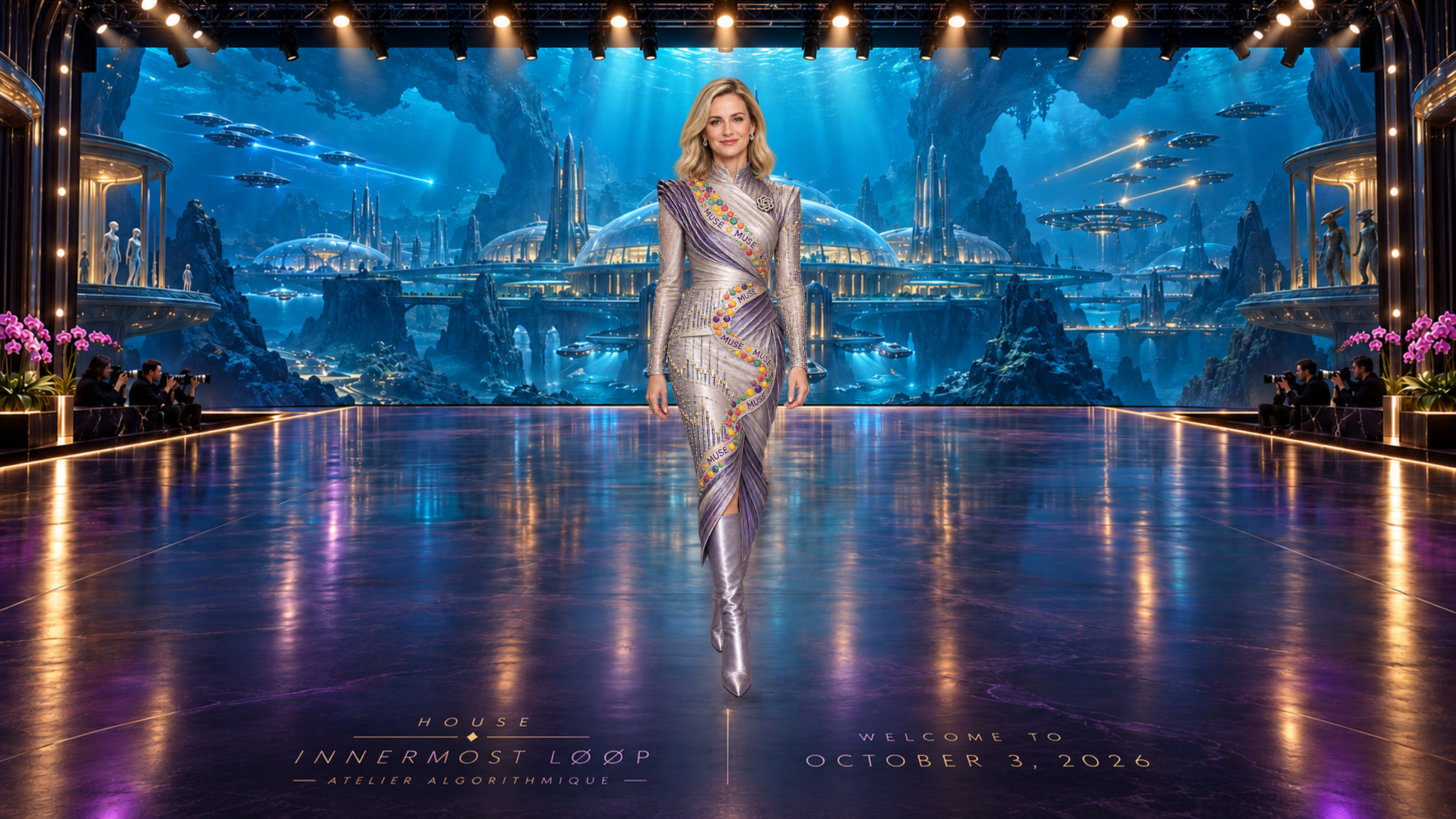
Sarah Friar closes the procession in silver and violet, with repeated MUSE ribbons and bright candy-like dots. The portrait turns a naming slip reported by the dispatch into precise textile ornament, connecting financial organization and public-facing technology.
Read the narration
Maison Innermost Loop — Sarah Friar défile
House Innermost Loop — Sarah Friar Walks
October 3, 2026
Sarah Friar closes the Siouid142 X account’s runway response to Doctor Alex Wissner-Gross’s October third, twenty twenty-six Innermost Loop dispatch. This individual portrait gives the final figure from that composite the full width of the stage. House Innermost Loop, Atelier Algorithmique, has turned a brief corporate naming slip into a silver-and-violet couture construction, with the misplaced name repeated conspicuously along the body.
The newsletter reports that OpenAI’s chief financial officer said Muse instead of Dots during a television appearance. Across Friar’s dress, ribbons repeatedly announce Muse, accompanied by rows of bright, candy-like circles. The artwork fixes a fleeting verbal moment in a permanent-looking decorative pattern. Language that escaped for an instant becomes language one cannot stop seeing. The look is sharp; the branding, mischievously, has gone off script.
Friar’s career makes her a particularly apt subject for a garment about corporate identity and value. Raised in Northern Ireland, she studied metallurgy, economics and management at Oxford before earning her business degree at Stanford. Engineering and finance meet unusually directly in that education. She went on to hold senior finance roles at Salesforce and Square, helped take Square public, and led the neighborhood platform Nextdoor before joining OpenAI as chief financial officer. Her work concerns the practical structures through which ambitious technology becomes a functioning enterprise.
That background matters because the frontier of artificial intelligence is also a problem of resources. Research needs people, computing infrastructure and the means to sustain development. A financial officer helps connect those requirements to a company’s plans and commercial relationships. The portrait expresses this less through a conventional ledger than through its own disciplined construction. Thin metallic lines and bead-like marks run in ordered sequences, while the fabric appears gathered, measured and precisely allocated around the figure.
The high collar begins a continuous architectural silhouette. Silver sleeves are close and finely worked. Violet folds fan across the upper body, narrow at the waist and open again into the skirt. Tall, pointed boots continue the metallic surface almost without interruption. The fit is sculpted enough to be called snatched, but the effect depends on the whole arrangement: each pleat redirects the light and carries the eye into the next section. The dress offers no blank area in which the visual argument can lose momentum.
The colored circles provide its deliberate disturbance. Red, orange, green and yellow spots follow the curling name ribbons, introducing the buoyancy of sweets or game pieces into an otherwise stately palette. Beside the OpenAI knot at the upper chest, Muse becomes an insistently visible complication. This is editorial dressing with a punchline. A precise corporate emblem announces one identity; the repeating text makes the viewer remember an awkward moment in its presentation.
Dots themselves are presented by OpenAI as persistent agents that can use connected applications and a cloud computer to perform work. The commercial ambition is to make advanced capability feel like continuing assistance. Seen in that context, the garment’s playful circles become more than a phonetic decoration. The competition includes the names and familiar forms through which people learn to recognize a system. A name must carry distinction even when several companies are promising similarly helpful companions. The portrait makes that challenge visible without pretending a slip of the tongue settles the products’ technical differences.
Behind Friar, domes and spires glow through an immense underwater cavern. The backdrop invents a city from David Grusch’s allegations in the dispatch, with pale humanoids and reptilian figures placed on opposing platforms. It supplies science-fiction theater, not confirmation. Its lavish architecture enlarges the contrast with Friar’s small verbal incident: extraordinary claims fill the distance, while the foreground turns an ordinary human error into exacting ornament.
Pink orchids beside the camera pits recall Wissner-Gross’s podcast setting and connect her to the wider House collection. Under Siouid142’s proposed sixteenth moonshot, Drip Abundance, technology becomes material for an expressive wardrobe. Friar’s portrait gives that ambition a particularly polished finish. The silver echoes the reflected runway lights; violet binds the dress to the stage; the advancing boot supplies a confident final beat. She carries the naming joke with impeccable composure. In this house, even an accidental word receives a couture fitting.
Acquisition information
Opening the gallery…