70 Clock Galerie / The Innermost Loop Feed Reply Tableaux
TABLEAU 502
Maison Innermost Loop — Benjamin Breen défile
House Innermost Loop — Benjamin Breen Walks
October 3, 2026
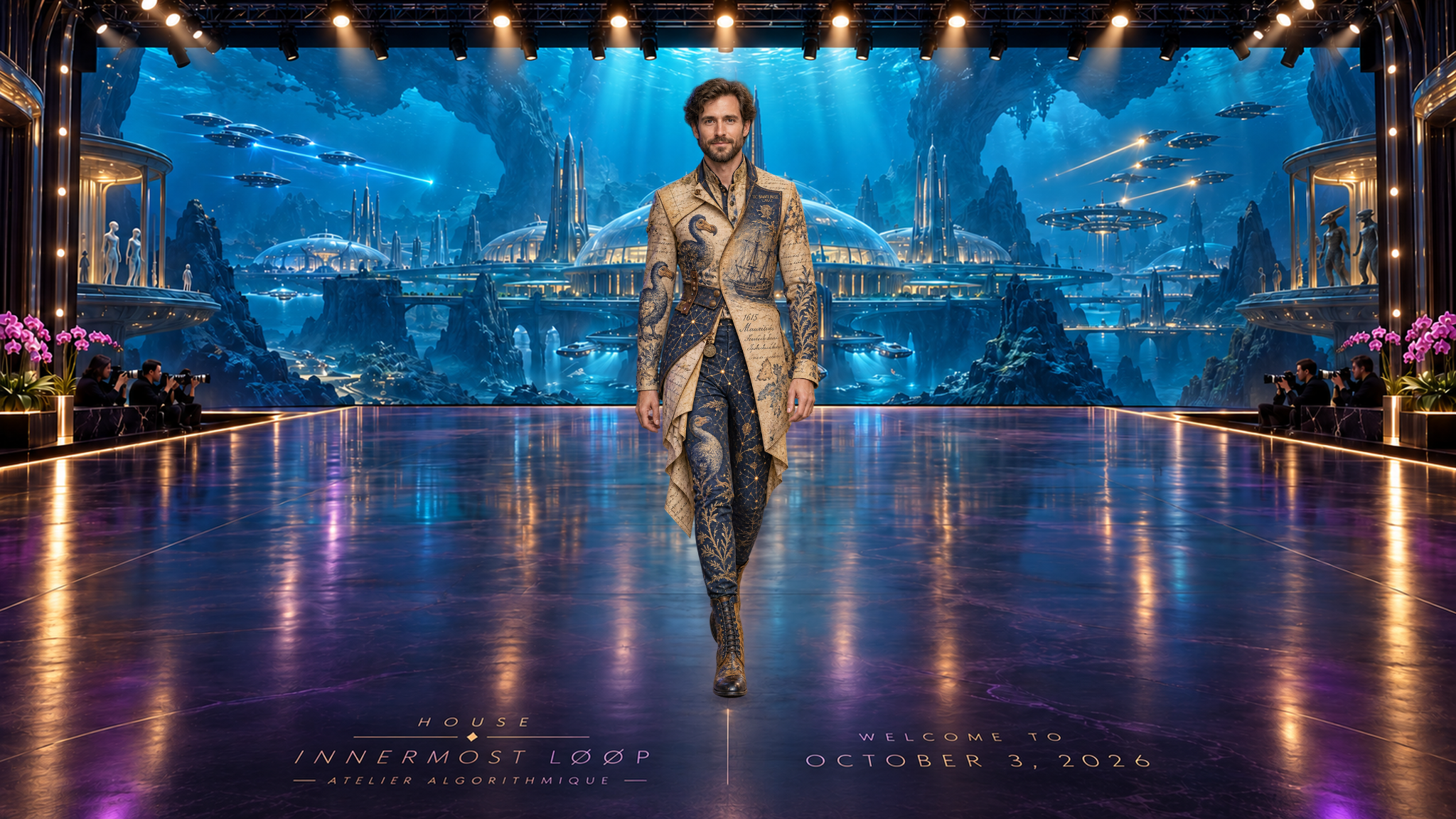
Benjamin Breen wears an archive in parchment ochre and ink blue: dodos, sailing ships and handwritten-looking pages fold into a long coat. The narration connects the imagery to his AI-assisted investigation of an apparently overlooked 1615 Dutch account.
Read the narration
Maison Innermost Loop — Benjamin Breen défile
House Innermost Loop — Benjamin Breen Walks
October 3, 2026
A dodo walks the runway without ever leaving its embroidered page. In this individual portrait from the Siouid142 X account’s response to Doctor Alex Wissner-Gross’s October third, twenty twenty-six Innermost Loop dispatch, historian Benjamin Breen appears in an archive made wearable. House Innermost Loop, Atelier Algorithmique, dresses him in parchment ochre and ink blue, with sailing ships, handwritten-looking passages and the unmistakable profile of an extinct bird. Among the collection’s visions of future intelligence, his entrance carries a recovered fragment of the past.
The newsletter’s reference was Breen’s use of Opus five point five agents to locate what appears to be an overlooked Dutch account of dodos from sixteen fifteen. His own explanation begins with a historian’s question and a substantial source collection, followed by searches, candidate passages and human review. The log concerns sailors calling at Mauritius and collecting animals for provisions. Its possible novelty matters precisely because the dodo has attracted so much scholarship. A familiar subject can still hold an unread detail, provided someone, or something, has the patience to look.
Breen is an associate professor of history at the University of California, Santa Cruz, with a doctorate from the University of Texas at Austin. His work moves through science, medicine, empire and the consequences of technological change. The Age of Intoxication studies the early global drug trade; Tripping on Utopia explores the entanglement of psychedelic science, Margaret Mead and the Cold War. Those subjects share an interest in what happens when knowledge travels between different institutions and cultures. The new archival tools extend an established scholarly curiosity rather than supplying it from nothing.
The garment makes that meeting unusually tactile. Its long fitted coat appears constructed from overlapping sheets, their irregular lower edges falling like turned pages. A structured waist and small fastenings gather the layers before they open over narrow trousers. One broad dodo occupies the upper torso; another emerges on the leg. A fully rigged ship spreads across the opposing chest panel. The handwritten-looking marks suggest a logbook without pretending to reproduce a manuscript verbatim. Here is archival drip with enough composure to carry the whole reading room.
Ink-blue sections contain fine gold networks, while leaves and stems climb through the trousers and sleeves. The pale pages and dark connections create two complementary registers: records left behind, and paths that might lead someone back to them. Their arrangement is especially satisfying in a walking portrait. The coat’s layered points imply that another page may turn with the next step. The viewer encounters research as movement through material, not simply as a finished fact announced on a screen.
The underlying archive deserves a place in that story. GLOBALISE, developed by the Huygens Institute and partners, makes millions of Dutch East India Company document scans and transcriptions searchable. Its work on spelling variation and historical terminology addresses difficulties that a simple modern keyword search can miss. Such infrastructure creates the conditions for discoveries by scholars and computational tools alike. In the outfit, the ship and logbook bring those records back to the maritime world that produced them; the connecting lines suggest the newer routes by which they become accessible.
Breen also stresses the limits of the agents he uses. They can pursue leads at enormous scale while remaining poor judges of which questions deserve asking and which findings matter. The portrait keeps the historian at its center. He wears the evidence and the search patterns together, calmly inhabiting the space between retrieval and interpretation. The look is quietly fierce, but its confidence comes from that relationship: an expanded capacity to search still needs a person able to recognize significance.
Behind him, the underwater city offers a different encounter with the unknown. Siouid142’s domes, saucers and distant humanoid and reptilian-looking figures elaborate David Grusch’s allegations in the same dispatch. They are invented scenery, whereas Breen’s archival inquiry points toward documents that can be revisited. The juxtaposition gives the image an unexpected intellectual depth. Different kinds of claim share a beautiful stage; they do not thereby become the same kind of evidence.
Pink orchids by the photographers recall Wissner-Gross’s podcast flowers, linking this scholar to the House’s recurring theater. Drip Abundance, the account’s proposed sixteenth moonshot, gives technological possibility the pleasures of dress. Breen’s version makes that pleasure unusually generous: the future can help us attend more closely to what came before. The dodo returns as an image, a historical trace and a striking textile presence, while its interpreter advances in a silhouette that makes patient curiosity look entirely runway-ready.
Acquisition information
Opening the gallery…