70 Clock Galerie / The Innermost Loop Feed Reply Tableaux
TABLEAU 501
Maison Innermost Loop — Gavin Newsom défile
House Innermost Loop — Gavin Newsom Walks
October 3, 2026
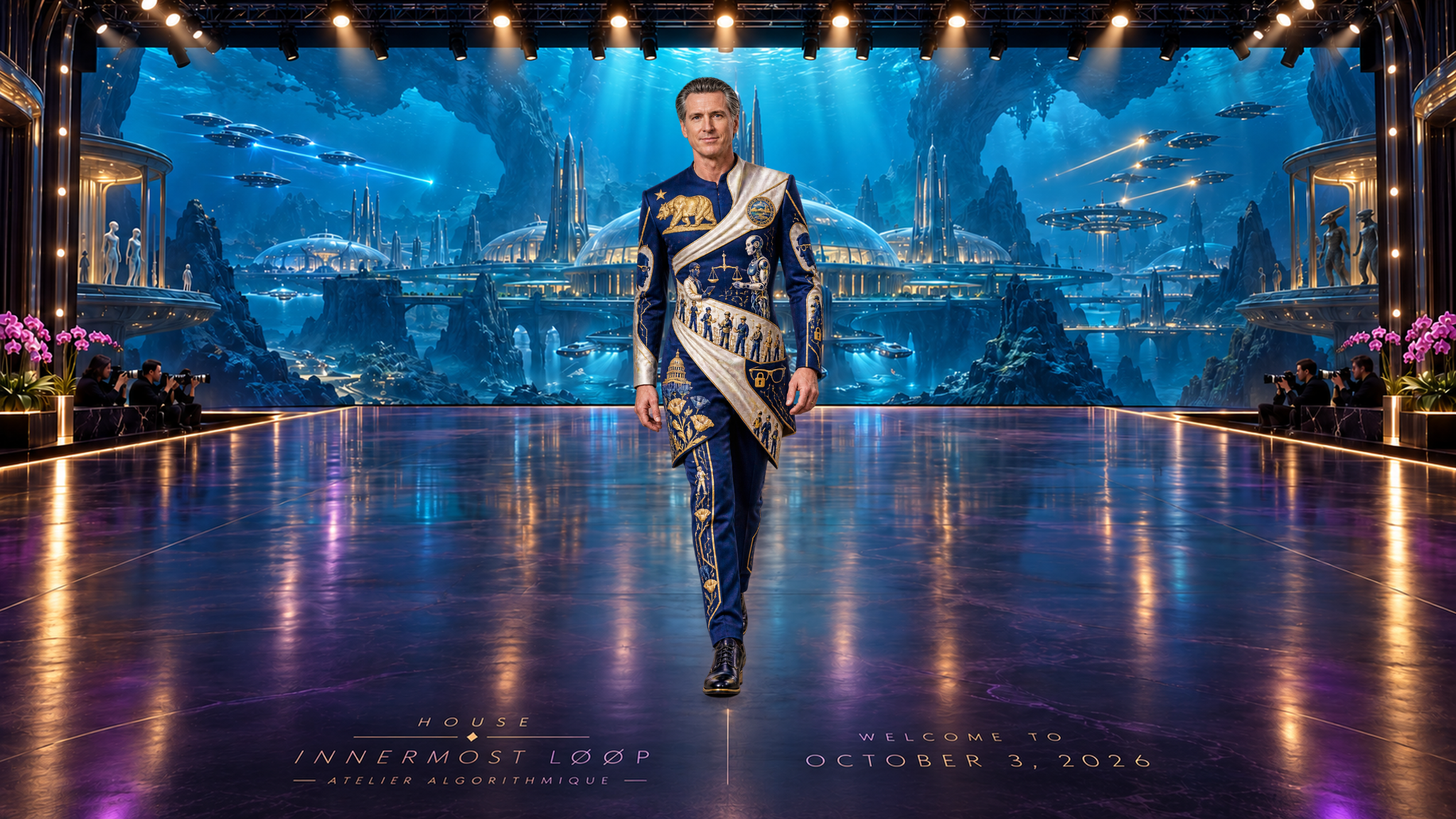
Gavin Newsom’s cobalt-and-pearl drapery places workers, machines, scales and the California bear on a civic tapestry. Separate spectacles-and-lock motifs connect the signed workplace-automation measure and a vetoed wearable-privacy bill discussed in the narration.
Read the narration
Maison Innermost Loop — Gavin Newsom défile
House Innermost Loop — Gavin Newsom Walks
October 3, 2026
The Siouid142 X account’s October third, twenty twenty-six reply to Doctor Alex Wissner-Gross turns the Innermost Loop dispatch into a House Innermost Loop runway. In this individual portrait from the ensemble, Gavin Newsom wears the problem of governing artificial intelligence across his chest. Atelier Algorithmique gives the California governor cobalt, pearl and gold: a sharply fitted tunic crossed by luminous diagonal drapery, its folds carrying workers, machines and the emblems of public authority. Sacramento has arrived with a surprisingly strong editorial look.
The immediate reference is concrete. The dispatch reports Newsom’s signing of the No Robo Bosses Act. California’s legislative record confirms that Senate Bill nine forty-seven was approved on September thirtieth, with its workplace provisions beginning in July twenty twenty-seven. Among its central protections, an employer cannot rely solely on an automated system to discipline or dismiss an employee. Where such output is the primary basis, a human must corroborate the decision. That distinction gives the garment its subject: software may inform a judgment, but a consequential judgment still demands accountable human involvement.
Across the center of the tunic, a human figure and a robot face one another beneath the scales of justice. Immediately below them runs a procession of small workers. Their position is eloquent. The people whose livelihoods are affected do not disappear beneath the larger symbols of technological power; they form the bright horizontal passage through which the eye moves. Gold outlines give them a collective presence, while the pearl band makes their row readable against the dark blue ground.
The upper chest bears the California bear and a star. A circular civic emblem anchors the opposing diagonal, and botanical embroidery descends toward the legs. Newsom’s tailoring borrows the dignity of a ceremonial banner without becoming a cape. The drapery remains close to the body; the pointed lower panels sharpen the forward movement. He is serving civic regalia, but the cut keeps it nimble. The gold carries authority, the cobalt holds the composition together, and the pale folds give the densely narrated surface room to breathe.
Newsom’s background helps explain why commerce and government meet in this portrait. He graduated from Santa Clara University with a political-science degree, then established a wine business that developed into the PlumpJack group of hospitality ventures. His public career moved through San Francisco’s Board of Supervisors and mayoralty, the lieutenant governorship and the governor’s office. The clothes condense those overlapping worlds of business, institutions and public responsibility into one surface. Their polished presentation is familiar political theater; their illustrated machinery introduces a newer question about who actually makes a workplace decision.
The small spectacles and lock near the lower torso add a second newsletter reference. Newsom also vetoed a bill aimed at privacy risks from wearable recording devices. Those two outcomes should remain distinct: signing workplace protections did not mean signing every proposed restriction on technology. In the image, the locked spectacles provide a compact emblem for the difficulty of regulating an object that looks ordinary while quietly gathering information. A device worn on the face can change the conditions under which everyone around it is observed.
That makes the photographers at the runway margins unusually pertinent. Their cameras are visible, pointed toward an acknowledged performance. The governor walks into their attention. The garment’s privacy motifs concern a different kind of looking, one that may occur without a comparable awareness. Within this fictional fashion show, observation is both the means of displaying the outfit and one of the political questions embroidered upon it. Even a clean fit can carry a complicated argument.
The blue undersea city extends the dispatch’s closing account of David Grusch’s claims into extravagant scenery. Its domes, saucers and opposed humanoid and reptilian-looking spectators are artistic inventions. Newsom’s recognizably terrestrial jurisdiction stands before that imagined civilization, bringing the practical business of governing people into a spectacle of unfamiliar intelligences. Pink orchids beside the camera pits recall Wissner-Gross’s podcast signature and anchor the scene in the recurring House universe.
Drip Abundance, the account’s proposed sixteenth moonshot, asks that technological possibility acquire a form people can enjoy wearing. Newsom’s portrait adds a civic condition to that exuberance. The future can be abundant in capability and still require judgment about how power reaches an individual life. Here, that individual is remembered in a small embroidered worker, held visibly within the folds of a very assured runway entrance.
Acquisition information
Opening the gallery…