70 Clock Galerie / The Innermost Loop Feed Reply Tableaux
TABLEAU 499
Maison Innermost Loop — Pete Hegseth défile
House Innermost Loop — Pete Hegseth Walks
October 3, 2026
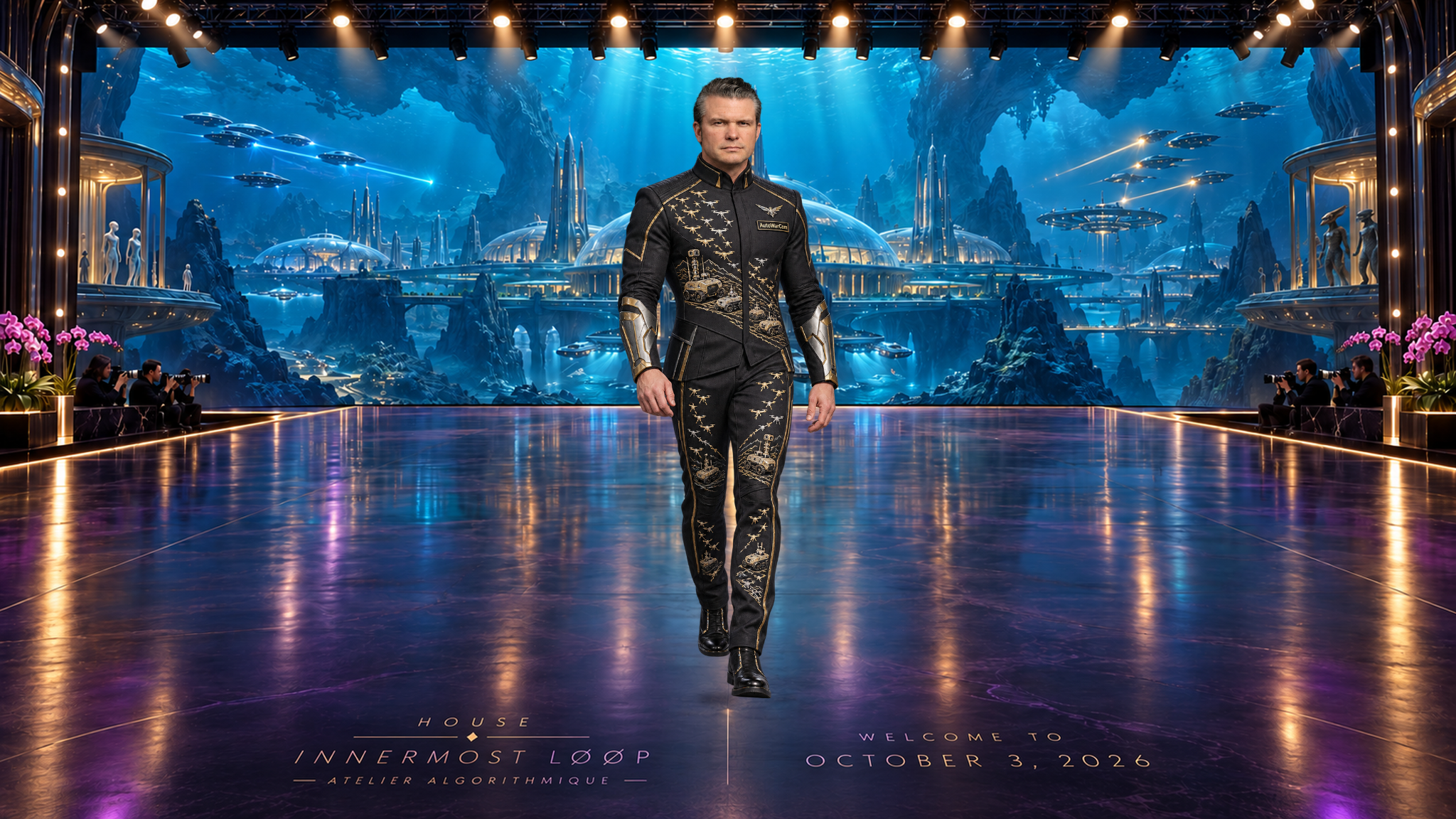
Pete Hegseth’s charcoal-and-gold tailoring arranges miniature aircraft and vehicles into a distributed force. AutoWarCom lettering and articulated forearm pieces turn the announced military automation initiative into a question about human command.
Read the narration
Maison Innermost Loop — Pete Hegseth défile
House Innermost Loop — Pete Hegseth Walks
October 3, 2026
Pete Hegseth advances down the House Innermost Loop runway with a formation of small golden machines moving across his chest. The portrait belongs to the Siouid142 X account’s response to Doctor Alex Wissner-Gross’s Welcome to October third, twenty twenty-six dispatch. Drawn forward from the Atelier Algorithmique group presentation, this individual look gives the newsletter’s military automation story the fitted silhouette and concentrated presence of technical couture.
The immediate reference is Hegseth’s announcement of an Autonomous Warfare Command, abbreviated on the costume’s chest badge as AutoWarCom. The proposed four-star command is intended to expand autonomous and robotic capabilities across the armed forces. Project Agincourt is the preparatory effort, including work on how the military develops and acquires such systems. A separate undertaking, Project Meridian, looks further ahead. These are distinct initiatives, and the garment concentrates on the coordinated machines that the command would bring into military organization.
Hegseth’s own biography locates him on the human side of that transition. After graduating from Princeton in two thousand three, he became an infantry officer in the Army National Guard, serving on deployments that included Iraq and Afghanistan. His official record includes two Bronze Star Medals. Before becoming the Pentagon’s civilian leader, he also worked in television and wrote books about military culture. The portrait therefore gathers together soldiering, public communication and institutional authority in one highly composed figure.
His posture carries the first part of the design. The shoulders remain level, the arms close, the gaze steady. A forward boot provides the movement while the torso retains a nearly frontal clarity. There is real runway presence in that economy. The body does not have to perform a dramatic action because the surface is already busy with formations, routes and vehicles. The face remains comparatively still while a whole field of activity unfolds below it.
Black and charcoal give the outfit a leather-like density. Gold piping follows the collar, shoulders and tapered seams, keeping the narrow cut legible against the dark ground. One broad section of the chest carries repeated small aircraft; lower down, wheeled machines sit within a finer network of lines. Across the trousers, the same motifs recur at different scales. The result suggests distributed capability: many small units arranged into a larger design.
Silver-and-gold forearm pieces provide a different texture. Their articulated appearance evokes machinery while leaving the hands exposed. That detail matters. The figure has not become a sealed robot; the human hands remain available for gesture and action. Metal, embroidered machines and uncovered skin occupy the same body. The couture does not resolve the division of responsibility between people and automated systems, but makes that division visible at the wrist.
The look is fierce without needing oversized armor. Its impact comes from controlled proportions and the exact placement of metallic brightness. Repetition supplies a rhythm that the eye can follow from shoulder to ankle. Yet the orderly pattern also raises the central interpretive question. A swarm of independent machines can look coherent when arranged as embroidery. Achieving useful coordination outside the textile involves much more: communication, adaptation, training and decisions about what a system is permitted to do. The attractive finish makes the promise intelligible while leaving its execution open.
Behind Hegseth, another account of conflict has become architectural spectacle. The newsletter’s closing Grusch allegations inspire the invented underwater city, its flying saucers and the pale humanoid and reptilian figures on distant platforms. None of this scenery establishes the allegations as fact. It puts a speculative war among imagined beings behind a very terrestrial announcement about military machines. The contrast stretches the picture’s horizon while keeping its two sources of imagery distinct.
Warm spotlights and the cool submerged skyline meet on the glossy violet floor. Photographers wait at the edges, beside pink orchids recalling Wissner-Gross’s podcast setting. Those familiar flowers place the portrait inside an ongoing artistic conversation. The House’s proposed sixteenth moonshot, Drip Abundance, turns that conversation into clothing: complex developments acquire silhouettes, textures and a little front-row swagger.
As part of the ensemble, Hegseth follows Gingrich’s ceremonial mapwork and Luckey’s technical tropical print. In this close view, the theme tightens into a disciplined black-and-gold design. The machines move across the garment; the wearer moves through the show. Between those two kinds of movement, the artwork asks the question that makes this particular portrait more than a display of equipment: when capability multiplies, how will human command take shape?
Acquisition information
Opening the gallery…