70 Clock Galerie / The Innermost Loop Feed Reply Tableaux
TABLEAU 498
Maison Innermost Loop — Palmer Luckey défile
House Innermost Loop — Palmer Luckey Walks
October 3, 2026
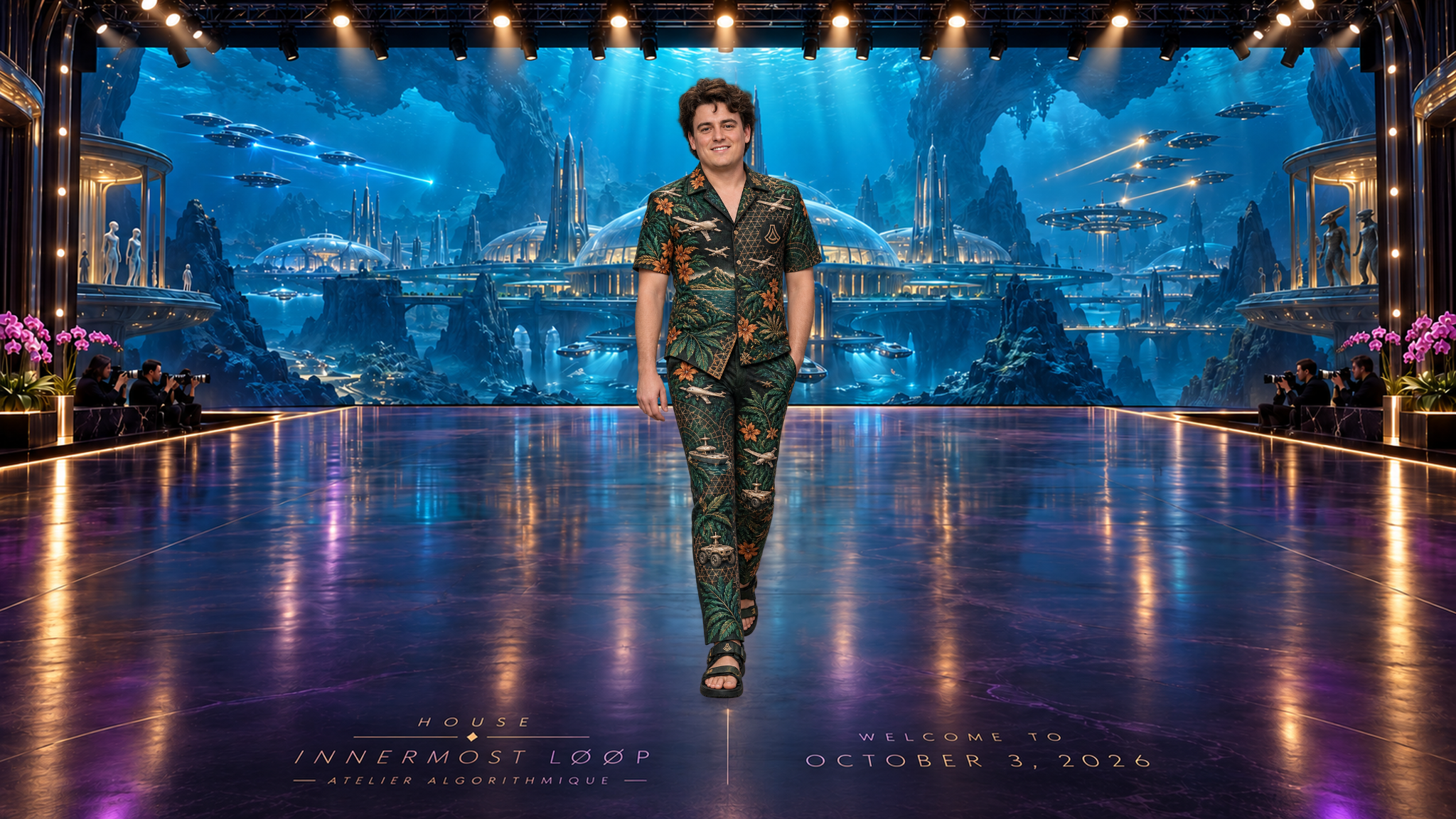
Palmer Luckey keeps his Hawaiian-shirt vocabulary in an emerald ensemble woven with orange flowers, sensors’ imagined connections and small land, sea and air machines. The narration connects the tropical pattern to Oculus, Anduril, Lattice and Project Meridian.
Read the narration
Maison Innermost Loop — Palmer Luckey défile
House Innermost Loop — Palmer Luckey Walks
October 3, 2026
For its response to Doctor Alex Wissner-Gross’s Welcome to October third, twenty twenty-six dispatch, the Siouid142 X account brings Palmer Luckey onto the House Innermost Loop, Atelier Algorithmique runway in his unmistakable Hawaiian-shirt register. This individual portrait unfolds a look first presented in the larger ensemble. Short sleeves, open collar, sandals and an expansive smile announce the ease of resortwear. Look again, and the tropical print is full of machines.
Luckey appears in the newsletter through the Pentagon’s future-war study. He joins Newt Gingrich and Elon Musk as a co-director of Project Meridian, which examines emerging capabilities and the circumstances in which future forces might use them. His contribution comes from a career spent making technology tangible, first through virtual reality and later through Anduril, the defense technology company he founded with his collaborators.
That career began with an unusually absorbing hobby. In his own account of Oculus’s beginnings, Luckey describes leaving school at nineteen to turn his experiments with head-mounted displays into a business. The Oculus Rift helped make immersive virtual reality a consumer ambition rather than an inaccessible laboratory curiosity. An essential design problem was presence: how to make someone feel situated inside a world represented by a machine. The distant, luminous city surrounding him here turns that earlier preoccupation into an unexpectedly apt setting.
Anduril addresses a different relationship between perception and action. Its Lattice software brings information from multiple sensors and systems into a shared picture that operators can use to direct other equipment. A camera, a radar and an uncrewed vehicle can provide different fragments of a situation. Connecting them matters because a collection of machines does not automatically become a coordinated system. The gold mesh running through this outfit offers an artistic equivalent of that connective ambition, without pretending to reproduce the software itself.
The camp shirt is deep emerald, with orange flowers, curling leaves and pale aircraft moving across its surface. Its fitted shape preserves the relaxed collar while giving the torso a clean line. Matching narrow trousers carry the print toward the feet. Boats, aircraft and small wheeled vehicles appear among the foliage, sometimes nearly disappearing into it. The repetitions make a complete look rather than a novelty shirt placed above neutral pants. Even the sandals contribute: they keep the outfit recognizably Luckey while the gold detailing brings them into the House’s couture language.
This is steeze with a systems diagram woven through it. The joke depends on how comfortably the two coexist. From a distance, the flowers establish a holiday mood. At closer range, the decorative landscape becomes a field of technical activity. The eye enjoys discovering each small machine, then realizes that discovery is itself part of the design. Equipment that would appear formidable in a product presentation becomes intricate and desirable as pattern.
The picture does not need to turn that observation into an accusation. It makes something visible about design: scale and setting change how we encounter an object. A vehicle enlarged against a battlefield, miniaturized in a shirt, or connected to others on an operator’s screen participates in a different kind of attention. Here, the runway invites admiration before technical recognition. Luckey is serving vacation energy, but the print has brought the entire operation along.
The backdrop is another transformation of newsletter material. Grusch’s allegations concerning undersea installations and different nonhuman beings become an invented blue-and-gold metropolis, with saucers passing between stone arches. Pale humanoids and darker reptilian figures appear on opposite platforms. Their presence belongs to the artwork’s science-fiction staging, not to established evidence. The city gives the machinery on Luckey’s clothes a spectacular imagined horizon while the overhead truss makes clear that we are watching a constructed show.
At either side, photographers aim inward and pink orchids recall the flowers associated with Wissner-Gross’s podcast appearances. These signatures connect the individual portrait to the wider House procession. They also anchor the artist’s proposed sixteenth moonshot, Drip Abundance: an invitation to experience technological imagination through clothes that have personality, pleasure and unmistakable presence.
Luckey’s look makes that invitation unusually direct. The artist has preserved the style viewers associate with him and intensified it until the casual shirt becomes a miniature account of his work. He does not have to abandon his public uniform to own the runway. The flowers, the network and the advancing sandal all belong to the same confident stride.
Acquisition information
Opening the gallery…