70 Clock Galerie / The Innermost Loop Feed Reply Tableaux
TABLEAU 497
Maison Innermost Loop — Newt Gingrich défile
House Innermost Loop — Newt Gingrich Walks
October 3, 2026
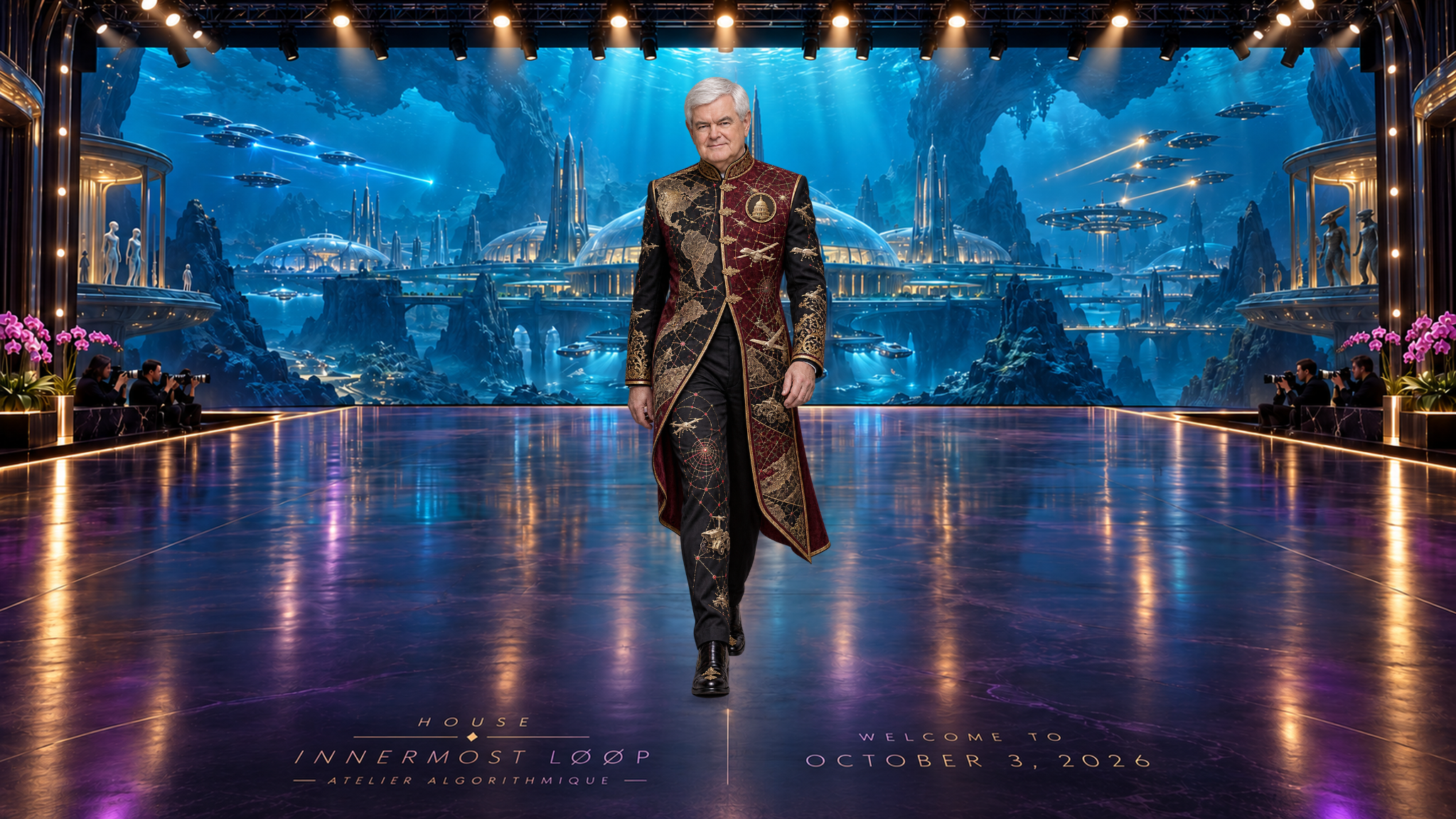
Newt Gingrich’s burgundy and antique-gold coat translates Project Meridian’s future-war study into maps, networks and miniature machines. The ceremonial tailoring connects the narration’s account of political experience and historical scholarship to strategic planning.
Read the narration
Maison Innermost Loop — Newt Gingrich défile
House Innermost Loop — Newt Gingrich Walks
October 3, 2026
The Siouid142 X account answered Doctor Alex Wissner-Gross’s Welcome to October third, twenty twenty-six dispatch by dressing its people in the stories that brought them into the news. This individual presentation brings Newt Gingrich forward from the House Innermost Loop, Atelier Algorithmique ensemble. The former Speaker of the House arrives wearing strategic imagination as courtly splendor. Burgundy, black and antique gold make an entrance that is considerably more extra than a congressional business suit.
His place in the dispatch comes from the future of warfare. Gingrich joins Palmer Luckey and Elon Musk as a co-director of Project Meridian, the study commissioned by the Pentagon and led by MITRE. Its subject is the emerging technologies and operational possibilities that could shape future conflict. The combination places a veteran political figure beside entrepreneurs associated with defense systems and spaceflight. On the runway, that meeting of institutional memory and technical ambition becomes a garment whose ceremonial silhouette contains a miniature technological world.
Gingrich’s background gives this costume a useful historical depth. He studied at Emory before earning a master’s degree and doctorate in European history at Tulane. He taught at West Georgia College before entering Congress and served as Speaker from nineteen ninety-five to nineteen ninety-nine. The historian became a participant in the institutions he had once approached as a subject of study. Here, someone trained to look backward has been recruited to consider what lies ahead.
The stand collar rises closely around his neck. Ornamental fastenings make a gold rhythm down the front, while fitted panels divide and lengthen below the waist. Their burgundy lining appears as the legs advance. The construction has the gravity of ceremonial dress, yet the restrained width keeps the body mobile. There is no sprawling mantle to carry his authority for him. He has to walk it. The result is a surprisingly fierce piece of statesman couture, with the severity of its tailoring held in check by a faint, knowing smile.
Gold geography occupies one side of the chest; a network of fine lines and small points crosses the other. A Capitol emblem anchors the design to political life. These motifs continue down the long panels and narrow trousers, where aircraft, wheeled machines and circular plotting patterns interrupt the map. The gaze moves between territory and the devices that might traverse it. Embroidery lends these subjects the patient finish of heirloom decoration, even as the machines suggest rapid change.
That contrast is the outfit’s most revealing proposition. A strategic diagram normally promises an overview: locations can be marked, relationships connected, possibilities arranged. Worn on a moving person, the diagram becomes unstable in a productive way. A fold interrupts a route. One leg carries a vehicle forward while another part of the map disappears behind a panel. The body restores contingency to the apparently complete picture. Planning is presented as something a person performs, rather than a view available from nowhere.
Behind him, the enormous underwater city offers another kind of imagined future. Its luminous domes, steep spires and passing saucers expand David Grusch’s allegations in the newsletter into science-fiction scenery. Pale figures occupy one distant platform, reptilian silhouettes another. The tableau stages those claims as spectacle; it supplies no evidence for them. For Gingrich’s portrait, the setting adds a useful question of scale: how does anyone prepare responsibly for a future whose boundaries remain unsettled?
The black lighting truss, mirrored violet floor and photographers bring that speculation back to the theater of a fashion show. Pink orchids at the margins recall Wissner-Gross’s podcast setting. They identify the conversation from which the artwork emerged, while the House’s proposed sixteenth moonshot, Drip Abundance, gives it a playful practical form. Abundance becomes something one might wear, touch and enjoy, as well as something discussed in plans and forecasts.
In the composite, Gingrich begins a sequence of three defense-related looks. Alone, he retains the distinctive task of translating political experience into a future-facing image. The gold catches the runway lights; the old ceremonial vocabulary accommodates drones and networked machines. He is serving institutional memory with a very ambitious update. The coat lets the viewer admire the finish while asking what a map, however sumptuous, can actually tell us about tomorrow.
Acquisition information
Opening the gallery…