70 Clock Galerie / The Innermost Loop Feed Reply Tableaux
TABLEAU 493
Maison Innermost Loop — Chris Olah défile
House Innermost Loop — Chris Olah Walks
October 3, 2026
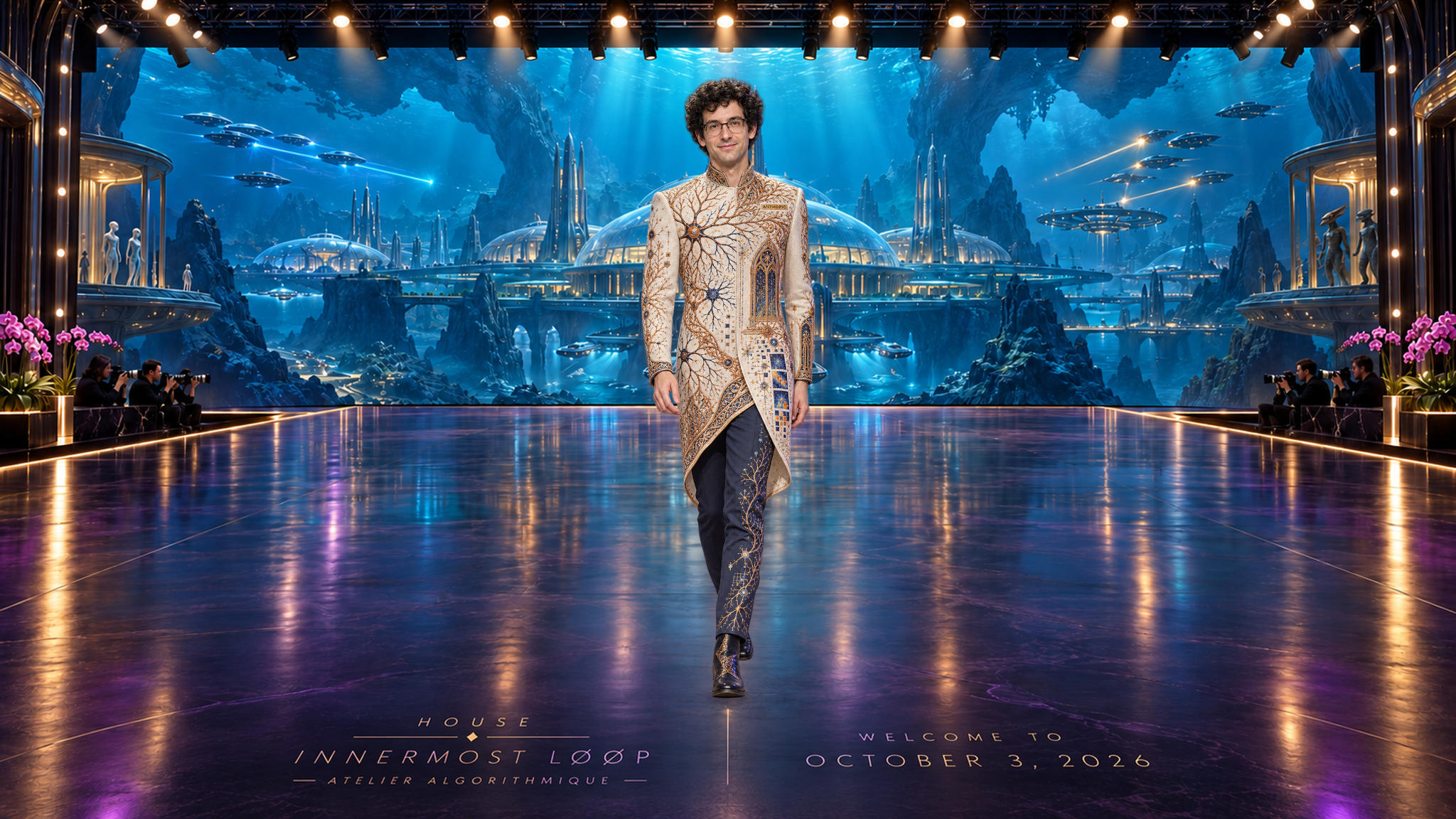
Chris Olah’s ivory and copper tunic brings neural-network interpretation and church architecture into one silhouette. Branching embroidery and a pointed window translate the narration’s encounter between mechanistic interpretability and papal discussions of machine consciousness.
Read the narration
Maison Innermost Loop — Chris Olah défile
House Innermost Loop — Chris Olah Walks
October 3, 2026
When the Siouid142 X account transformed Doctor Alex Wissner-Gross’s October third, twenty twenty-six Innermost Loop dispatch into the House Innermost Loop runway, Chris Olah received a garment about interpretation itself. This individual portrait draws him out of the larger cast, where he stands beside Pope Leo the Fourteenth. Their neighboring positions translate a reported disagreement about machine consciousness into a conversation between two kinds of embroidered authority.
Olah is an Anthropic co-founder whose work asks what artificial neural networks are actually doing. Before Anthropic, he worked at Google Brain and led interpretability research at OpenAI. He also helped establish Distill, a research journal distinguished by unusually clear visual explanations. That concern with making difficult structures understandable gives the outfit its governing idea: what ordinarily happens beneath a model’s surface has been brought into view as pattern.
Mechanistic interpretability attempts to trace the internal processes contributing to an AI system’s behavior. A model’s numerical activity is difficult to read directly. Researchers identify recurring patterns associated with concepts, then test what happens when they alter those patterns. Anthropic’s work with Claude has shown, for example, that strengthening a feature associated with the Golden Gate Bridge can make the model bring that bridge into otherwise unrelated answers. Such experiments investigate how a response is produced. They do not, by themselves, establish an experiencing mind.
That distinction matters to this newsletter appearance. Wissner-Gross links a report that Olah considered withdrawing from the launch of the papal encyclical Magnifica Humanitas over its treatment of AI consciousness. Yet Olah did speak at the Vatican event. His published remarks urged participation from people outside the commercial incentives of AI laboratories and called for continuing examination of the systems’ nature. The encounter contained disagreement, but also an invitation to sustained conversation.
Siouid142 gives that complicated position an ivory tunic covered in copper branches. Dark centers spread fine filaments across the shoulder and chest, suggesting neurons, roots and diagrams simultaneously. The fabric resembles an illuminated page whose annotations have grown beyond their margins. On one side, a tall pointed window introduces the architecture of a church; below it, little blue and gold squares suggest a mosaic dissolving into a computational grid.
The references meet within a single, unusually elegant cut. A standing collar frames the face. Long sleeves remain close to the arms, while the diagonal hem opens over ink-blue trousers. Further branching embroidery descends one leg and returns on the boot. The outfit is editorial without becoming cumbersome. Olah’s slight smile and relaxed hands give all this intellectual ornament a remarkably easy delivery. The fit has range.
None of the embroidered networks needs to be an actual laboratory chart to perform its visual work. Their branching structure invites the eye to follow connections, while the window asks what kind of light might make those connections legible. Scientific visualization and sacred ornament both promise access to something difficult to see. The garment places their methods in contact without pretending they ask identical questions or deliver interchangeable answers.
Behind him, an invented undersea city extends the collection’s interest in unfamiliar intelligence. Its pale figures and reptilian silhouettes come from Siouid142’s imaginative treatment of David Grusch’s allegations reported in the same dispatch. Their speculative status makes the contrast useful: some unknowns are investigated through repeatable experiments, while others arrive through testimony. The shared stage is an artistic arrangement, not a declaration that all its stories possess equal evidence.
The House’s Atelier Algorithmique pursues Siouid142’s proposed sixteenth Moonshot, Drip Abundance: a future in which technical possibility also becomes something people can wear and enjoy. Olah’s contribution is a couture argument for making complexity approachable. Pink orchids at the runway edges recall Wissner-Gross’s podcast signature, returning this ambitious spectacle to the conversation that prompted it.
The portrait finally asks the viewer to do something close to Olah’s own work: look past the first impression and inspect how the parts relate. Branch, window, grid and seam each reorganize the reading of the others. Understanding emerges through attention. For a researcher committed to opening black boxes, an outfit that rewards a second look is an unusually apt runway assignment.
Acquisition information
Opening the gallery…