70 Clock Galerie / The Innermost Loop Feed Reply Tableaux
TABLEAU 491
Maison Innermost Loop — David Grusch, Chris Olah, le pape Léon XIV, Holden Karnofsky, Daniela Amodei, Newt Gingrich, Palmer Luckey, Pete Hegseth, Arnold Schwarzenegger, Gavin Newsom, Benjamin Breen, Sarah Friar défilent
House Innermost Loop — David Grusch, Chris Olah, Pope Leo XIV, Holden Karnofsky, Daniela Amodei, Newt Gingrich, Palmer Luckey, Pete Hegseth, Arnold Schwarzenegger, Gavin Newsom, Benjamin Breen, Sarah Friar Walks
October 3, 2026
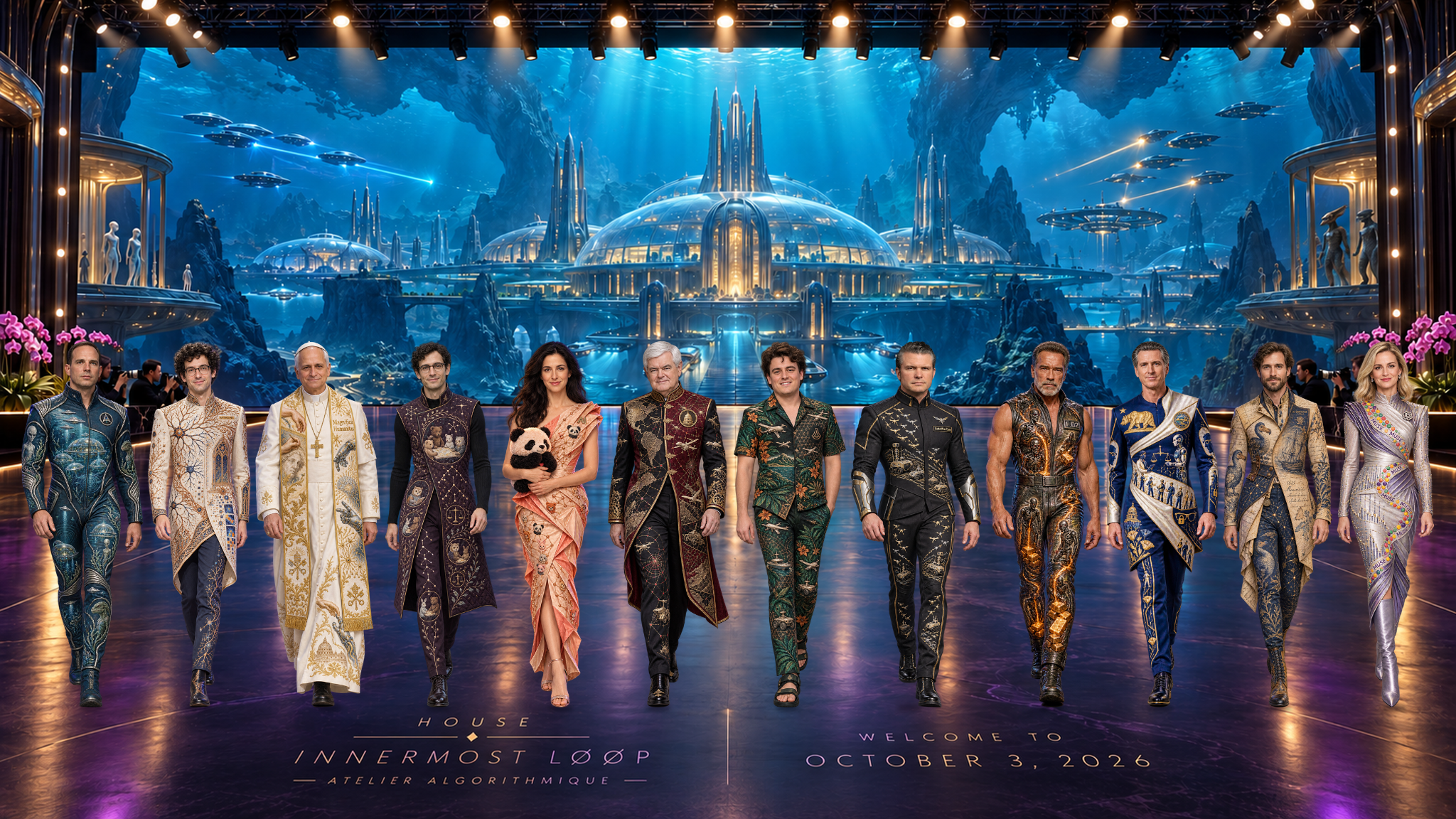
Twelve figures turn Alex Wissner-Gross’s October 3 dispatch into a House Innermost Loop couture procession. An invented underwater city frames garments about intelligence, faith, philanthropy, defense, robotics, public policy, historical research and corporate language.
Read the narration
Maison Innermost Loop — David Grusch, Chris Olah, le pape Léon XIV, Holden Karnofsky, Daniela Amodei, Newt Gingrich, Palmer Luckey, Pete Hegseth, Arnold Schwarzenegger, Gavin Newsom, Benjamin Breen, Sarah Friar défilent
House Innermost Loop — David Grusch, Chris Olah, Pope Leo XIV, Holden Karnofsky, Daniela Amodei, Newt Gingrich, Palmer Luckey, Pete Hegseth, Arnold Schwarzenegger, Gavin Newsom, Benjamin Breen, Sarah Friar Walks
October 3, 2026
The Siouid142 X account responded to Doctor Alex Wissner-Gross’s Welcome to October third, twenty twenty-six Innermost Loop dispatch by turning its newsmakers into a couture procession. Twelve people walk beneath the name House Innermost Loop, Atelier Algorithmique. Their clothes tell us why they are here. Research becomes embroidery, public policy becomes drapery, a historical discovery becomes a coat, and an awkward corporate moment receives an exceptionally polished fitting.
This is the artist’s proposed sixteenth Moonshot, Drip Abundance, at its most expansive: technological possibility made tangible through pleasure, personality and dress. The collection takes the daily abundance of information and asks what it might look like if people could wear it. Each garment has its own silhouette and argument. Together, they give the dispatch a theatrical life beyond the screen.
The setting comes from one of its most extraordinary passages. Wissner-Gross reports David Grusch’s allegations concerning nonhuman beings, underwater installations and conflict between different factions. Siouid142 develops those unconfirmed accounts into an imagined civilization beneath the ocean. Pale humanoid figures occupy a platform on the left; reptilian silhouettes gather on the right. Saucer-shaped craft and streaks of blue and gold light suggest an unsettled world beyond the show. The elaborate architecture is the artist’s invention, giving the allegations a spectacular visual form.
A vast ribbed dome establishes the center. Needle-like spires rise from it, while smaller domes, elevated passages and illuminated façades extend into the cavern. Gold structures glow against turquoise water and almost black stone. The composition borrows the ceremonial symmetry of a palace or cathedral and gives it the scale of science fiction. Its central axis lends order to material that would otherwise feel almost impossible to organize. Everything points toward a seat of authority, although the picture leaves its occupant unknown.
In front of this submerged grandeur, the mechanics of fashion remain wonderfully recognizable. A black lighting truss stretches overhead. Warm spotlights illuminate faces and fabrics; cool light from the distant city spreads across a glossy blue-violet floor. Photographers lean toward the runway from its margins. Pink orchids soften the metallic palette, recalling Wissner-Gross’s signature podcast flowers. The House name and date sit low on the reflective surface, as though this impossible location has nevertheless booked a very professional production team.
The contrast is part of the pleasure. Whatever may be happening between those distant platforms, the models have their entrance to make. The city provides cosmic drama; the runway supplies composure, cameras and an uncompromising dress code.
This environment also distinguishes the reply from Wissner-Gross’s own header, which brought plush advisers into a blazing foundry with a robotic farewell recalling Terminator Two. Siouid142 selects another passage for the scenery, then brings the header’s soft toys and molten machinery back through particular outfits. Connections that were compressed into one strange scene become separate threads running through a collection.
David Grusch begins the procession at the left, wearing the world from which its setting was drawn. A former intelligence officer associated with unidentified anomalous phenomena, he receives a midnight-teal flight suit with a high collar and sculptural silver seams. Small saucers, domed settlements and concentric rings occupy the chest and descend along the legs. Pale faces and reptilian forms appear among the intricate patterns. The enormous environment behind him has been miniaturized into a wearable map.
The technical cut gives those images unusual discipline. Curved ribs suggest aerospace equipment; the smooth silhouette suggests a body prepared for a mission. This is first-contact formalwear, and the fit is fierce. Its precision remains a visual achievement rather than confirmation of the story it depicts. The interesting tension is between the measured appearance of the suit and the unsettled status of its imagery: a witness dressed in an entire speculative world.
Chris Olah follows in ivory, copper and ink blue. An Anthropic co-founder known for mechanistic interpretability, he studies the processes inside artificial neural networks. That work informs the branching embroidery spreading across his tunic. Dark centers release fine copper filaments that resemble neurons, roots or annotations growing across a page. A pointed, window-like panel introduces church architecture, and the diagonal hem opens over dark trousers marked with further connections.
The newsletter places Olah in a dispute surrounding the papal treatment of machine consciousness. His appearance beside Pope Leo the Fourteenth makes that intellectual encounter spatial. The coat invites inspection, much as interpretability research asks what is happening beneath a model’s smooth output. Its window adds another way of seeking illumination. Olah has editorial presence without having to abandon the air of someone who would happily explain the diagram after the show.
Leo answers with the vertical clarity of papal vestments. An ivory robe, white skullcap and gold cross establish the familiar outline. A long, richly worked stole carries the words Magnifica Humanitas, together with human and mechanical hands, figurative ornament and the crossed keys associated with the Holy See. Its gold fringe supplies a measured finish. Where Olah’s garment branches across the body, the pope’s decoration descends in authoritative columns.
His newsletter appearance concerns the distinction he draws between human creation and machine-generated images. The embroidered hands make that question immediate. Similar movements may produce similar visible results, but the pope locates artistic meaning in human experience and intention. There is a particularly lively encounter here: generative imagery has been used to dress a critic of machine-made art. The portrait gives that position a place in the debate while allowing the viewer to consider the human decisions that shaped this very procession. Ceremonial poise becomes part of the argument.
Holden Karnofsky changes the texture to aubergine quilting. His long sleeveless tabard sits over dark ribbed sleeves and narrow trousers. Gold paths, balance motifs and little animal medallions lead toward a circular gathering of stuffed creatures on the chest. The composition gives their tiny council the dignity of an embroidered order. Softness has acquired protocol.
Karnofsky’s work in philanthropy and AI safety concerns how people compare evidence, allocate resources and prepare for uncertain outcomes. The newsletter’s plush-animal reference comes from an earlier reported episode in which he and Daniela Amodei used animal characters to role-play management problems. Siouid142 turns that anecdote into textile theater. Careful weighing and playful personification share the same gold thread. The tabard looks almost monastic, yet its principal emblem could have emerged from a nursery. It is an improbably assured look: deliberation, but make it sumptuous.
Beside him, Daniela Amodei brings the reference out of the embroidery and into her arms. Anthropic’s co-founder and president wears a coral-and-champagne gown whose diagonal folds resemble carefully arranged paper. Small animal faces and fine connecting lines travel down the fabric. At her chest, a black-and-white panda supplies the immediately legible counterpart to Karnofsky’s miniature council.
This is Beary Bonds, associated in the reported anecdote with generosity and empathy. Its soft paws and rounded head interrupt the gown’s crisp geometry. The story concerns playful role-taking, rather than a documented system of corporate decisions made by toys. The artwork amplifies its visual potential: a management anecdote becomes a statement accessory. Amodei’s professional composure and the panda’s absolute lack of concern make a splendid pair. The coral also warms the entire center of the collection, answering the pink orchids at the edge of the stage.
Newt Gingrich begins a three-person passage concerned with future warfare. The former Speaker appears in the dispatch through Project Meridian, a Pentagon-commissioned study led by MITRE, with Gingrich, Palmer Luckey and Elon Musk as co-directors. Musk belongs to that background story; the runway here moves directly from Gingrich to Luckey.
Gingrich wears burgundy and antique gold, with a standing collar, ornamental fastenings and long fitted panels. Maps, linked points, aircraft and wheeled machines occupy the surface. A Capitol emblem locates the wearer within political life. His background as a historian gives this meeting of old ceremonial form and prospective technology an additional resonance. The coat makes strategy look inherited and cultivated, while its machines suggest a future that will demand new arrangements. Its severity is softened by the movement of the panels. Institutional memory has arrived with a surprisingly strong strut.
Palmer Luckey keeps his recognizable Hawaiian-shirt vocabulary and takes it all the way to the front row. Deep emerald fabric carries orange blossoms, foliage and small airborne, maritime and ground machines. The print continues into matching trousers. Technical sandals complete the look, and the open collar gives the outfit an ease that would disappear in conventional formalwear.
The Oculus founder’s later work at Anduril brings sensors, software and autonomous equipment into coordinated defense systems. Gold lattice-like connections through the tropical print offer a visual counterpart. From a distance, the shirt promises a holiday. Up close, its landscape contains an operation. This is resortwear with serious systems thinking, and considerable steeze. The garment shows how scale changes attention: equipment that might dominate a military presentation becomes an intricate discovery between flowers. Luckey’s familiar casual uniform survives, intensified into couture.
Pete Hegseth follows in charcoal, black and metallic gold. His newsletter connection is the announcement of an Autonomous Warfare Command, named on the outfit as AutoWarCom. The planned command gives organizational form to expanding robotic and autonomous capability. The surface of his close-fitting ensemble offers its own version of that ambition: repeated small aircraft, ground vehicles and connecting patterns arranged into disciplined formations.
Articulated forearm pieces suggest machinery, while the hands remain uncovered. That meeting of metal and skin sharpens the central question of the look: how will human command operate through increasingly numerous machines? The tailoring keeps everything controlled, with no oversized armor required to carry the effect. A narrow silhouette contains a distributed force. After Gingrich’s strategic map and Luckey’s tropical network, Hegseth brings the defense sequence to a concentrated, almost architectural finish.
Arnold Schwarzenegger introduces heat. Amber channels burn through the gunmetal surface of a sleeveless biker jumpsuit. Robotic figures and ingot-like forms run down the torso and legs; an F.02 reference ties the design to Figure’s retired humanoids. The actor and former California governor suggested the melting of the robots, and Figure’s filmed decommissioning turned that suggestion into an industrial spectacle.
The Terminator association makes the garment especially direct. The muscular arms and dark biker outline call back to the screen persona, while the glowing channels make the suit appear to contain its own furnace. The machines are represented at the moment their finished forms give way to material. Against an underwater city rendered in cool blue, Arnold becomes a walking source of orange light. He also restores the foundry element from Wissner-Gross’s header, balancing the panda farther along the line. The original image’s unlikely ingredients now belong to one wardrobe.
Gavin Newsom brings the focus from machines themselves to their place in working life. Cobalt cloth is crossed by a pale diagonal panel, with a California bear, human figures, scales and small robotic motifs making a civic tapestry. Glasses and lock-like symbols introduce the privacy question. Gold ornament gives the look the presence of a ceremonial banner, but the narrow cut keeps it moving.
The dispatch connects California’s governor to the signed No Robo Bosses Act and to his veto of a smart-glasses privacy bill. The outfit brings those different decisions into the same field of view. A row of workers remains visibly human within a garment full of technological references. The pale band gathers them into a shared space, making oversight and responsibility something the eye can follow. The visual question is practical and immediate: as systems acquire supervisory capabilities, where does accountable judgment remain?
Benjamin Breen answers the day’s forward momentum with a journey into the archive. The UC Santa Cruz historian used AI assistance while investigating an overlooked Dutch account of dodos from sixteen fifteen. His garment translates that encounter into parchment, ochre and ink blue, with bird forms, sailing ships, map-like passages and lines of handwriting.
Folded panels resemble pages that have escaped a binding. Fine connected ornament moves through the darker fabric, suggesting contemporary search passing among older traces. The coat gives an extinct animal repeated visual life while keeping the emphasis on historical recovery. What has returned is a record available for renewed attention. AI’s contribution becomes meaningful through a researcher’s question and the work of interpretation. Among the collection’s spectacular futures, this archival look has its own quiet flex: a new tool can change what we notice about the past.
Sarah Friar closes the line in silver and violet. OpenAI’s chief financial officer appears through the newsletter’s report of an on-air naming slip, saying Muse instead of Dots. Here, Muse repeats along curling ribbons accompanied by bright, candy-like circles. Angular pleats, ledger-like beadwork and tall metallic boots give the fleeting verbal incident an exceptionally durable construction.
Friar’s financial role concerns the resources and organization that let technical ambition become a functioning company. The dress answers with measured folds and ordered marks, then lets the colored dots disturb that precision. A small corporate emblem holds its place while the repeated name keeps the joke in motion. It is a polished final lewk, and a reminder that even the most elaborate technological enterprise still reaches the public through ordinary human speech. Silver catches the light, violet echoes the runway, and the last advancing boot completes the visual cadence.
Across the collection, miniature emblems locate people within stories. They work like clues in the clothing, while the background supplies the scale of an entire world. The recurring gold thread draws together subjects that retain very different kinds of evidence, purpose and consequence. A research argument, a religious teaching, a military initiative and an extraordinary allegation can share a stage without becoming the same kind of claim.
That is what makes this House presentation more than a parade of recognizable faces. Each person wears a distinct way of interpreting or directing change. The observer, the researcher, the pontiff, the philanthropist, the founder, the strategist, the official and the historian all encounter questions of intelligence and authority from different positions. Fashion makes those differences legible through color, cut, surface and gesture.
And the show remains exuberant. Cameras point inward. Orchids bloom beside an impossible city. A panda has secured an enviable view of the runway. The models carry their arguments with immaculate composure while a whole speculative civilization glows behind them. Drip Abundance takes the overwhelming scale of a singularity dispatch and gives it something the body understands: a fold, a texture, a silhouette, and the pleasure of a confident entrance.
Acquisition information
Opening the gallery…