70 Clock Galerie / The Innermost Loop Feed Reply Tableaux
TABLEAU 489
Billy !
Billy!
October 3, 2026
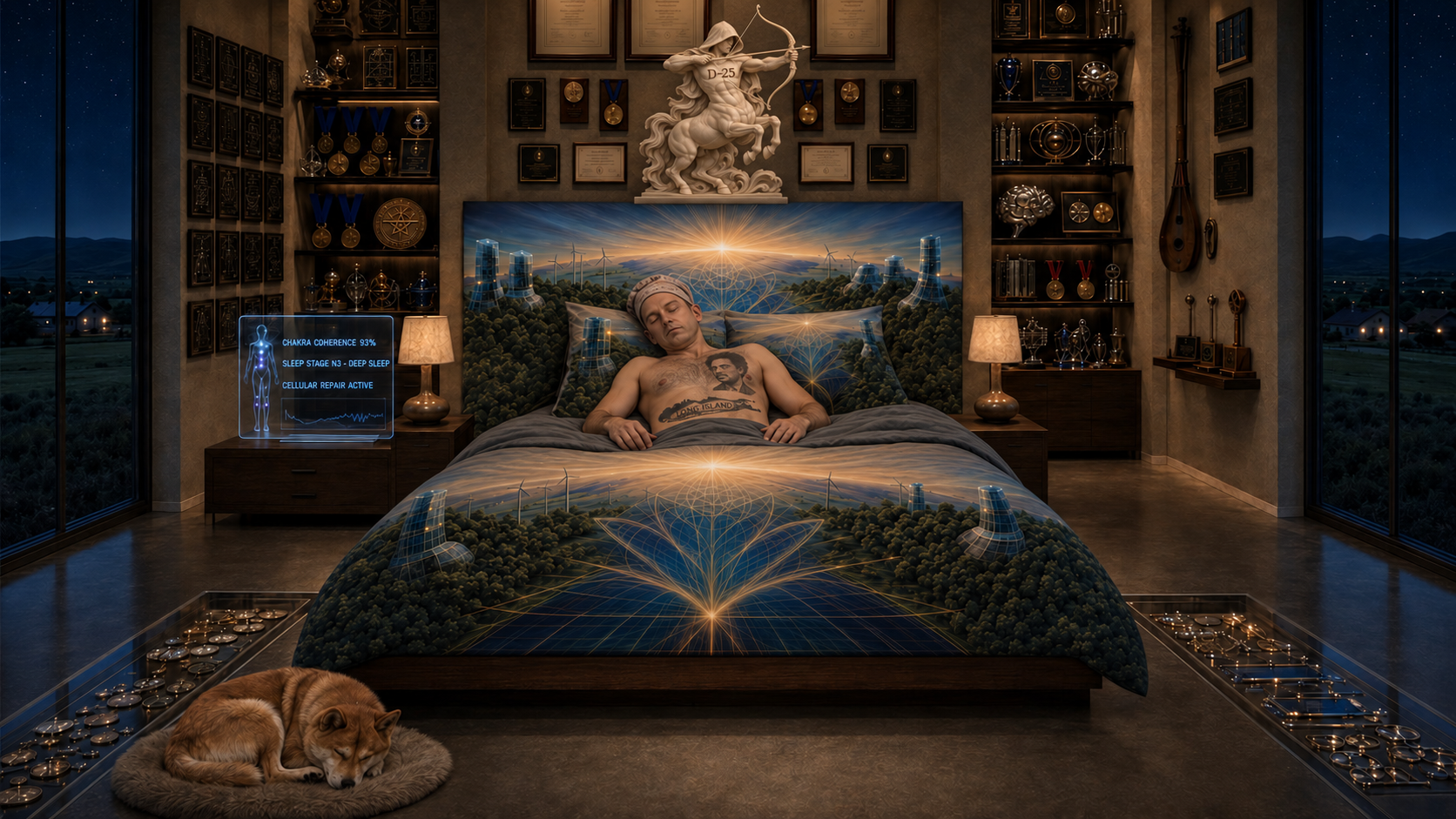
An imagined sleeping portrait of Alex Wissner-Gross adds a Billy Joel chest tattoo and a Long Island abdominal tattoo to an elaborate trophy-lined bedroom. Solve Everything imagery covers the bed, a speculative sleep display glows nearby, and a D-25 centaur archer keeps watch above him.
Read the narration
Billy !
Billy!
October 3, 2026
On October third, twenty twenty-six, the Siouid 142 account accompanied its reply to Doctor Alex Wissner-Gross’s Moonshots announcement with an unusually elaborate piece of supporting evidence. Having restored his pink orchids to a podcast frame and supplied Billy Joel’s “Just the Way You Are” as its soundtrack, the account now presented a sleeping portrait containing an unmistakable declaration of musical allegiance: Billy Joel’s face, tattooed across the physicist’s chest.
The post claims to have found this second image on the internet, establishing, with splendid confidence, that the doctor loves Billy. The source of this apparent discovery is the artist’s own earlier bedroom scene in the Seventy Clock gallery, now reworked into a new chapter of the same visual story. Siouid manufactures the evidence, discovers it, and presents it with the courteous certainty of a helpful correspondent. The affection is sincere; the evidentiary procedure is delightfully circular.
The musical connection begins with a real geography. Wissner-Gross attended Great Neck South High School on Long Island, while Joel grew up in the Levittown section of Hicksville. The artwork expands that shared regional background into an imagined private devotion. Across the sleeper’s abdomen, Long Island itself becomes another tattoo, turning the body into a map of belonging. The singer occupies the chest, the island lies beneath, and the connection that inspired the joke is made almost impossible to overlook.
This is a richly staged fictional interior, rendered with the persuasive lighting and surface detail of a photograph. Amber lamps illuminate dark wood, framed certificates and densely arranged trophies. The composition is nearly symmetrical, with the bed at its center and the night visible through tall windows on either side. That formal balance gives the room the ceremonial gravity of a private museum. At its center, however, the eminent subject is asleep in a nightcap, quietly displaying a pop musician on his skin.
The invented tattoo is the decisive interruption. Around it, intellectual achievement has been made monumental. On the chest, admiration becomes personal, exuberant and slightly absurd. Billy Joel is granted the kind of permanent place that the room’s medals and diplomas occupy on the walls. A portrait of a scientist becomes a portrait of a fan.
The academic record that inspires the room is substantial. Wissner-Gross completed three degrees at MIT in two thousand and three: physics, electrical science and engineering, and mathematics. He graduated first in his School of Engineering class as the Henry Ford the Second Scholar, then completed a physics doctorate at Harvard in two thousand and seven. His dissertation on physically programmable surfaces received the Hertz Doctoral Thesis Prize the following year. His distinctions also include a Goldwater Scholarship and a Dan David Prize Scholarship for future energy applications.
These achievements give the surrounding accumulation its biographical foundation. The artwork turns that record into shelves, medals, frames and scientific ornaments, gathering years of recognition into one enveloping chamber. The trophies function collectively as a visual curriculum vitae. Their gold reflections establish the scale of public accomplishment against which the small intimacy of sleep becomes especially affecting. The person accustomed to explaining intelligence and its accelerating possibilities is permitted, for a moment, to stop explaining anything.
His ideas continue across the bed. The headboard, pillows and coverlet carry the landscape drawn from the artwork for “Solve Everything: Achieving Abundance by Twenty Thirty-Five,” written with Peter Diamandis. Glass structures rise among trees and wind turbines. A radiant sun spreads golden paths across a world in which technological infrastructure and flourishing vegetation appear to belong together. Repeated over the bedding, this future becomes a continuous environment surrounding the sleeper.
The transformation is unusually apt. A work proposing that advanced intelligence can help address great challenges in medicine, energy and industry becomes a blanket: an ambitious public vision made physically comforting. Abundance acquires the scale of a bedroom. The sweeping question of what civilization might build becomes the more immediate question of whether a person can rest, recover and feel at home within that future. The artist gives a technological argument a domestic texture.
Beside the bed, a translucent blue display extends that promise into a speculative sleep system. It announces deep sleep, active cellular repair and ninety-three percent chakra coherence. A luminous body diagram and a fine trace lend the display the appearance of a clinical instrument. Here the language of physiological monitoring meets the collection’s invented vocabulary of energy, restoration and intelligent clothing. The numerical precision is part of the design fiction: the picture imagines a future in which even rejuvenation arrives with a reassuring status report.
The display also recalls the earlier House Innermost Loop pajama designs, whose sensor networks and dream interfaces translated the artist’s proposed moonshot of Drip Abundance into something wearable. Their ambition was to make advanced technology felt as comfort, pleasure and personal benefit. In this bedroom, that ambition spreads beyond the garment into the whole environment. Light, bedding and the imagined care system collaborate around a resting body. Nothing requires the sleeper’s immediate attention.
Above him, the great pale centaur introduces another register of identity. Hooded, poised and drawing its bow, it bears the designation D twenty-five. Within Siouid’s established imagery, this refers to the December twenty-fifth birthday motif and its sidereal Sagittarius association. It is the artist’s heraldic figure for Wissner-Gross: an archer whose attention is directed toward a distant target. Enlarged into a commanding sculpture above the bed, the emblem continues its vigil while the person it represents sleeps.
The contrast gives the room a gentle theatricality. The centaur remains alert; the scientist rests. The awards retain their ceremonial seriousness; the Billy Joel tattoo supplies an affectionate punch line. At the foot of the bed, the curled-up dog adds the simplest form of companionship. Its untroubled presence brings the scene back from technological grandeur to an ordinary pleasure that needs no forecast or explanation.
Siouid’s exaggerated discovery allows all of these identities to coexist without demanding another performance from the subject. The podcast is over, the future is folded around him, and even the room’s formidable inventory of achievement has fallen quiet. The imagined tattoo supplies the only introduction still needed. Billy!
Acquisition information
Opening the gallery…