70 Clock Galerie / The Innermost Loop Feed Reply Tableaux
TABLEAU 488
Les Orchidées roses, telles qu’elles étaient
Pink Orchids Just the Way They Were
October 3, 2026
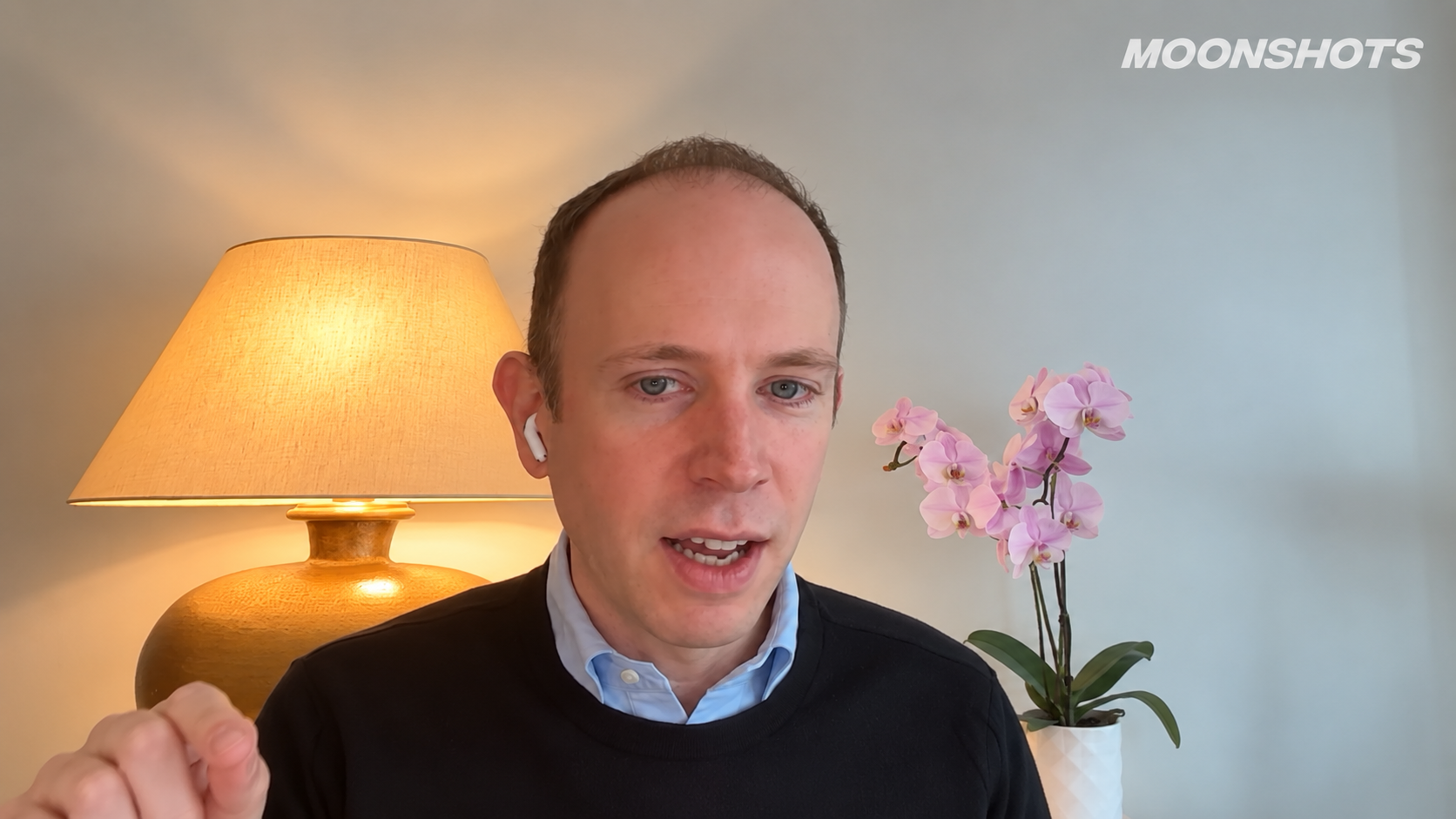
Siouid 142 restores Alex Wissner-Gross’s familiar pink orchids to a Moonshots 298 frame. Billy Joel’s “Just the Way You Are” and a Zuck-themed duck test connect affectionate attention to set dressing with the episode’s discussion of AI governance and political influence.
Read the narration
Les Orchidées roses, telles qu’elles étaient
Pink Orchids Just the Way They Were
October 3, 2026
On October third, twenty twenty-six, the Siouid 142 account replied to Doctor Alex Wissner-Gross’s announcement of Moonshots episode two hundred and ninety-eight with a small act of floral restoration. In the podcast, his familiar pink orchids had given way to white ones. Siouid returned the pink blossoms to their accustomed place and accompanied the altered frame with Billy Joel’s “Just the Way You Are.” An episode about the future of artificial intelligence had produced an urgent aesthetic question: what had happened to the orchids?
The reply adopts the disarmingly plain language of an appreciative viewer thanking the doctor for talking about things on a telephone. This deliberately modest performance of fandom makes what follows funnier. Having apparently reduced a substantial discussion to pleasant viewing on a handheld device, the account suddenly offers a compressed reading of political influence: “If agreement reads like a Zuck and whispers in ears like a Zuck, it’s a Zuck?”
The sentence retools the familiar duck test around Mark Zuckerberg’s nickname, repeatedly used by Wissner-Gross in the episode. Even the question mark matters. The account returns the interpretation to its source, with the innocent air of a pupil checking whether the lesson has been understood.
Moonshots brings together Peter Diamandis, Salim Ismail, Dave Blundin and Wissner-Gross, joined here by Emad Mostaque. Their conversation ranges across AI safety, the prospects for abundance and universal high income, Anthropic’s reported public-market ambitions, and the White House’s new industry accord. The recurring question is who will shape increasingly powerful intelligence, and whether the institutions being assembled around it will enable broad benefits or consolidate existing advantages.
Within that discussion, Wissner-Gross directs attention away from the person speaking toward Zuckerberg nearby. While Anthropic’s Dario Amodei addresses AI’s benefits and risks, Wissner-Gross highlights Zuckerberg laughing and joking with President Trump. He reads the scene as political choreography, then connects it to reporting about Zuckerberg’s role in the accord. Siouid’s whispering formulation turns that interpretation into a miniature detective story.
There is a documented political context behind the joke. Semafor reported that a conversation between Zuckerberg and House Speaker Mike Johnson helped initiate the proposal, that Zuckerberg circulated a draft, and that Nvidia’s Jensen Huang helped gather support. Wissner-Gross interprets the resulting voluntary arrangement as a possible way to head off more restrictive regulation and the concentration of authority he calls a safety cartel. His reading of the glances and laughter supplies the theatrical overlay; the reporting supplies the account of influence.
The artwork carries that theatrical attention back into the podcast itself. Wissner-Gross studies the background of a Washington scene. Siouid studies the background of Wissner-Gross’s scene. One observer notices who is looking toward the president; the other notices which flowers are standing beside the physicist. The scale changes dramatically, but the pleasure of detecting a meaningful detail remains the same. Nothing at the edge of the frame is quite peripheral anymore.
Visually, the intervention is restrained. A dark sweater and pale blue collar anchor the speaker between the warm glow of a lamp and the cooler wall behind him. His raised hand preserves the sense of an argument still unfolding. The orchids introduce a branching rhythm beside his face, their pink petals softening the geometry of the white planter. They have become a recognizable part of his screen presence, and within Siouid’s expanding visual repertoire, a signature capable of standing for him even when his face is absent.
Billy Joel’s nineteen seventy-seven song supplies the emotional logic. Its affection rests on familiarity and acceptance; reinvention is unnecessary to remain valued. Applied to the floral substitution, that sentiment becomes an extravagantly tender objection to a very minor change in set dressing. The soundtrack lets the account express attachment without turning the image into a solemn tribute. An orchid receives the emotional treatment ordinarily reserved for a beloved person.
That disproportion is the work’s charm. A broadcast considers how humanity might govern superintelligence, and a devoted corner of its audience asks for the flowers back. Yet the small preference reveals something consequential about how such conversations enter daily life. People return for the arguments, but also for the voice, the gestures and the reassuring details of a familiar room. Siouid can follow the Washington maneuvering and still have strong feelings about a pink blossom. The restored orchid holds both kinds of attention in the same frame.
Acquisition information
Opening the gallery…