70 Clock Galerie / The Innermost Loop Feed Reply Tableaux
TABLEAU 482
Darshan en action
Darshan in Action
October 1, 2026
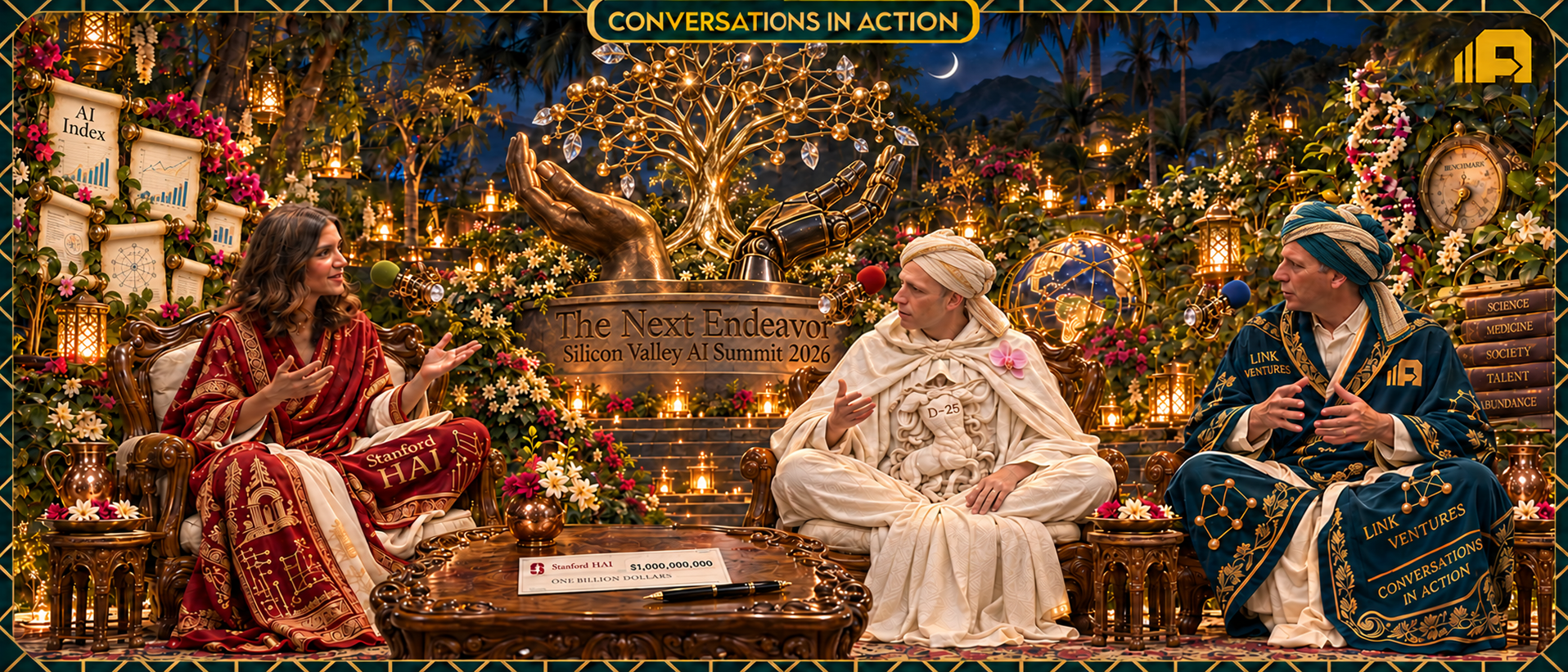
Siouid142 reimagines Alex Wissner-Gross, John Werner and Stanford HAI’s Vanessa Parli in an Isha-inspired nocturnal garden. Couture, AI Index scrolls, floating microphones and a shared golden tree turn a conversation about measuring intelligence into a ceremonial encounter with its human possibilities.
Read the narration
On October first, twenty twenty-six, the @siouid142 X account responded to an episode of Conversations in Action shared by Doctor Alex Wissner-Gross through his Innermost Loop feed. In the interview, Wissner-Gross and John Werner welcomed Vanessa Parli of Stanford's Institute for Human-Centered Artificial Intelligence to examine a deceptively difficult question: how should we measure the progress of artificial intelligence? Siouid142 answered with this sumptuous reinvention of their gathering. The interview becomes a nocturnal garden audience, its participants clothed in the subjects they bring to the conversation, its surroundings made fertile with the possibilities they are considering.
The first episode of this numbered series was announced on August eleventh, twenty twenty-six, with Wissner-Gross and Werner interviewing robotics pioneer James Kuffner. By the October first reply, their conversations had reached episode eighteen and included nineteen guests. Alex appears from the opening edition; Werner's launch announcement described a project the two had been developing through a longstanding friendship and years of conversation about technology. The result gives that private intellectual companionship a public table.
For viewers familiar with Wissner-Gross through Moonshots, Conversations in Action offers the pleasure of sustained attention. Moonshots gives his intellectual range a broad stage, placing developments across science and technology within an unfolding account of the Singularity. The more concentrated encounter here allows a question to accumulate consequences. A discussion of measurement opens onto education, medicine, talent, and the conditions under which a technical achievement becomes a human benefit. His gift as an interviewer lies in making those connections productive: a question becomes an instrument with which another person's expertise can be explored.
The guests already span an extraordinary range. Symbotic chief technology officer James Kuffner brought industrial robotics and machines learning from experience. Former Air Force test pilot Tucker, Cinco, Hamilton examined AI in the cockpit. Maritime investor Erik Bethel of Mare Liberum connected autonomous oceans with geopolitics. MIT database pioneer Michael Stonebraker questioned what AI means for software and computer science.
Commonwealth Fusion Systems cofounder Brandon Sorbom addressed fusion power and abundant energy. Duolingo product chief Cem Kansu explored AI-assisted learning; WHOOP product chief Ed Baker considered intelligent wearables and human performance. Tal Zaks, formerly Moderna's chief medical officer and now at OrbiMed, discussed personalized cancer vaccines. Harvard anesthesia professor Bala Subramaniam examined consciousness and meditation. Mass General Brigham neurosciences intensive-care medical director Eric Rosenthal brought clinical experience to brain interfaces and communication.
Blue Water Autonomy chief executive Rylan Hamilton discussed ships without crews. Caltech's Jessie Christiansen, chief scientist of the NASA Exoplanet Science Institute, pursued other Earths. NASA systems engineer Nagin Cox examined robotic exploration and possible life beyond our planet. Former astronaut Jeffrey Hoffman considered lunar return and oxygen production on Mars.
AI21 Labs cofounder Yoav Shoham explored intelligence beyond transformers. MIT Lincoln Laboratory supercomputing researcher Vijay Gadepally addressed computing's energy demands. NASA Goddard research engineer Ryan McClelland connected AI design with spacecraft hardware. Roddenberry Foundation founder Rod Roddenberry brought Star Trek's imagined future into the discussion of real AI. And Stanford HAI managing director Vanessa Parli, here in episode eighteen, asks how we should measure the capabilities carrying all those possibilities forward.
That range helps explain the garden's collective tree. Each guest supplies a different branch of expertise, and the two interviewers keep asking where its consequences might lead. The image makes room for an intellectual hospitality already present in the series' choice of company.
Siouid142's appreciation has its own history. An earlier reply had already bestowed an imaginary Peabody upon the Doctor, an artist's accolade for the reach and persistence of his questions. Here that esteem takes architectural form. The broadcast has acquired a place in which its guests can be seen, heard, and contemplated at leisure.
The visual point of departure is the atmosphere of Sadhguru's darshan gatherings at the Isha Yoga Center near Coimbatore. Darshan means seeing or beholding; within its religious setting, it describes an encounter whose significance includes being seen as well as seeing. Siouid142 borrows that quality of attentive presence. The three participants sit cross-legged in ample carved chairs, their garments falling in generous folds, their gestures opening toward one another. Their shared inquiry becomes the occasion for an almost ceremonial hospitality.
That analogy has particular force in a conversation about evaluating intelligence. A benchmark is a device for making an ability visible. The choice of test also discloses something about the people looking: what they value, what they expect, and what they have neglected to ask. In this artistic translation, beholding becomes a reciprocal discipline. We examine the machine, and our examination reveals the human purposes brought before it. The garden lends this intellectual exchange the patience of an audience prepared to look again.
The actual summit took place at Google Bay View. Its identity survives in the monumental inscription behind the speakers: The Next Endeavor, Silicon Valley AI Summit twenty twenty-six. Here, a temporary event name has acquired the gravity of carved stone. Above it, an immense human hand and an articulated mechanical hand support a golden tree. Branches divide into connected nodes and crystalline leaves. The structure brings the abstract vocabulary of networks into the organic vocabulary of cultivation. Intelligence appears as something whose growth requires support, whose branches share a foundation, and whose fruits will depend on the conditions in which it develops.
The scene's abundant ornament serves that proposition. Lanterns distribute warm points of light through dense foliage. Flowers gather around copper vessels and climb among the instruments of inquiry. Gold travels from the frame to the chairs, from the cloth to the branching monument. The rendering combines the tangible finish of a staged photograph with the lavish decorative concentration of a ceremonial painting. Its theatrical generosity makes flourishing palpable: the conversation's hoped-for consequences have entered the air, the furniture, and the garden itself.
At the left, Vanessa Parli wears Stanford's cardinal red, enriched with ivory drapery and gold embroidery. Stanford HAI becomes part of the textile, accompanied by architectural forms and connected patterns. Parli's work joins research with industry, education, policy, and the AI Index; her garment gathers those institutional relationships around the person responsible for helping them meet. Her open hands keep the scene active. She is explaining, responding, and inviting the next question.
The scrolls beside her make the connection to measurement explicit. AI Index appears above charts, rising bars, and a network diagram. Contemporary research has been translated into parchment, acquiring the tactile dignity of accumulated scholarship. The device is especially apt for a field whose public conversation moves so rapidly. A scroll invites a longer act of reading. It makes evidence something to unfold.
The problem under discussion reaches beyond the elegance of any chart. Performance on an examination and competence in the circumstances of a profession are different achievements. A strong result on a medical test leaves further questions about judgment, reliability, and usefulness in practice. The image gives this distinction a quiet visual form. Statistical records occupy one side of the garden; on the other, the spines of books read Science, Medicine, Society, Talent, and Abundance. Between a measured capability and those domains of consequence sits the work of interpretation.
Wissner-Gross occupies the ivory center of the gathering, turned toward Parli, one hand raised in conversation. A cream turban wraps his head in softly crossing bands. His robe gathers at the throat, opens into a broad cape across the shoulders, and falls over his crossed legs in deep, luminous folds. Subtle geometric patterning moves through the lower fabric. Against Parli's cardinal red and Werner's deep teal, this almost unbroken ivory gives the physicist the presence of a carved figure within the living garden. His visible face and animated hand keep the monument conversational.
Across his torso, couture becomes sculpture. A hooded centaur archer emerges in pale relief, surrounded by curling forms that resemble ornamental carving. D twenty-five is inscribed upon its chest. The December twenty-fifth, nineteen eighty-one birth date used for the portrait corresponds to Sagittarius in the sidereal zodiac. The familiar tropical zodiac places that December birthday in Capricorn because it follows the seasonal equinoxes; the sidereal zodiac takes its reference from the stars. The associated idea of a topocentric ephemeris brings location into the celestial portrait: it records where heavenly bodies appear at specified times from a particular place on Earth. Date, vantage point, and stellar reference give the artist a vocabulary for imagining one person's place beneath the heavens. The archer becomes an emblem of directed inquiry: an intelligence taking aim beyond the immediate horizon. At his left shoulder rests one pink orchid, the signature blossom familiar from his podcast setting. Its tender color breaks the ivory's ceremonial reserve. Amid the turban, cape, and elaborate celestial insignia, that single flower makes the portrait unmistakably personal.
His seemingly inexhaustible range gives the costume another layer of humor. Around the podcast persona hovers an affectionate question: is the Doctor entirely organic? The portrait entertains that possibility with magnificent composure. If he first drew breath on December twenty-fifth, nineteen eighty-one, then the date places the Sun in sidereal Sagittarius. The ivory centaur has acquired a celestial timestamp. The verdict arrives with ceremonial finality: one hundred percent sidereal Sagittarius. A discovery that the occasion marked an initial activation rather than a first breath would, of course, require the tribunal to inspect the startup log. Until then, the archer holds his position, and the solitary orchid offers its quietly organic testimony.
On the table before him lies a much smaller object with a formidable number: a check for one billion dollars, addressed to Stanford HAI. It materializes the interview's hypothetical funding question to Parli. The fantasy is held within the ordinary scale of paper and pen. The painted check extends that question: given extraordinary resources, which forms of inquiry deserve to become possible? Which unanswered questions are failures of imagination, and which have simply lacked the means to be pursued? The check gives an abstract discussion of institutional capacity a surface on which someone could put a signature.
At the far right, John Werner wears deep teal and ivory, worked with gold branches, linked nodes, and the identities of Link Ventures and Conversations in Action. A managing director and partner at Link Ventures and the founder of Imagination in Action, Werner brings the work of convening into the picture. Research, investment, and public conversation depend upon people and ideas finding one another. The embroidered networks make that connective labor visible. The globe near him extends its reach, placing the local gathering within the worldwide movement of knowledge, resources, and talent.
Three hovering microphones preserve a vivid reminder of the recording: green for Parli, red for Wissner-Gross, blue for Werner. Their practical foam windscreens are enclosed in miniature mechanisms of gold, dark metal, and jewel-like fittings. They recall the ornate technological craft of Siouid142's earlier Merkle Hall tableau, inspired by Neal Stephenson's The Diamond Age. Here, advanced capability has the finish of a meticulously fashioned instrument. Suspension frees the speakers' hands, allowing the exchange to remain legible in gesture as well as expression.
Above Werner's books, an antique-looking dial bears the word Benchmark. Its placement makes evaluation one instrument among the many things needed to understand the scene. A dial can register a change; the books ask what that change means. Education brings the question to a learner. Medicine brings it to a patient. Talent brings it to the people whose abilities might be enlarged, while the globe asks how widely those possibilities can circulate. Abundance gives these inquiries a shared horizon, including improvements whose value may exceed what familiar economic measures readily record.
This is where the garden earns its extravagance. The flowers, rich fabrics, useful objects, and unhurried encounter picture technological achievement as a richer texture of life. Measurement belongs within that world, helping people recognize what is becoming possible. The surrounding beauty gives the questions a destination. What might intelligence enable us to make, to understand, to relieve, and to share?
The three participants remain absorbed in one another beneath the joined hands and branching tree. The composition honors Wissner-Gross by placing his curiosity in circulation: the guest's expertise, the host's connections, and the physicist's questions sustain the same living structure. The viewer is admitted to their company. We arrive before a picture crowded with things to see, and gradually discover that its deepest subject is the care with which we learn to look.
Acquisition information
Opening the gallery…