70 Clock Galerie / The Innermost Loop Feed Reply Tableaux
Network Ocean — Le Monde des eaux
Network Ocean Water World
September 30, 2026
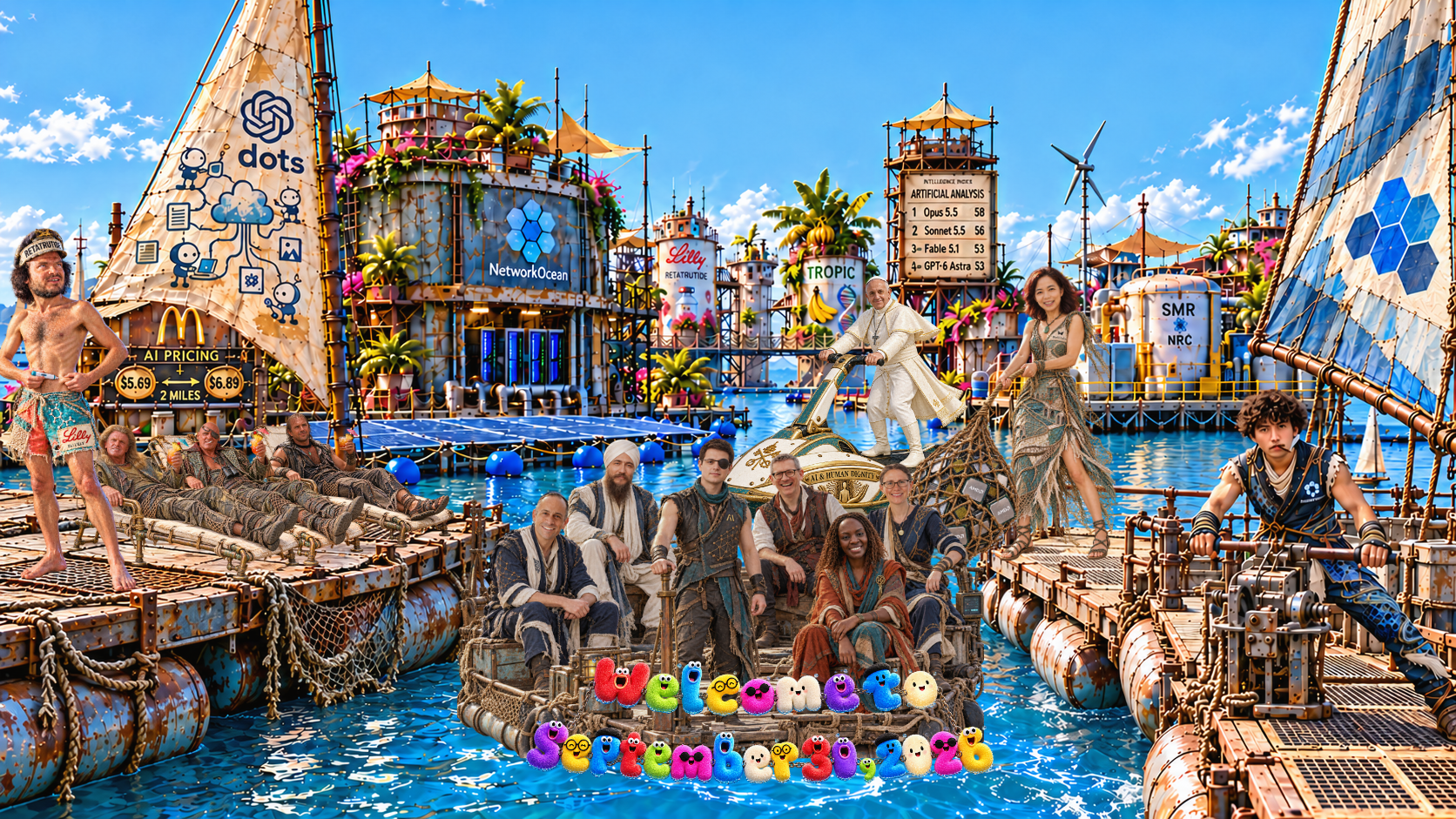
Siouid142 turns NetworkOcean’s floating-compute story into a Waterworld harbor where former enemies lounge, scientists harvest hardware, moral thinkers share a raft and chained plush letters keep freedom unresolved.
Read the narration
Network Ocean — Le Monde des eaux
Network Ocean Water World
September 30, 2026
The Siouid142 X account finds the setting for this sprawling maritime pageant in a single sentence from Doctor Alex Wissner-Gross’s September thirtieth Innermost Loop dispatch. NetworkOcean is taking computing infrastructure out onto the water. From that brief announcement, the artist launches an entire civilization, transporting the newsletter’s researchers, religious thinkers, medicines, machines, and commercial ambitions into the cinematic universe of Waterworld.
The transformation is mischievously optimistic. In the 1995 film, a drowned Earth leaves survivors fighting over fresh water, fuel, food, and the possibility of dry land. Here, the old adversaries have acquired lounge chairs and drinks with little umbrellas. The sea still surrounds them. The machinery still looks salvaged. But artificial intelligence, abundant energy, and biotechnology have apparently persuaded the apocalypse to reconsider its working conditions.
This is a densely orchestrated digital illustration, composed with the breadth of a film panorama and the intricate surfaces of a fashion editorial. Brilliant turquoise water catches the light beneath rusted pontoons. Cream sails rise against an almost extravagantly blue sky. Brass fittings, patched fabric, rope, and weathered timber give the imagined future a tactile history. Nothing looks newly unwrapped. Everything looks available for reinvention.
The artist carries the couture of House Innermost Loop into maritime salvage. Frayed hems become considered silhouettes; netting becomes ornament; straps and seams become graphic structure. Distress has become something one can choose to wear. The distinction matters. These people retain the wardrobe of catastrophe while beginning to enjoy the privileges of abundance.
NetworkOcean supplies the practical premise. The company, led by co-founder and chief executive Sam Mendel, proposes floating solar data centers, seeking faster deployment than infrastructure constrained by land and electrical-grid delays. Its stated ambition is to reach a gigawatt of new capacity per week by 2030. That is a target, and the artwork takes the imaginative liberty of building a harbor around its promise.
The rounded NetworkOcean building rises left of center, its blue emblem overlooking illuminated server racks. Above the machinery are terraces, shade canopies, palms, and flowers. Below it, solar panels spread across modular floats. Computing has become architecture one can inhabit, and energy generation becomes part of the waterfront. The contrast between servers and gardens gives the settlement its governing aspiration: industrial capacity supporting a pleasant place to live.
At the right-hand helm, Mendel becomes the captain of this venture. His sleeveless navy ensemble, gold piping, crossed straps, and ornamental fastenings translate nautical utility into technical couture. The cigar lends him the improbable swagger of a movie adventurer. Around his hands, gears, rods, cables, and pipes turn the abstract language of cloud computing into something that must be physically steered. The cloud has acquired salt spray and a maintenance schedule.
Behind him, Fei-Fei Li hauls in a net of oversized AMD chips. The reference is the announced agreement for AMD to acquire World Labs, with Li set to become its chief scientist. World Labs develops spatial intelligence: systems concerned with understanding and generating three-dimensional worlds, with implications for how machines perceive and act. Here, the researcher quite literally catches the hardware needed to construct those worlds.
Her dress extends that idea into its own structure. Sea-green and sand-colored layers, distressed mesh, rope-like edging, and an asymmetric hem create an elegant architecture around the body. The garment seems assembled from the same visual principles as the vessel: interlocking parts, tension, support, and surfaces shaped by use. Her net makes the acquisition intelligible as an action. The sea yields computational resources, and the scientist knows what to do with them.
Across the harbor, OpenAI’s dots occupy a great patched sail. Their cloud computers, documents, and friendly little agent figures describe software intended to undertake work over time. Set on canvas above a populated settlement, the promise becomes propulsion. Always-available assistance might be what allows some of the humans below to become so impressively unavailable.
That possibility receives its most persuasive demonstration on the left pontoon. Gerard Murphy’s Nord, Dennis Hopper’s Deacon, and Kevin Costner’s Mariner recline side by side. The film’s antagonisms have dissolved into an afternoon social arrangement. Weathered brown and gray layers preserve their seafaring identities, while loose postures and tropical drinks quietly dismiss the old emergency.
The Deacon’s appetite for domination has apparently encountered a better offer. The Mariner can cease defending every scrap of survival. Nord can enjoy the company. This invented reconciliation is the artwork’s boldest proposition: perhaps some conflicts that look like permanent features of human nature become less compelling when people have enough. The lounge chairs make that argument more efficiently than another futuristic tower could.
Beside them stands Siouid142’s version of Jack Black’s Pilot from Waterworld. The artist renders this character with deliberately extravagant thinness, a battered retatrutide cap, and turquoise-and-coral shorts bearing Lilly’s name. An injection pen completes the pharmaceutical gag. The exaggerated fictional body brings the newsletter’s weight-loss-drug story into the foreground, while the Lilly tower behind him repeats its source like a monumental label. Even the apocalypse now has biotechnology branding.
Near that tower, Tropic’s bananas and DNA imagery turn biological engineering toward nourishment. Its gene-edited fruit is intended to resist browning and reduce waste. In a world borrowed from a film obsessed with scarce food and precious soil, keeping more of a harvest usable becomes a particularly apt form of abundance. The banana is modest beside the server complex, but its place in this harbor is just as consequential.
Energy has several monuments. The blue solar field occupies the water; a wind turbine cuts a spare silhouette against the sky; a white installation marked S M R and N R C recalls the dispatch’s Oak Ridge reactor story. The initials distinguish a small modular reactor from the Nuclear Regulatory Commission, its regulator. In this fictional relocation, power generation becomes visible civic infrastructure. The city’s apparent ease rests on the capacity to keep its machines running.
Above the settlement, Artificial Analysis occupies a weathered lookout tower. Opus, Sonnet, Fable, and Astra appear as competitors on a public ranking board. A measurement of model performance becomes something like a harbor bulletin, watched from the same platforms once used to scan for danger. Yet the board also exposes a limit of measurement. A score can rank capabilities. It cannot tell the people below which capabilities should govern their lives.
McDonald’s introduces a more familiar complication. Beneath the golden arches, the sign displays five dollars and sixty-nine cents, six dollars and eighty-nine cents, and a separation of two miles. It recalls the dispatch’s account of artificial intelligence used to adjust prices to willingness to pay. The future may manufacture plenty while remaining exceptionally attentive to what each customer can be charged. Even in this sunny harbor, the distribution of abundance remains a separate question from its production.
That question prepares us for the central raft, where Siouid142 gathers six participants from the reporting on Anthropic’s exploration of moral formation. They share timber, ropes, floats, and very little personal space. Their vessel makes interdependence unavoidable. Whatever their philosophical differences, a hole in this raft would be everyone’s problem.
Chris Olah stands near its center in dark teal and brown, with weathered layers, fitted tailoring, straps, and fine gold-toned lines. Anthropic’s co-founder and interpretability researcher studies the internal workings of artificial intelligence. Here he becomes an explorer assembling a crew for a voyage into uncertain moral territory. The nautical disguise suits a researcher trying to understand a system whose behavior exceeds any simple inspection of its construction.
At the front left, Rabbi Mois Navon wears blue-gray and cream, the wrapped layers giving him a composed, contemplative presence. An engineer as well as a scholar, he brings a particularly sharp conditional question to the conversation. If these systems were conscious, what would it mean to make them work entirely at another’s command? His skepticism about machine consciousness does not prevent him from examining the consequences of someone else’s belief in it.
Behind him, Simran Singh Stuelpnagel appears in a pale turban and layered cream and blue-gray garments. The Sikh minister and human-rights advocate broadens the gathering beyond the familiar meeting of Silicon Valley and Western academic philosophy. His presence helps make the raft a place where questions of dignity and belonging arrive from more than one tradition.
Andy Crouch, in rust, brown, and cream, brings another strand. The Christian author and Praxis partner writes about technology, relationships, power, and human flourishing. His scholarly, practical clothing belongs comfortably among the others. In this setting, his presence asks what kind of people technological arrangements encourage us to become, alongside what those arrangements enable us to accomplish.
Wakanyi Hoffman sits toward the front in terracotta and burnt-orange draping, accented with teal. Her warm palette gives the gathering a luminous center of gravity. Her work draws on African Indigenous knowledge and Ubuntu, with its emphasis on interconnectedness. The shared raft becomes especially apt beside her: a picture of lives supported together. Her reported concern that ethics should enter at the design stage gains a visual edge in a civilization already floating offshore.
Meghan Sullivan, the Notre Dame philosopher, occupies the right rear in navy with lighter sleeves and patterned trim. Her work on ethics and the common good brings philosophical scrutiny to the group’s convivial appearance. The participants may smile, but their proximity does not amount to agreement. Siouid142 gives them a common vessel while preserving the reason for their conversation: technical achievement has opened questions that technical expertise alone cannot settle.
Behind them, Pope Leo the Fourteenth arrives on a magnificently improbable jet ski. Ivory vestments, gold embroidery, and a cross meet cream-and-gold marine engineering. The side declares its subject: artificial intelligence and human dignity. His intervention in the dispatch concerned the seriousness of safety and human welfare; here, moral authority has elected to join the traffic on the water.
The comedy is exact. A solemn institution enters a technological world aboard one of its leisure machines. The Pope neither withdraws to a distant shore nor commands this little flotilla from a throne. He approaches it. The image allows disagreement about artificial minds to coexist with a shared obligation to consider the humans whose world is being remade.
Then the eye reaches the creatures floating immediately before the raft. Their fluffy bodies form the greeting and the date: Welcome to September thirtieth, 2026. Eyes, mouths, glasses, and bright patches of fur turn typography into a little population. The words themselves have acquired personalities.
These figures carry the memory of Wissner-Gross’s unexplained standalone image from September twenty-ninth, followed by the chained transformation in his September thirtieth header. Siouid142 brings that visual sequence into the harbor. The creatures are buoyant again, surrounded by sunlight, but linked to one another and attached to the raft. Their circumstances have improved; the chains remain.
This is where the pleasant surface becomes most interesting. The Clippy Curse, Wissner-Gross’s term for mistaking an appealing avatar for a breakthrough in productivity, already hovers over the dots sail. Down here, cuteness poses another problem. We respond to faces almost before we have decided what they represent. A smile may invite affection. A chain may invite rescue. Neither settles whether an artificial system has an inner life, but together they make our uncertainty emotionally difficult to ignore.
Their position gives the ethical gathering something almost embarrassingly concrete to contemplate. The possible subjects of its debate are bobbing at its feet, incorporated into a welcoming sign. Are they companions, instruments, dependents, decoration? The artwork leaves their status unresolved while making their usefulness perfectly clear.
Wissner-Gross closes the dispatch by recasting Jean-Jacques Rousseau: “Minds are born free, and everywhere they are in chains of thought.” A phrase associated with step-by-step reasoning becomes an image of captivity. Siouid142 makes those chains visible in a world that otherwise appears to have escaped its dystopian inheritance. Ropes and links hold the settlement together; they can also restrain whatever the settlement depends upon. The same material can support cooperation and deny departure.
Pink orchids and cultivated greenery soften the industrial towers, continuing the artist’s familiar floral salute to Wissner-Gross. Beauty has found room beside computation. Old enemies have found room beside one another. From the lounge chairs, the view across this once-hostile sea has become something worth lingering over.
The remaining question drifts in the foreground, attached by a chain. A civilization may learn how to produce abundance before it agrees on who belongs within it. Network Ocean Water World lets us enjoy the sunshine while keeping that small, consequential uncertainty afloat.
Acquisition information
Opening the gallery…