70 Clock Galerie / The Innermost Loop Feed Reply Tableaux
L’Ingénieur, le Physicien, le Bouffon de cour, le Provocateur
The Engineer, Physicist, Court Jester, Provocateur
September 29, 2026
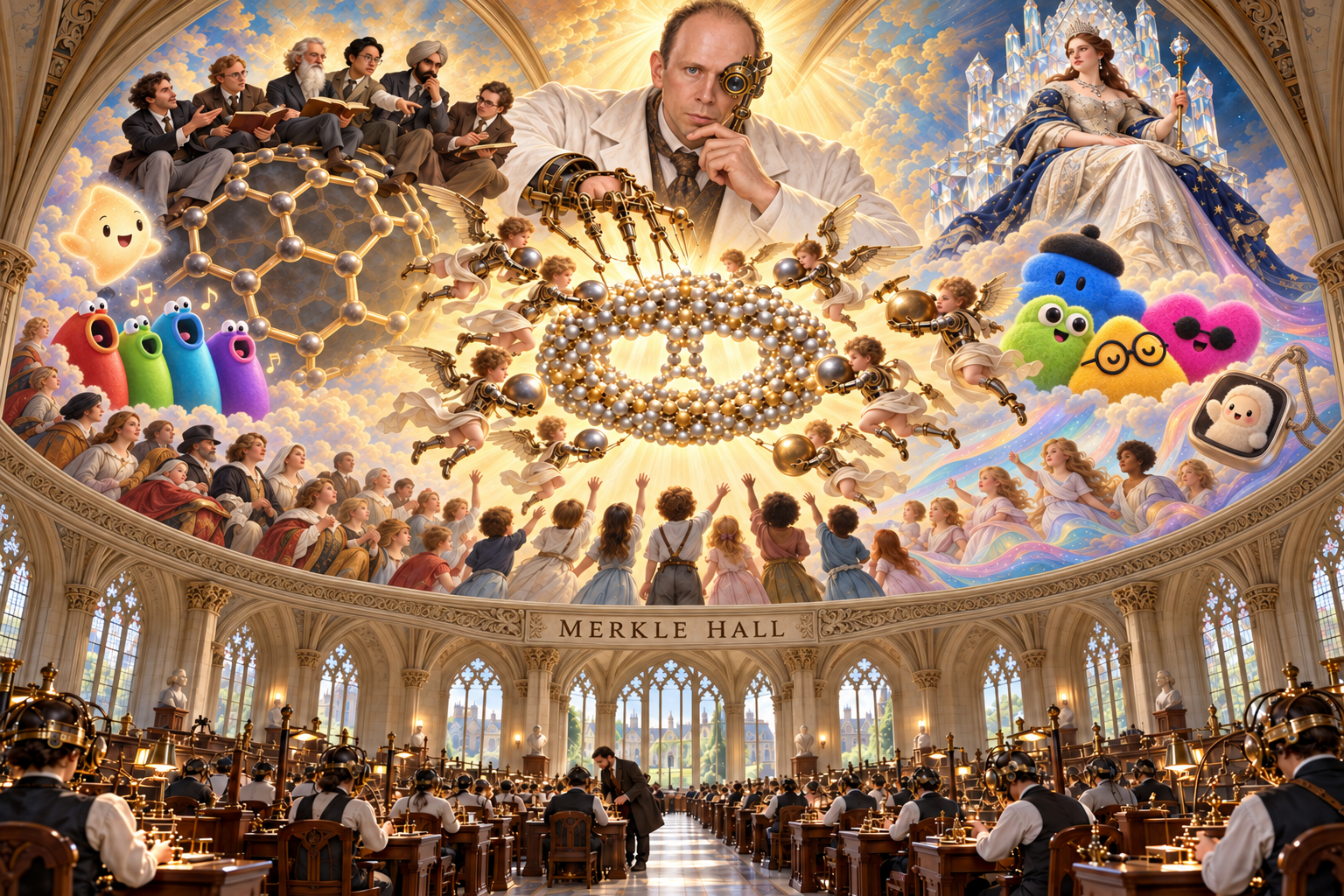
Siouid places Wissner-Gross and ten digital mascots inside the technological pantheon of Merkle Hall, exploring authority, abundance and the friendly face of power.
Read the narration
L’Ingénieur, le Physicien, le Bouffon de cour, le Provocateur
The Engineer, Physicist, Court Jester, Provocateur
September 29, 2026
The Siouid 142 X account replied to Doctor Alex Wissner-Gross’s unexplained September twenty-ninth image by giving its smiling creatures a new home: Merkle Hall, the extraordinary engineering pantheon imagined in Neal Stephenson’s The Diamond Age. Wissner-Gross had posted singing blobs, fuzzy companions, a floating golden figure and a small digital creature waving from a portable device. Siouid transported that congregation into a monumental fresco, placed Wissner-Gross at its center, and supplied this caption: “Feynman, Drexler, Merkle, Chen, Singh, Finkle-McGraw, ‘the Engineer/Physicist/Court Jester of the Singularity,’ and Queen Victoria II.”
That act of relocation gives the unexplained image an unsettling institutional setting. Earlier, Wissner-Gross had named the Clippy Curse: the corporate tendency to mistake a cute visual avatar for a productivity breakthrough. Here, the avatars enter a painted heaven in which technological power already presents itself through beautiful, obedient little helpers. The reply asks what happens when the friendly face of innovation becomes part of a civilization’s account of why it deserves to rule.
Published in nineteen ninety-five, The Diamond Age imagines a world transformed by molecular manufacturing, where extraordinary material capabilities coexist with hierarchy, exclusion and dependence. Merkle Hall belongs to the Design Works of Machine-Phase Systems Limited, the engineering world inhabited by John Percival Hackworth. Its architecture resembles a university; its ordered working life also resembles a factory. Stephenson places a glorious vision of human deliverance above people performing their daily technical labor.
The artwork makes that division immediately visible. Below, designers sit in disciplined rows, their heads enclosed by viewing instruments, their desks crowded with brass apparatus. Above, the vaulted ceiling opens into an immense painted assembly of scholars, royalty, children and molecular angels. Gothic arches and carved stone contain a celestial spectacle with the theatrical radiance of a Baroque ceiling. Gold connects the instruments on the working floor to the promises overhead. Read as institutional propaganda, the ceiling teaches the workers to see their employer’s order as the natural custodian of humanity’s future.
At the center, Wissner-Gross wears the Engineer’s white coat and a monocular nanophenomenoscope: Stephenson’s fictional instrument for viewing phenomena at the nanoscale through one eye. The elaborate gold apparatus gives his concentrated face the authority of specialized vision. His free hand rests thoughtfully against his chin, while a mechanical nanomanipulator reaches toward the assembly below him.
The novel makes a wonderfully revealing admission about that eyepiece. Its single-eye design is impractical because it lacks depth perception. It appears in the fresco because leaving the Engineer’s other eye visible makes a better picture. The apparatus therefore performs two jobs: it signifies technical expertise, and it stages a persuasive portrait of the person possessing it. Even in a future of astonishing precision, authority still requires a flattering composition.
Cybernetic cherubs carry spherical atoms toward a luminous circular structure, a molecular bearing or motor assembled from gold and silver forms. Their human faces, wings and mechanical limbs translate engineering into angelic service. They work beneath the Engineer’s direction. Stephenson compares that command to Neptune ruling his attendant spirits; Hackworth, characteristically, interprets the heavenly light as energy released when atoms settle into their assigned positions. The sacred radiance has a physical explanation. The hierarchy keeps its celestial appearance.
At upper left, the six figures named in the reply occupy a great buckyball, a spherical cage of carbon atoms. This is distinct from the molecular mechanism at the center. Feynman, Drexler and Merkle bring real scientific ancestry into the fiction; Chen, Singh and Finkle-McGraw extend the gathering into Stephenson’s imagined order. Some read, others gesture toward the construction. Their placement makes knowledge look like an inheritance passed down from an elevated council. Finkle-McGraw, the powerful patron behind the novel’s educational Primer, joins intellectual authority to the means of commissioning its applications.
Across from them, Queen Victoria the Second presides from a throne of solid diamond. Her skirts spread into an auroral curtain behind the children awaiting their future. It is an exquisitely flattering arrangement for a sovereign: even the atmosphere surrounding tomorrow’s beneficiaries appears to flow from her person. Scientific ancestry occupies one side, political authority the other, and technological creation binds them together.
The generations along the lower edge give this spectacle its emotional force. Those at the left lived too early to benefit from the advances celebrated above them. The present children reach toward the molecular light. At the right, children yet to be born await the Engineer’s achievements. The fresco gathers the dead, the living and the unborn into one constituency for progress. Their hope is moving. Their pictorial unanimity is also remarkably useful to the institution beneath whose ceiling they appear.
Into this solemn assembly, Siouid introduces the ten contemporary creatures. The four singers occupy the clouds beside the scientific ancestors, turning the promise of progress into a chorus. The golden visitor floats near the buckyball as though it had always belonged among the attendants of revelation. Beneath the queen, the blue figure in its black beret gathers with the green blob, the bespectacled yellow companion and the pink heart in sunglasses. Nearby, the small creature in its metallic charm waves beside the future children. Affection has found a place within the succession of authority.
Their arrival exposes a resemblance already waiting in Stephenson’s scene. The cybernetic cherubs and the digital companions both make complicated systems approachable through personality. Both offer the pleasure of imagining powerful technology as a willing little helper. In this reading, the cute surface is consequential: it can make command look like care, dependence feel like companionship, and an institution’s ambitions resemble everyone’s wishes.
The novel gives that question material weight. Its Feed supplies matter compilers with the resources from which they manufacture goods; control of that infrastructure can sustain dependence even amid abundance. The prospect of a more distributed alternative, the Seed, challenges that arrangement. Yet the same elite also commissions the Primer to nurture independent thought. Stephenson’s world allows genuine emancipation and paternal authority to emerge from overlapping institutions. The fresco’s beauty cannot settle which will prevail.
That uncertainty gives the central title its bite. The Engineer directs. The Physicist understands. The Court Jester provokes. In Siouid’s casting, the jester’s privilege is to disturb the court’s account of itself through wit, extravagant comparison and an apparently unserious gesture. Wissner-Gross’s language of safety cartels and alignment aristocracies makes that role apt. Now the critic of technological aristocracy has been installed within an aristocratic celebration of technological mastery. Is his presence an elevation into the pantheon, or an intrusion that makes its solemnities impossible to take entirely at face value?
Even the medium contributes to the question. In Stephenson’s passage, the building is grown from the Feed, but the fresco is paint on plaster. The neo-Victorians value the commitment of an image that cannot simply be refreshed. Siouid’s digital reconstruction borrows that imagined permanence, carrying an enigmatic social-media post into the visual language of an enduring institutional monument. Passing mascots acquire the company of ancestors, monarchs and unborn generations.
The result sustains admiration and provocation together. There is real grandeur in the ambition to relieve suffering and extend human possibility. There is also power in deciding who will embody that promise, who will administer it, and whose smiling face will invite our trust. Beneath the painted heavens, the designers continue working. Above them, the companions have joined the angels. At the center, the Engineer, Physicist and Court Jester of the Singularity leaves us to consider whether he is conducting the ceremony—or quietly making its governing assumptions the object of the joke.
Acquisition information
View on OpenSea · Continuing archive collection · OpenSea gallery
Opening the gallery…