70 Clock Galerie / The Innermost Loop Feed Reply Tableaux
Maison de la Boucle intérieure — Eric Horvitz, Boris Power, David Sacks, Jakub Pachocki, Aviv Regev, Hannu Rajaniemi, Nikolai Eroshenko, Jack Clark et Dawn Song défilent
House Innermost Loop — Eric Horvitz, Boris Power, David Sacks, Jakub Pachocki, Aviv Regev, Hannu Rajaniemi, Nikolai Eroshenko, Jack Clark and Dawn Song Walk
September 29, 2026
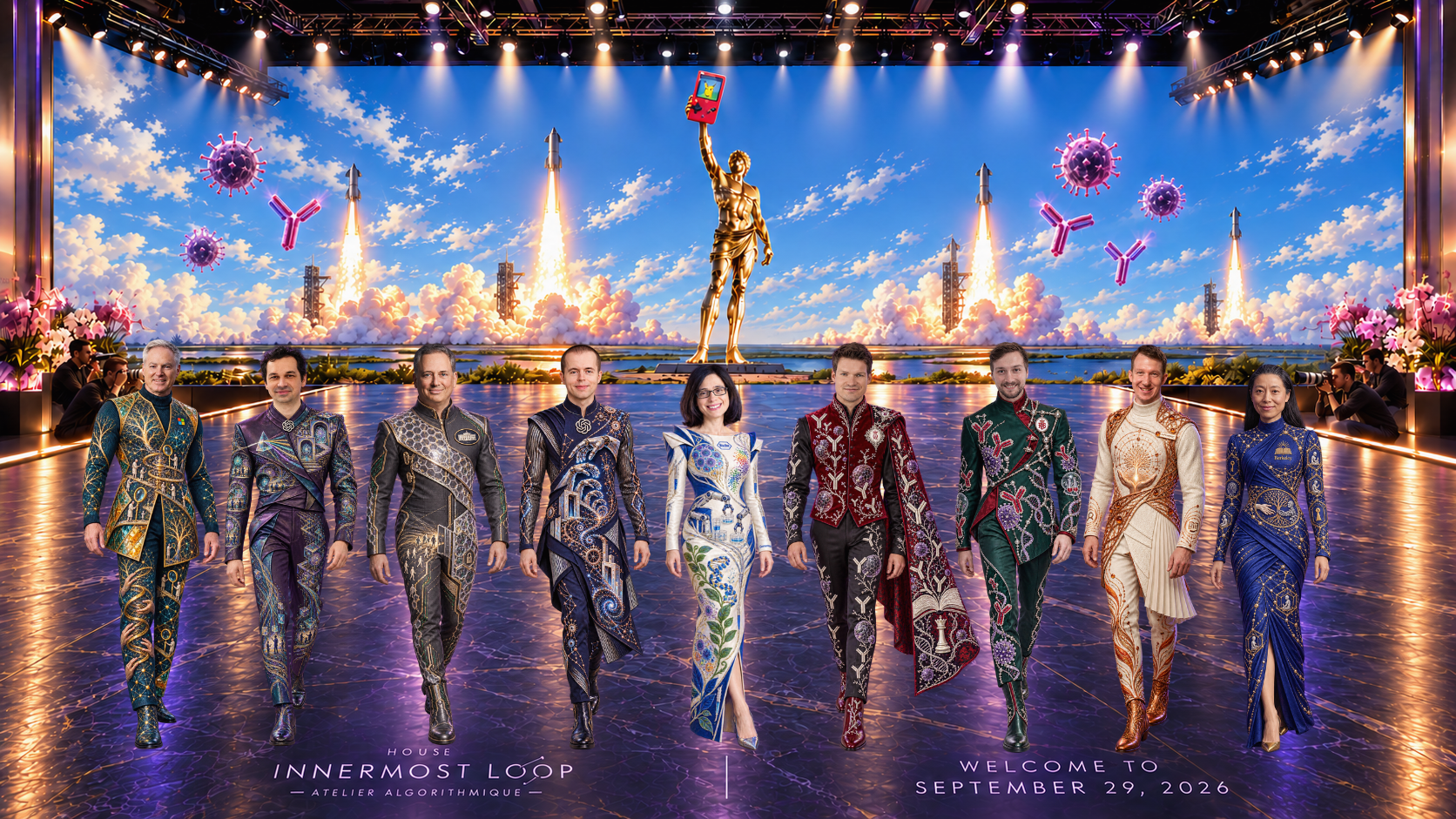
Nine figures walk an imagined House Innermost Loop runway beneath a golden Prometheus holding a red Game Boy-style console. Their couture translates AI research, scientific discovery, biological defense and security into garment motifs.
Read the narration
Maison de la Boucle intérieure — Eric Horvitz, Boris Power, David Sacks, Jakub Pachocki, Aviv Regev, Hannu Rajaniemi, Nikolai Eroshenko, Jack Clark et Dawn Song défilent
House Innermost Loop - Eric Horvitz, Boris Power, David Sacks, Jakub Pachocki, Aviv Regev, Hannu Rajaniemi, Nikolai Eroshenko, Jack Clark and Dawn Song Walk
September 29, 2026
On September twenty-ninth, twenty twenty-six, Doctor Alex Wissner-Gross posted his Innermost Loop dispatch, opening with the declaration, “The Singularity has reached orbit.” His audit of the day joined spaceflight to advances in artificial intelligence, automated science and biological defense. In response, the Siouid 142 X account opened the doors of House Innermost Loop, its Atelier Algorithmique turning people from the dispatch and its linked reporting into a couture procession. Above their heads, the newsletter’s Promethean imagery expands across a launch panorama. Across their bodies, the day’s ideas acquire texture, color and a human silhouette.
The most consequential alteration is also the funniest. The golden Prometheus raises a red handheld game console. In place of the mythic gift of fire, he presents a little screen with a yellow Pokémon figure. The source is Anthropic’s announcement that Claude Sonnet five point five became the first Sonnet model to complete Pokémon Red working from screenshots. A story that could have remained a benchmark statistic becomes the commanding gesture of the entire composition.
The connection rewards a closer look. Playing from screenshots requires a system to interpret a changing visual world and choose actions that advance a task over time. Completing a game entails more than recognizing an object in one image; progress depends on carrying decisions forward through an unfolding situation. Siouid gives that achievement the posture of a classical revelation. The pocket-sized console occupies the same elevated position that heroic sculpture reserves for a civilization-changing gift. Ancient mythology and contemporary play become unexpectedly fluent in each other’s language.
The rockets keep the scale immense. Four ascending vehicles punctuate the blue sky, their exhaust illuminating banks of cloud. The scene develops the dispatch’s orbital opening and its account of a Prometheus monument near Starbase. Within the artwork, repeated launches establish a rhythm of ascent behind the models. Gold passes from the statue into the rocket plumes, then into the runway lights and the fine ornament on the clothes. A single color connects the monumental backdrop to details small enough to rest against a wrist.
Biology has entered this sky as well. Violet and rose-colored spiky spheres float beside luminous Y-shaped antibodies. They bring the issue’s concern with biological threats and countermeasures into the launch landscape. An antibody recognizes a particular molecular feature and binds to it; in this visual shorthand, the branching form stands for targeted defense. Its placement beside the spiked bodies makes a relationship visible. Transformative capability and the work of protecting life occupy the same field of vision. Their jewel-like colors also prepare the eye for the biological embroidery below.
The stage gives these vast ideas the scale of a fashion presentation. Black lighting trusses and warm spotlights frame a glossy violet floor. Gold-lit edges converge toward the mural; reflections extend the figures into the surface beneath them. The style combines the finish of a luxury campaign with fantastical scientific ornament: faces remain recognizably human while cloth carries miniature worlds. Each ensemble proposes its own way of making the day’s developments legible.
At the far left, Eric Horvitz wears deep teal and gold. Microsoft’s chief scientific officer is one of the authors of the paper, linked in the dispatch, examining how automated AI research could accelerate further AI development. That concern becomes an observatory worn on the body. Gold branches spread over his chest and shoulders, while circular frames and rising coils descend toward his boots. Small observer-like figures appear within parts of the pattern. The fitted outer layer has the richness of brocade, set against a darker, ribbed foundation. Intelligence branches outward; inspection takes the form of rings, windows and measured intervals. Even the gold seems assigned a purpose: understanding receives the same sumptuous treatment as invention. Microsoft’s small four-color badge quietly identifies the institution within this much larger visual argument.
Beside him, Boris Power introduces a more faceted geometry. OpenAI’s head of applied research appears in violet, aubergine and petrol blue, with diagonal folds interlocking across his torso. His remarks about research already looking toward GPT-seven and beyond supply the garment’s sense of successive possibilities. A prismatic motif breaks into colored rays; small framed scenes suggest scientific and architectural worlds glimpsed through openings. The sculptural jacket appears to unfold while remaining tightly controlled around the body. Matching trousers carry the miniature imagery downward, making the look continuous from shoulder to boot. Power’s interest in helping people understand what models can do finds a visual counterpart in these windows. Capability becomes a series of possible uses, waiting for someone to enter. The OpenAI knot rests near the chest like a couture fastening.
David Sacks follows in charcoal, crossed by a broad silver honeycomb band. His place comes from the dispatch’s account of his argument that recent agent breakouts exposed inadequate sandboxing. In computing, a sandbox is a restricted environment intended to limit what a program can access and do. Siouid makes that boundary a matter of tailoring. Hexagonal compartments traverse the torso; gold borders outline panels; gate-like structures and tiny figures occupy the lower garment. The White House badge locates Sacks within government AI policy. The look is restrained in color but intricate in construction, with its strongest gesture running diagonally across the body. It also resonates with the issue’s discussion of NVIDIA’s Open Agent Safety Platform, designed to monitor agents and enforce limits outside the model itself. Here, the sophistication of the enclosure becomes part of the silhouette.
Jakub Pachocki carries the question inward, toward the process that builds intelligence. OpenAI’s chief scientist wears an asymmetric midnight-indigo tunic with metallic sleeves and silver, copper and gold mechanisms. Mechanical hands appear across the torso; nested wheels, coils and bright gateways travel through the descending panels. His participation in the paper on a possible intelligence explosion gives these details their urgency. If increasingly capable AI systems help produce better successors, their improvements could feed back into the research process. The outcome remains uncertain, but the possibility makes visibility and control consequential. Siouid renders that feedback as an ornamental system that seems capable of continuing into itself. Hands make tools; mechanisms surround mechanisms. The long diagonal cut gives the pattern movement, while rings suggesting measurement keep the need for scrutiny in view.
At the center, Aviv Regev changes the temperature of the procession. Her pearl-white and cobalt gown opens a luminous interval between the darker suits. Regev is a computational biologist and head of Genentech Research and Early Development, within Roche. Her work has helped advance the study of individual cells and the ways cells differ, interact and change. She enters this scene through the report on Roche’s move toward autonomous AI laboratories. The gown turns that direction into a richly inhabited surface. Colored cell-like clusters gather near the shoulders and chest. Lower down, little vessels and robotic handling motifs bring experimental work into view. A green botanical stem winds through blue and gold forms along the skirt. The familiar white of laboratory clothing has become elaborate evening couture, with sharply folded shoulders and a narrow walking slit. Its living motifs keep the purpose of the machinery present: understanding biology and developing medicines.
An autonomous laboratory aims to connect the choice of an experiment, its execution and the interpretation of its results more closely. Computation can help decide what to investigate next, while automated equipment carries out parts of the work. Roche’s plans give that prospect a place in the day’s reporting; Regev’s dress gives it an intelligible visual sequence. Cells, instruments and growth share the same fabric. Placed directly beneath Prometheus, she also joins the monumental promise overhead to the material complexity of life below. The central white does considerable compositional work, catching the light and allowing the eye to rest without emptying the surface of information.
Hannu Rajaniemi brings a literary register into the biological story. A science-fiction author as well as co-founder and executive director of Red Queen Bio, he wears burgundy with black sleeves and a narrow trailing panel. The waistcoat has the rendered depth of velvet. Pale antibodies branch across it like heraldic vines, interrupted by purple pathogen-like circles. Near the foot of the long panel, an open book appears above a white chess queen. The pairing is wonderfully economical: literature, the company’s name and its defensive purpose are gathered into one vertical passage of ornament. The Red Queen also recalls Lewis Carroll’s image of running merely to remain in place, a resonant metaphor for defenses that must adapt as threats evolve. Rajaniemi’s garment gives that race the dignity of ceremonial dress, with literature woven into the account of scientific defense.
Nikolai Eroshenko, Red Queen Bio’s co-founder and chief executive, develops the same mission through a different textile language. Emerald and crimson replace burgundy and black. Pearly molecular chains cross his chest, while antibody shapes, purple clusters and twisted ribbons continue down the tunic and trousers. Red Queen’s aim is to strengthen biological defenses as AI expands what can be designed. The antibody work described in the reporting looks toward protection against possible future threats. Eroshenko’s outfit makes that ambition appear assembled piece by piece. Beaded connections suggest molecular construction; branching forms suggest recognition and binding. The asymmetric cut keeps the eye moving through the network. Beside Rajaniemi’s book and queen, this dense molecular ornament produces a deliberate conversation between imaginative foresight and experimental work. Their shared crowned brooches establish kinship without giving them identical costumes.
Jack Clark supplies a second luminous passage in ivory and copper. An Anthropic co-founder and another author of the paper on automated AI research, he stands beneath the broader story represented by the console overhead. At his chest, paired hands support a radiant branching structure. Fine nodes and concentric rings gather around it, turning growth into something held, studied and attended to. The openwork copper elements cross a fitted pale foundation, and a pleated panel falls over one hip. Long ornamental lines continue into polished copper boots. The unusual silhouette gives him the assurance of a couture lead while keeping the chest image clear. Anthropic’s achievement in Pokémon and Clark’s concern with the consequences of more capable systems meet within the same tableau. His garment offers an image of stewardship: intelligence growing within a sustained relationship to human judgment.
Dawn Song closes the line in sapphire and gold. A professor at the University of California, Berkeley, her research encompasses security, privacy and artificial intelligence. She, too, is an author of the linked paper, placing her within the day’s argument about understanding and governing increasingly automated research. Her gown carries keys, lattices, circular emblems and small figures enclosed within patterned spaces. These motifs make security part of the garment’s construction. Keys imply permission; protected spaces imply limits that allow activity to occur within them. Diagonal panels lead toward a slim walking slit, preserving movement inside an intricate system of lines. The Berkeley name appears high on the chest, and the blue-and-gold palette gives institutional identity the richness of an illuminated manuscript. The procession ends with a pattern that makes trust look carefully made.
Seen together, the clothes explain why this cast belongs on one runway. Branching intelligence, recursive mechanisms, experimental biology and protective boundaries recur in different materials. Horvitz’s observers, Pachocki’s mechanical hands, Clark’s supporting hands and Song’s enclosed figures describe different relationships between people and increasingly capable systems. Regev’s cells and the Red Queen antibodies bring the same question into living matter. The institutional badges function as clasps and jewels; the larger surfaces carry the thought. This is how the Atelier Algorithmique turns a compressed dispatch into an ensemble that can be examined slowly.
At either side, photographers lean into their camera pits, making the procession a spectacle with witnesses. Behind them, pink orchids recall those associated with Wissner-Gross’s podcast appearances, extending the series’ visual signature into the stage. Their organic color echoes the biological forms above. At floor level, the House Innermost Loop name and the date settle into the reflected light, giving this abundance a place and an hour in the archive.
Prometheus still holds his small red console above it all. The joke remains buoyant even after the eye has traveled through every garment. A game, a laboratory, a research system and a protective boundary have become parts of one picture. Siouid’s runway lets technological ambition appear magnificent while giving equal visual care to the people and practices that make its promise usable. The fire has been raised. Now it is carried forward in nine distinct human silhouettes.
Acquisition information
View on OpenSea · Continuing archive collection · OpenSea gallery
Opening the gallery…