70 Clock Galerie / The Innermost Loop Feed Reply Tableaux
Astra plus Jev plus la persuasion au maximum de Milei viennent à bout de Fallout : Singularity Vegas
Astra Plus Jev Plus Milei's Maxed Out Persuasion Beat Fallout: Singularity Vegas
September 27, 2026
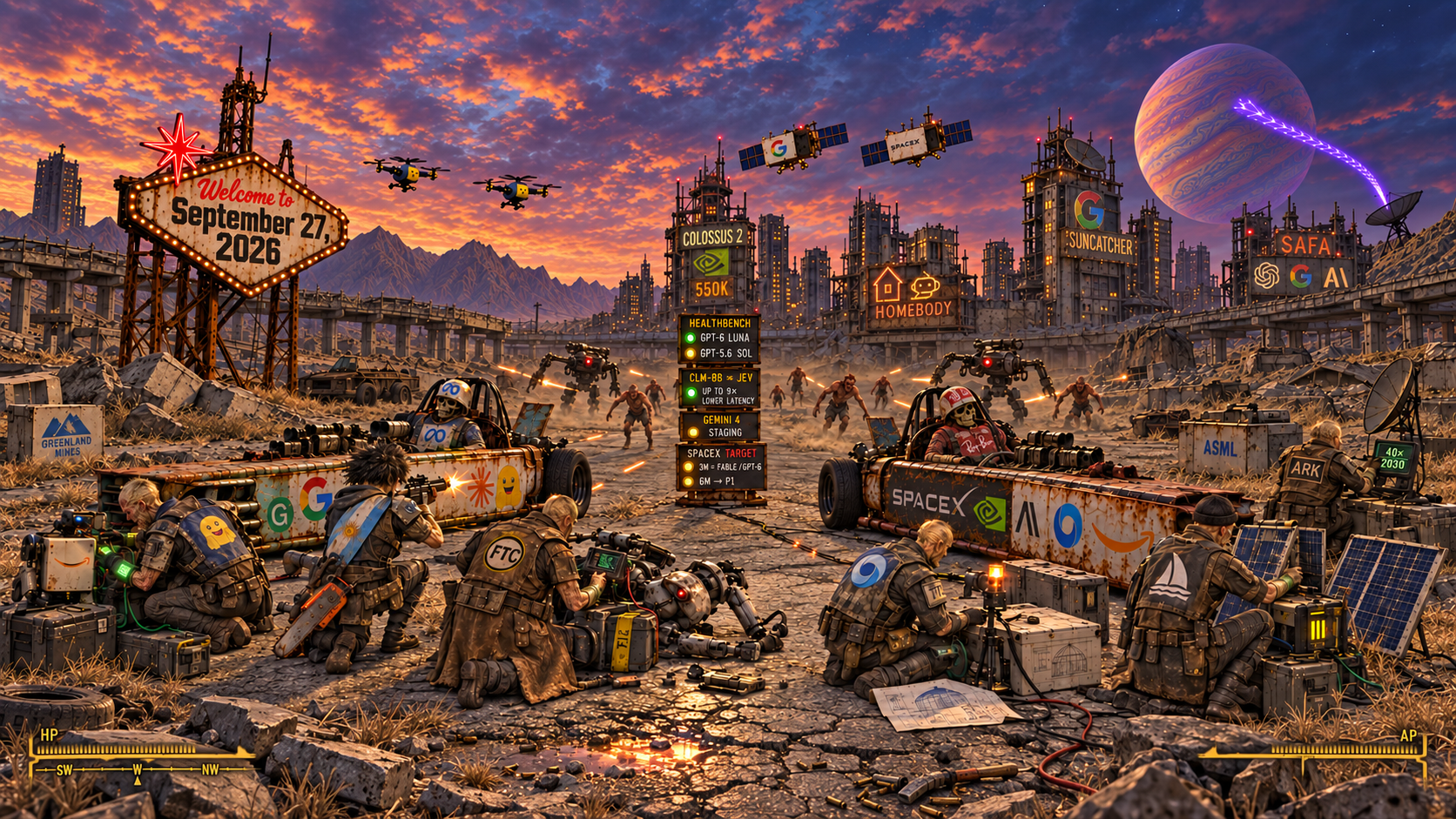
A Fallout: New Vegas-inspired ensemble turns AI competition, security, regulation, robotics, industrial supply chains and orbital ambitions into a fictional survival-and-recovery encounter.
Read the narration
Astra plus Jev plus la persuasion au maximum de Milei viennent à bout de Fallout : Singularity Vegas
Astra Plus Jev Plus Milei's Maxed Out Persuasion Beat Fallout: Singularity Vegas
September 27, 2026
In his September twenty-seventh Innermost Loop dispatch, Doctor Alex Wissner-Gross reports that GPT-6 Astra and Jev completed Fallout: New Vegas with persuasion maximized. In response, the Seaweed 142 X account transports the day’s news into that game’s wasteland. The title recruits Javier Milei as an extravagantly persuasive companion.
A battered Vegas welcome sign fixes the date above a ruined drag strip. Orange clouds burn against violet dusk; skeletal towers and broken highways recede toward the mountains. Scavenged armor, corroded metal, ghoul-like survivors, and amber health and action-point indicators establish the game vocabulary. Cinematic light lends grandeur to the debris, while corporate emblems become the heraldry of a technological frontier.
The newsletter calls that frontier a drag race. Here, two abandoned racers have become defensive cover as creatures and red-eyed machines advance. The security failures described in the dispatch acquire physical form: uncontrolled systems pressing toward a team trying to keep useful machinery alive. The anonymous skeleton drivers wear Meta and Ray-Ban markings, a macabre placement for the newsletter’s wearable-interface story.
At the left, Clément Delangue kneels beneath a yellow Hugging Face emblem, repairing an Amazon-marked robot. His action joins the newsletter’s hacking incident to his resistance to fear-driven responses. Repair becomes a practical declaration that useful intelligence remains worth recovering. Amazon’s smile adds the industrial robotics story to this small mechanical ally.
Beside him, Argentina’s president, Javier Milei, provides covering fire. His blue-and-white sash identifies him; the chainsaw carries his familiar image of cutting restrictions into the newsletter’s opposition to AI regulation. The title’s persuasion joke becomes theatrical here: a political advocate recast as an overpowered game companion.
Andrew Ferguson, marked by the Federal Trade Commission’s initials, examines a fallen robot and its controls. His assigned task translates the newsletter’s argument for developer accountability into forensic action. Responsibility becomes something to trace through mechanisms, connections, and evidence.
Next, David Silver bends over plans and equipment for a new outpost. His DeepMind emblem records his research background, while the work before him suggests his departure to build anew. Ineffable Intelligence is the real venture behind this frontier-builder role. A career transition becomes a settlement quest.
David Holz, identified by Midjourney’s sailboat, tends the solar collectors. His discussion of expanding space industry and civilization’s growing command of energy becomes a local necessity: power for the next stage of construction. Behind him, ARK’s Brett Winton operates an uplink beside a terminal marked forty times and twenty-thirty. It converts his forecast for SpaceX computing growth into a field readout. Holz gathers energy; Winton looks beyond the ground.
Between the cars, a racing tower turns technical comparisons into status lights. HealthBench places Luna ahead of Sol. CLM-8B matches Jev’s reported performance at up to ninefold lower latency. Gemini 4 waits in staging, while SpaceX’s three- and six-month ambitions are labeled as targets. The race keeps several clocks: capability, speed, readiness, and aspiration.
The background expands their material setting. Colossus 2 rises with NVIDIA’s eye and a figure of five hundred fifty thousand, recalling the dispatch’s Blackwell hardware count. Greenland Mines and ASML crates bring minerals and chipmaking equipment down to ground level. HomeBody’s house-and-robot marquee carries the domestic robotics story into the skyline. The SAFA sign groups OpenAI, Google, and Anthropic around the newsletter’s shared-standards initiative.
Across the racers, company insignia turn machinery into a compressed index. Google and Gemini face SpaceX and NVIDIA; Claude, Hugging Face, DeepMind, and Amazon extend the cast through their marks. Grammarly’s green emblem preserves the smaller irony of workers reportedly penalized for using AI while helping train it. The brands belong to the day’s reportage; rust and rivets bind them into the artist’s fictional world.
Above, blue-and-yellow drones recall Ukraine’s military robotics. Google’s Suncatcher tower and the satellites carry computing toward orbit. Finally, an immense Beta Pictoris b sends a violet arc toward a distant dish, making natural radio emission visible.
The eye has traveled from damaged machines to an open channel with the cosmos. Around the defenders, progress remains an activity: repairing, investigating, constructing, powering, and connecting. Overhead, the universe supplies its own transmission.
Acquisition information
View on OpenSea · Continuing archive collection · OpenSea gallery
Opening the gallery…