70 Clock Galerie / Innermost Loop Reply Tableaux
TABLEAU 427
Maison Innermost Loop — Edsger Dijkstra, Sam Altman, Boris Power, Yann LeCun, Donald Trump, Bernie Sanders, Greg Casar, Scott Bessent et Xi Jinping défilent
House Innermost Loop — Edsger Dijkstra, Sam Altman, Boris Power, Yann LeCun, Donald Trump, Bernie Sanders, Greg Casar, Scott Bessent, and Xi Jinping Walk
September 24, 2026
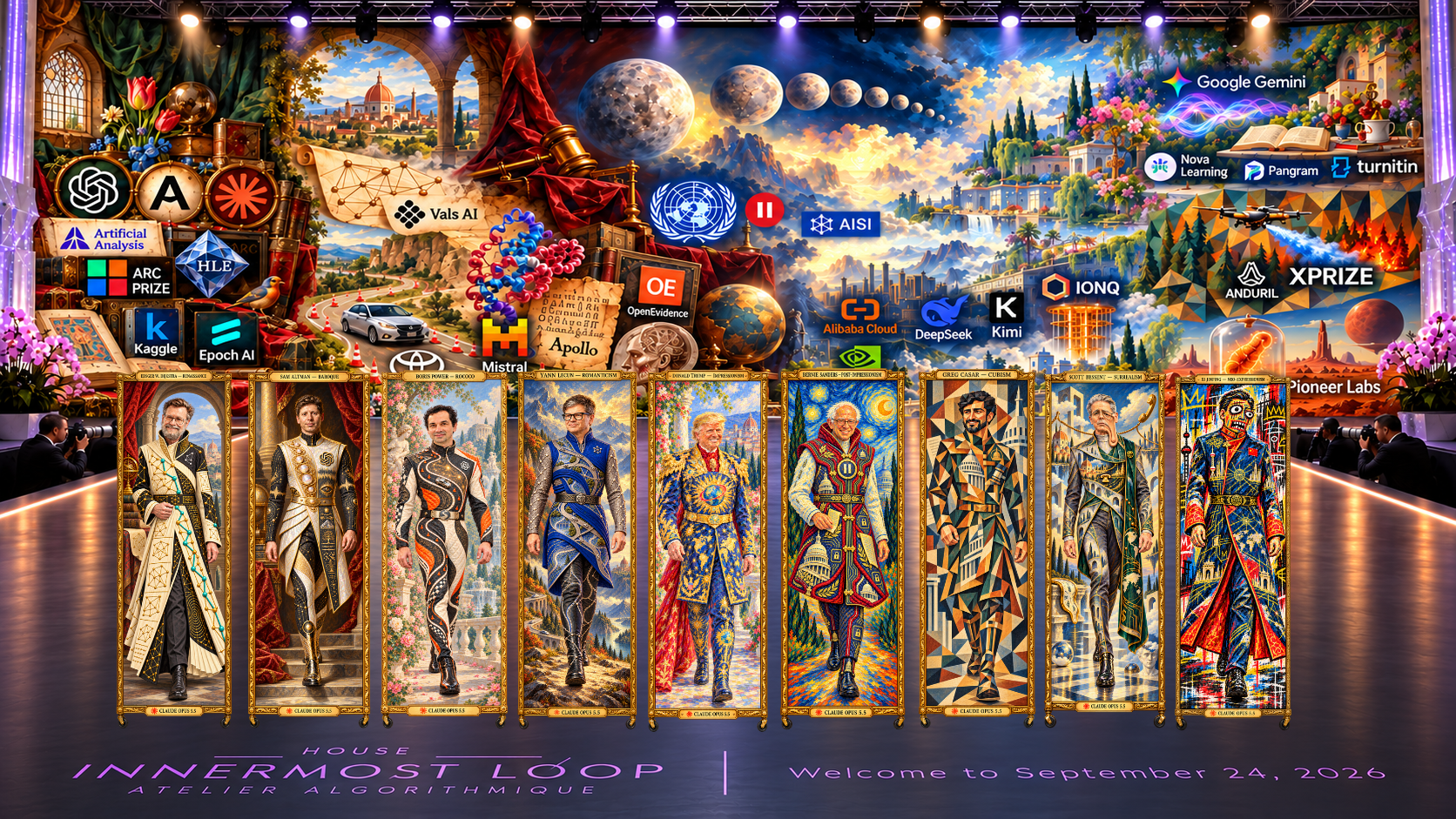
Seaweed 142 combines its established practice of dressing newsletter figures as runway models with framed portraiture, responding to the dispatch’s account of Claude painting like the masters through code. Nine couture portraits progress from Renaissance to Neo-Expressionism, while a continuous painterly panorama gathers the day’s science, companies, institutions and policy debates.
Read the narration
Maison Innermost Loop — Edsger Dijkstra, Sam Altman, Boris Power, Yann LeCun, Donald Trump, Bernie Sanders, Greg Casar, Scott Bessent et Xi Jinping défilent
House Innermost Loop — Edsger Dijkstra, Sam Altman, Boris Power, Yann LeCun, Donald Trump, Bernie Sanders, Greg Casar, Scott Bessent, and Xi Jinping Walk
September 24, 2026
On September twenty-fourth, twenty twenty-six, Doctor Alex Wissner-Gross opened his Innermost Loop dispatch with a technological development that sounded like an aesthetic judgment. Discussing Claude Opus 5.5, he declared, “But the real upgrade is taste.” Among the demonstrations he cited was the ability to “paint like the masters in pure code.” The Seaweed 142 X account responded by combining that painterly invitation with its established House Innermost Loop repertoire: assembling people from a newsletter as runway models whose clothes illustrate the stories that brought them there. For this reply, those models become framed portraits. The familiar fashion procession now walks through the history of painting.
Across the foreground, nine full-length portraits occupy nine frames. Behind them, a vast painted world gathers the dispatch's companies, discoveries, institutions and arguments into a continuous panorama. A runway has become a portable museum. Its models still advance one foot at a time, but each now moves within a different conception of what a picture can be.
The sequence begins with Renaissance order and concludes in the insistent marks of Neo-Expressionism. Between them, bodies pass through the theatrical light of the Baroque, Rococo ornament, Romantic landscape, Impressionist sensation, Post-Impressionist intensity, Cubist construction and Surrealist transformation. This is a selected itinerary through Western painting, with each stop chosen to give a particular news story a visible form.
At the bottom of every frame, the orange Claude emblem and the words Claude Opus 5.5 repeat like a refrain. They identify the technological occasion for this homage. Above, the name of the sitter and the name of the movement establish a different partnership: a contemporary argument entrusted to a historical way of seeing. Gold, warm light and the shared scale of the frames hold the procession together as its visual rules progressively change.
The first figure is Edsger Dijkstra, the computer scientist whose name has become inseparable from finding shortest paths through networks. His presence is a meeting between mathematical inheritance and a reported new algorithmic result. Vals AI described Claude agents developing an improvement in a specified class of shortest-path problems, with a formal proof checked in Lean. Its theoretical advantage concerns how computational work grows as problems become large; practical superiority over familiar methods still requires separate demonstration.
Dijkstra's Renaissance portrait makes that abstract distinction tangible. His long ivory-and-black coat resembles a scholar's manuscript unfolded around the body. Golden rods connect round nodes across the chest and sleeves. A turquoise line selects a route through them, descending along the garment as though the eye itself were executing a search. The gold supplies the network of possibilities; the colored path gives a decision direction.
Parchment-like panels hang beside dark embroidered sections. Their small diagrams and writing contribute the texture of mathematical thought, while the high collar and ordered silhouette give the scholar ceremonial presence. Behind him, an arch opens onto a sunlit city with a Renaissance dome. Books, drapery and an astronomical instrument establish a chamber in which knowledge can be collected, measured and placed in relation. The clear architectural depth suits an algorithm that makes a complicated field navigable. Before this procession begins to fracture the visible world, Dijkstra offers a way through it.
Sam Altman follows in the language of the Baroque. The newsletter places him within OpenAI's ambition to offer powerful models at different price points. His portrait translates a model portfolio into courtly regalia. Ivory and pearlescent panels fall over black clothing; gold borders articulate the torso; polished boots complete a figure poised between ceremonial dress and technological armor.
The OpenAI knot occupies the chest. Pearl-like spheres held in golden settings suggest a family of capabilities, while waveforms and an eye motif bring sound and sight into the same ensemble. Networks continue onto the trousers, so that computation seems to circulate through the entire costume. The body becomes an instrument of several senses.
Crimson curtains and a monumental column place him within a theater of patronage. Light catches the pale surfaces and gold fittings, allowing them to emerge emphatically from darkness. Baroque painting lends this technological figure its language of concentration: attention, wealth and authority gathered around a luminous center. The garment turns an assortment of services into the coherent display of a court portrait.
Boris Power of OpenAI steps into a much lighter atmosphere. His Rococo garden is filled with flowers, pale architecture and decorative curves. Through it walks a figure in a black, cream and orange racing suit, carrying an entire driving course on his body.
A small silver car sits high on the garment. A winding road crosses the torso and continues down the legs, accompanied by lane markings, traffic cones and checkered strips. The design follows the seams rather than sitting on the chest as a detached illustration. Navigation becomes tailoring. Its curves answer the curling foliage and shell-like ornament of the frame.
Power appears because of his response to DrivingBench, in which general-purpose models were tested at controlling a real Toyota Corolla. The experiment used a closed cone course with a safety driver. Power took the result as an argument for generalist systems, and the portrait gives that enthusiasm an exuberant vehicle. A tightly controlled evaluation has entered the decorative world of an eighteenth-century pleasure garden. The orange of the cones becomes a fashion accent; the test route becomes an elegant promenade.
Beside him, Yann LeCun opens the scene into Romantic space. A mountainous landscape, an elevated road, clouds and distant architecture surround a solitary figure. Where Power's costume celebrates a particular course, LeCun's blue tunic appears to contain a world.
Silver bands spiral across royal-blue cloth. Between them lie landscapes, roads and miniature routes of travel. Network marks extend over the sleeves and trousers, binding the body to the terrain it carries. The same problem exists at two scales: an immense environment behind the thinker, and a modeled environment folded into his clothes.
The newsletter invokes LeCun's ideas through someone else's commentary on general models and physical understanding, rather than quoting his response to the driving test. His portrait stages the underlying question: what must an intelligence understand about the world in order to act within it?
Romanticism makes that question spatial. The human figure faces an environment larger than his immediate command. Roads promise passage, but mountains and atmospheric distance preserve the world's complexity. The sublime landscape lends intellectual disagreement a scale that a benchmark score alone cannot convey.
Donald Trump occupies the fifth position, at the center of the nine portraits, as the procession reaches Impressionism. His inclusion follows the United Nations speech in which he used the phrase “super intelligence” and opposed global control of AI. A globe therefore sits at the center of his chest, surrounded by radiating gold.
The blue costume carries eagle-like shoulder ornaments, small American flags and repeated terrestrial motifs. A crimson train sweeps behind him. His conspicuously abundant blond hair continues the artist's recurring use of the flamboyant, AI-amplified hairstyle seen in social-media caricature. Both hair and train enlarge the performance of the figure.
Here, however, the apparatus of political display has become a field of colored touches. Gold flickers into yellows and oranges. Face, hands, flowers and embroidered surfaces share the same broken light. The eye assembles the figure from these marks, just as it assembles the garden around him. A world-scale claim of authority is held within a momentary visual impression. The portrait's brilliance is inseparable from the way its surfaces dissolve under close attention.
Bernie Sanders carries the next transformation into Post-Impressionism. His white hair and glasses remain familiar, but thick directional strokes sweep through the face, sleeves and surrounding sky. Deep blue, red, cream and gold establish an emphatic rhythm. Luminous circles turn above cypress-like trees, recalling the restless energy of Van Gogh's landscapes.
At the center of this agitated world sits the simplest possible request for stillness: a pause symbol. Two vertical bars occupy a circular medallion on Sanders's chest. Capitol domes, padlocks, circuitry and documents repeat across the substantial coat. Each contributes a part of the legislative story. The dome locates authority, the document proposes rules, the lock restricts access, and the pause interrupts motion.
Sanders and Representative Greg Casar had introduced legislation proposing a prohibition on artificial superintelligence, a pause in advanced development and a new federal regulatory structure. The clothes translate that proposed program into ornaments that can be read without deciphering a bill. Around them, the paint continues to surge. That friction gives the portrait its force: the sign requests suspension while the whole pictorial world seems unable to stand still.
Casar, immediately to the right, carries the same legislative story into Cubism. Green, brown, ochre, copper and cream break the body into intersecting planes. His face, hands and forward step undergo the same reconstruction as the coat. Architecture enters the figure, and the figure becomes part of architecture.
Capitol domes and governmental fragments recur across the chest and surrounding space. Paper-like shapes and an instrument of judgment join them. The original couture silhouette survives, but its surface has become an assembly of institutional parts. One can move from a shoulder into a facade, from a sleeve into a document, without crossing a stable boundary.
This is an especially apt transition between two legislators sharing a proposal. Sanders's portrait concentrates conviction in the pressure of the brushstroke. Casar's concentrates on construction: how a public program acquires form through buildings, offices, laws and people. Even the frame participates, exchanging curling ornament for angular corners. Legislative power becomes something assembled, seen through several aspects at once.
Treasury Secretary Scott Bessent then steps into a world whose surfaces appear convincing until they begin to behave impossibly. Surrealism retains the precision of architecture, tailoring and light, while allowing a telephone to bridge cities and a face to soften into a fold.
His graphite, silver, jade and gold clothing contains arches, towers and urban scenes. A green stole carries globes and connecting paths. The garment seems to become habitable, as if the institutions it represents have acquired rooms inside the body. A golden telephone at the chest provides the clearest connection to the news: discussion of communication between the United States and China concerning AI incidents.
The dispatch also drew on reporting that Bessent might take a leading AI-policy role. That prospect remained disputed and unconfirmed, which makes the portrait's uncertain architecture particularly suggestive. This is an official pictured within possibilities still taking shape.
A suspended telephone receiver occupies the sky. A soft clock disrupts the apparent solidity of the setting. The distortion reaches his cheek and jaw, drawn downward beside the collar in a Dalí-like treatment. Human anatomy now follows the same dream logic as policy's elaborate stage. The telephone remains an intelligible promise of connection, even when the spaces it would connect refuse to stay fixed.
At the far right, Xi Jinping closes the sequence in Neo-Expressionism. The earlier portrait's calm claim to resemblance gives way to oversized unequal eyes, emphatic black outlines and an angular mouth. Red, blue, yellow, white and black collide across face, garment and background.
The high-collared navy costume retains red linings, a Chinese flag badge and a name belt. Golden routes connect city-like towers and globes across the body, linking the portrait to the prospective Trump–Xi encounter and the wider contest over technological systems. Yet those routes now read as urgent strokes. The red lining opens into sharp wedges around the advancing leg. Connectivity has become a restless graphic activity.
Crown motifs, grids and scratched signs recall a Basquiat-inflected language of power and public marks. The frame itself looks darkened and abraded. The sitter has been translated into the same charged paint as the world around him. This deliberate distortion gives the final image its expressive pressure; it is a property of the portrait's construction.
Looking back across the row reveals the full journey. Dijkstra began in ordered space, with a recoverable path through a network. By the end, networks, cities, anatomy and emblems compete within one insistent field. Between those points, the series has repeatedly changed what it means to make a person visible. The garments preserve the day's information even as the painting transforms the form in which that information can be understood.
Above the frames, the same experiment unfolds on the scale of a world. At the far left, warm light enters through an arched window. Books, flowers, fruit, pearls, a globe and decorated containers gather in a dark scholar's room. The close attention to surfaces recalls a Northern European still life. Knowledge has weight here. It can be bound, polished, inherited and placed on a shelf.
Among these treasures sit three large medallions: OpenAI's knot, an A representing Anthropic, and Claude's orange starburst. Corporate marks have entered the place once occupied by portraits and prized objects. Their circular forms make them look like collected emblems of a new intellectual patronage.
Below them, Artificial Analysis identifies comparative model evaluation. ARC Prize and the small Kaggle mark recall the dispatch's report of progress toward a demanding reasoning prize. The jewel labeled HLE makes a visual pun of HLE-Diamond, the refined edition of Humanity's Last Exam. A difficult test has become a precious stone among books and pearls. Nearby, Epoch AI introduces another measure of value: the falling cost of achieving a given level of capability.
These signs ask different questions within the same cabinet. What can a system do? Can it generalize? How difficult is the examination? What does the performance cost? The still life places those contemporary measurements within a much older practice of displaying intellectual wealth. A little bird perched among the books adds living movement to the collection. Flowers and fruit bring organic time into a setting devoted to preserving achievement.
The pink orchids below this arrangement give the composition a more personal reference. They recall the flowers associated with Wissner-Gross's podcast appearances. He is present in the reply through that homage, through the Innermost Loop identity and through the date of the dispatch. The orchid offers a small, recognizable human association within a world increasingly articulated by institutional marks.
Beyond the chamber, a parchment carrying the Vals AI name opens across the landscape. Its gold network repeats Dijkstra's clothing at a larger scale. The algorithmic story passes from a wearable manuscript into a public diagram. Behind it, an orange-red dome and ordered city streets connect contemporary reasoning with the spatial confidence of the Renaissance.
Below, the Toyota Corolla and the DrivingBench label return us to the test that links Power and LeCun. Orange cones mark the winding road. The route travels through the painted hills, allowing the eye to experience navigation before it considers the argument about navigation. The car's modern familiarity, placed within this historical-looking landscape, makes the anachronism purposeful. The present is traveling through an inherited representation of space.
A large red, blue and purple protein ribbon rises nearby. Its loops and folds translate the dispatch's biological research into a sculptural form. Anthropic reported that hundreds of Claude agents examined a vast collection of reverse-transcriptase sequences and identified an unusual enzyme-associated system. Its biological function still required investigation. The image gathers that exploratory achievement into the familiar visual language of molecular ribbons.
Those ribbons also resemble fabric. Their folds answer the garments below, bringing molecular structure into the same ornamental conversation as couture. A discovery in sequence data becomes something the eye can follow around a curve.
Beside it, an aged fragment bearing Apollo and Greek-looking writing introduces the recovery of ancient language. This Apollo is an Ancient Greek language-model project developed through a collaboration involving the Austrian Academy of Sciences, Mistral and SAIL Reply. Its suggestions help scholars consider missing portions of damaged texts. The Mistral mark locates that computational partnership within the still life.
The parchment is particularly well placed in an artwork reviving earlier painting traditions. One system helps reconstruct a damaged textual inheritance; the reply reconstructs historical ways of making a world visible. In both cases, continuity depends on interpretation. The gap in a manuscript and the distance between artistic periods invite informed acts of reconstruction.
The OpenEvidence panel, a classical or anatomical head and a terrestrial globe bring this learned interior toward medicine. Their connection is the reported collaboration with Anthropic to broaden access to clinical AI in lower-income countries. The head gives knowledge a bodily subject; the globe gives distribution a geography. Books and golden links connect the two, making the reach of medical information part of the room's intellectual wealth.
Near the upper center, a large gold gavel emerges from crimson drapery. The United Nations emblem, a pause symbol and the initials of the United Kingdom's AI Security Institute place authority within the same panorama. The newsletter's debates over human control, international oversight and institutional strain become emblems arranged with almost Baroque theatricality.
The gavel appears heavy enough to arrest the picture, but clouds and mountains continue beyond it. Its surrounding movement supplies a visual setting for the question repeated through the political portraits: how can institutions give stable form to capabilities that keep changing? The red folds concentrate attention on the machinery of decision while refusing to seal that machinery off from the world it would regulate.
Across the sky, Mercury diminishes through a procession of smaller planetary bodies. This recalls the scientific item that furnished Wissner-Gross's own header tableau for the day. Here, the laughing cartoon planet has been translated into a grand celestial passage. Cratered spheres recede through luminous cloud, turning contraction into a repeated arc that guides the eye across the background.
The underlying science concerns gradual planetary cooling and the evidence it leaves in Mercury's crust. The painting exaggerates that contraction into a visible rhythm. Its enormous timescale hovers above announcements measured in days and product releases measured in decimal points. The same panorama accommodates a fleeting news cycle and a planet's long material history.
Below that sky, the cloud acquires a second meaning. Alibaba Cloud appears over a built landscape of towers and waterways, connecting to the company's infrastructure expansion. NVIDIA's emblem recalls the hardware enabling new concentrations of computation, including the Armenian development discussed in the dispatch. The dam-like structure and cascading water make the physical demands of that computation visible: energy, cooling, construction and place.
DeepSeek's whale and Kimi's bold letter introduce the Chinese model ecosystem. Kimi belongs to Moonshot AI; both Moonshot and DeepSeek appear in the issue's reporting on an investigation into alleged data routing to Claude. Their position among the city and infrastructure imagery connects model competition with national policy and the movement of information across institutional boundaries. The investigative context remains reporting about allegations.
This landscape gives a useful body to a word as airy as cloud. Computation rises on foundations, crosses borders and consumes resources. Its golden city has the atmospheric grandeur of a Romantic prospect, but the identifiable logos keep the view attached to contemporary industrial decisions.
IonQ contributes a suspended golden apparatus nearby, almost a technological chandelier. It refers to a result in quantum error decoding: the classical computation needed to interpret evidence of errors and help guide correction. IonQ's reported software demonstration used a conventional processor and simulated quantum circuits. The luminous object gives that largely invisible computational task an ornamental presence within the landscape.
Praxis appears amid terraces, gardens, bridges and blue-roofed buildings. Its connection is a proposed community in Uruguay for a society transformed by AI. The image gives that proposed future the sensory fullness of a sunlit inhabited place. Water sparkles; flowers break into bright touches; buildings emerge through greenery. The promise of an economy becomes a prospect one can almost enter. In this part of the panorama, the question is what technological abundance might look like as a setting for everyday life.
At the upper right, Google Gemini presides over waves of violet, pink and blue light. An open book and ordinary study objects sit beneath them. The waves refer to the speech-generation release described in the dispatch, making the passage from written language to synthetic voice visible as a luminous flow.
Around that study space, Nova Learning connects to the reported shift of student interest from computer science toward engineering. Pangram and Turnitin bring in the difficulties of evaluating student writing when AI assistance is readily available. The book now occupies a complicated position: an object of learning, a source for machines, and a surface on which human authorship may become harder to assess.
This scene answers the scholar's chamber at the opposite end of the composition. There, knowledge accumulated in manuscripts, books and instruments. Here, writing can be generated, examined and transformed into speech. The cup and flowers preserve the intimacy of a working table. A civilization-scale change reaches the ordinary place where someone sits down to read.
Immediately below, the landscape breaks into angular planes. A drone passes over faceted trees and directs a pale spray toward orange fire. Anduril and XPRIZE identify the autonomous wildfire-response story, in which Anduril took first place in the competition's autonomous track. Detection and suppression are condensed into one legible intervention.
The Cubist treatment gives forest, machine and fire a common construction. Each becomes an interacting shape within the same problem. This is a different use of the visual language seen in Casar's portrait: there it assembled legislative authority; here it organizes a system acting upon a physical emergency. The shared style allows the viewer to compare institutional action and technical action without making them identical.
At the lower right, earthly gardens yield to rusty terrain, rock spires, pale domes and an organism glowing beneath glass. NASA and Pioneer Labs identify two separate stories brought together through the expanded conditions under which life might function. NASA-supported research concerns a heat-tolerant amoeba. Pioneer Labs concerns an engineered microbe intended to help produce materials in protected systems for future Mars habitation.
The bell jar preserves the idea of an experimental environment, while the domes extend that experiment toward the possibility of settlement. A reddish world suspended above an improbable support makes the scene openly Surrealist. The glowing organism is a symbolic presence, concentrating life, heat and transformation into a single visual ember.
The panorama has traveled from an old scholar's room to the imagination of life beyond Earth. Its course has been carried by roads, folds, rivers, clouds and recurring architectural forms. Every transition gives information another material: proof becomes parchment, a driving test becomes a road, a protein becomes a ribbon, governance becomes drapery and a gavel, speech becomes light, and a proposed future becomes a landscape.
Across the foreground, the nine portraits perform the same operation at the scale of a body. Dijkstra wears the route. Altman wears a repertoire of capabilities. Power wears the test. LeCun wears the world to be understood. Trump wears the globe. Sanders wears the pause. Casar wears the machinery of law. Bessent wears the possibility of communication. Xi wears the connected city, recast as an urgent field of signs.
The lavender House Innermost Loop inscription anchors all of this abundance to a particular place in the archive. Atelier Algorithmique names the imagined workshop; September twenty-fourth, twenty twenty-six names the day whose reportage supplied its materials. The pictorial centuries remain distinct, yet the dated floor gathers them into one encounter.
What, then, does taste mean within this reply? It emerges in the choice of what to preserve as a story changes form: the turquoise route through Dijkstra's gold network, the pause at the center of Sanders's restless sky, the telephone surviving Bessent's impossible architecture. Each makes an argument through placement, color, rhythm and association.
The newsletter offered a claim about a model's capacity to emulate painters. House Innermost Loop develops that occasion into a curatorial act. It selects, dresses, arranges and interprets. One day's accelerating information receives the duration of a guided viewing. The figures walk through painting's remembered languages, and the passing feed acquires the form of an illuminated chronicle.
Acquisition information
View on OpenSea ↗ · Continuing archive collection · OpenSea gallery
Opening the gallery…