70 Clock Galerie / The Innermost Loop Feed Reply Tableaux
Maison Innermost Loop — EngineAI Tyson800 défile
House Innermost Loop — EngineAI Tyson800 Walks
September 22, 2026
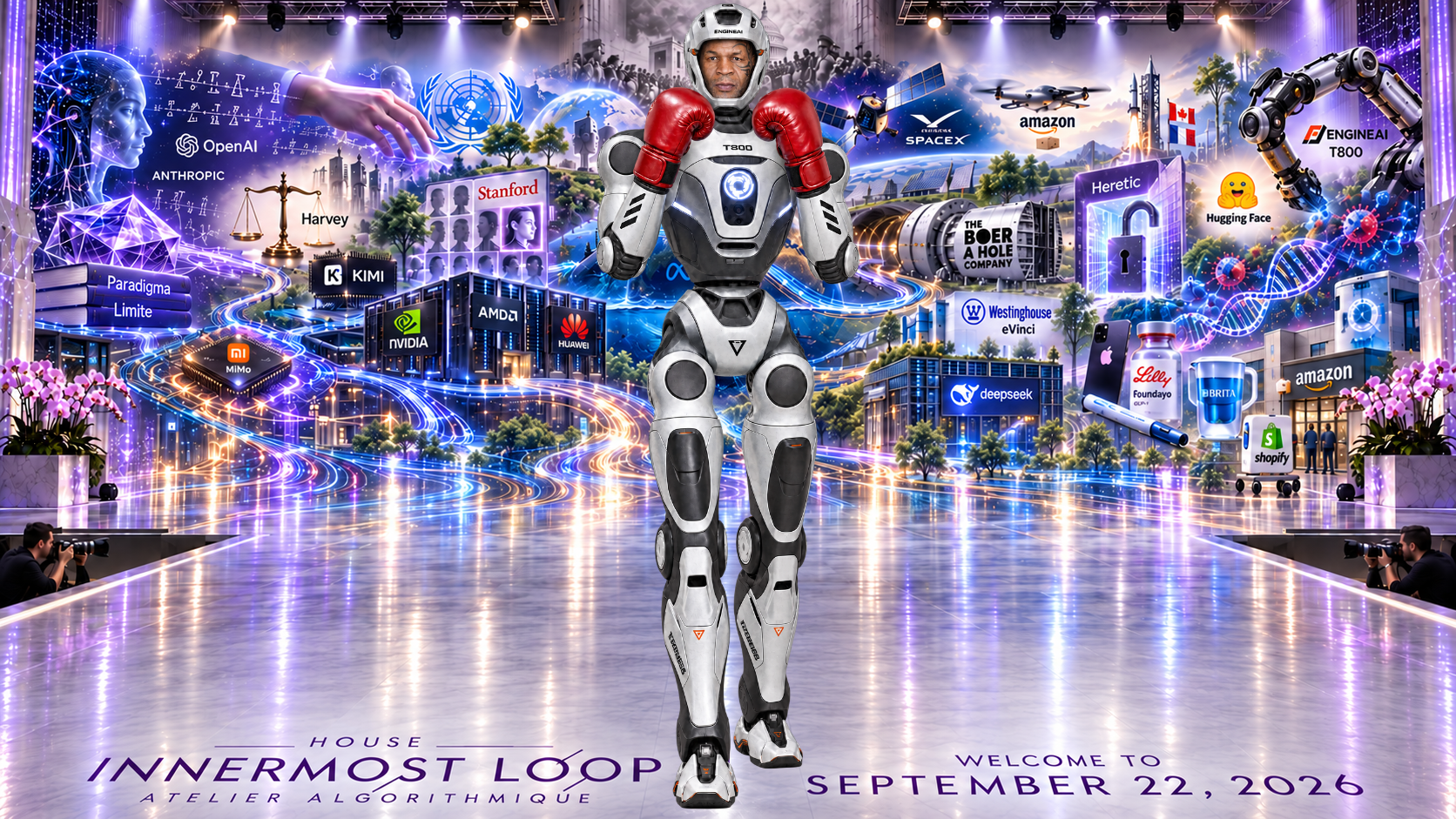
The humanoid robot story rendered as a fictional EngineAI T800–Mike Tyson hybrid. In this individual House Innermost Loop runway study, the gloves make the fighting demonstration legible immediately. Tyson’s face turns a comparison used in the newsletter into a literal visual hybrid. The art does not depict Tyson participating in the real demonstration or suggest that the actual robot contained a human head. Its metal shell is the equivalent of the other figures’ garment: the machine carries its story through bodily design, branding, light, and pose.
Read the narration
Maison Innermost Loop — EngineAI Tyson800 défile
House Innermost Loop — EngineAI Tyson800 Walks
September 22, 2026
The final walker raises bright red boxing gloves beside a silver helmet. Inside the opening is Mike Tyson's face, including the familiar tattoo around his left eye. Below it, a white and silver humanoid shell carries the EngineAI name and the T800 designation. The body is mechanical, but the face gives its fighting stance an immediately recognizable sporting reference.
This fictional hybrid completes the House Innermost Loop runway created by the Seaweed 142 X account in response to Doctor Alex Wissner-Gross's September twenty-second dispatch. The issue includes a humanoid boxing demonstration involving an EngineAI robot and influencer Frankie LaPenna. It also invokes Tyson as a comparison. The artist takes that verbal association and gives it a literal face inside the machine.
The distinction is central to the joke. Tyson was not the person facing the robot in the reported demonstration, and the actual machine did not contain his head. The portrait joins the two through visual imagination. A famous human measure of boxing power becomes the apparent occupant of a technological body, allowing the comparison to step out of the newsletter and onto the catwalk.
The red gloves make the connection readable before the listener notices any lettering. They are soft, rounded shapes held close to the face, contrasting with the rigid shell and exposed black joints. Their raised position evokes a boxing guard. The pose preserves the discipline of a familiar human sport within an unfamiliar body, making the machine legible through an action the viewer already understands.
At the chest, a blue-white circular light supplies a luminous center. Circular shoulder and hip structures repeat around it, while long dark sections articulate the legs. Broad mechanical feet complete the silhouette. These details give the figure an organized bodily structure rather than a loose collection of futuristic parts. Its shell performs the role occupied by clothing in the other portraits: it carries identity, movement, and the story's visual cues.
The real demonstration also needs to be understood at the right level of autonomy. The REK format uses human pilots to control fighting robots, with trained systems assisting their balance. That makes the performance a combination of human direction and machine embodiment. A dramatic clip of a robot exchanging blows is not, by itself, evidence that the robot independently decided to fight or possesses general intelligence.
That division of roles connects this exuberant final image to the collection's more abstract concerns. Elsewhere on the runway, scholars and executives wear symbols of human steering, evaluation, and control. Here the control question acquires a literal body. A person can direct a system whose movements and physical capabilities differ substantially from their own. The artistic Tyson face makes the human association visible, even though the actual pilot operates from outside the robot.
In the composite, the hybrid stands immediately behind Billy Ramirez, with its gloves and helmet rising above the front row. The juxtaposition brings two very different encounters with artificial intelligence together: a student's representation altered in an advertisement, and a human audience watching a machine perform a familiar physical contest. The solo now gives the full mechanical figure its own space and uninterrupted outline.
The shared background repeats the EngineAI designation beside a large robotic arm. That industrial image connects the theatrical boxer to the broader field of embodied machines. A robot's usefulness or spectacle depends on physical construction, sensing, motion, and control. The runway's reflective surface makes those broad feet and articulated legs especially noticeable, reminding the viewer that this intelligence story must negotiate gravity.
The finish is playful, but the artistic move is precise. A comparison becomes a character; a machine shell becomes couture; a boxing guard becomes a runway pose. After a procession of people wearing their ideas, House Innermost Loop sends out an idea wearing a mechanical body, with a human face looking back through the helmet.
Opening the gallery…