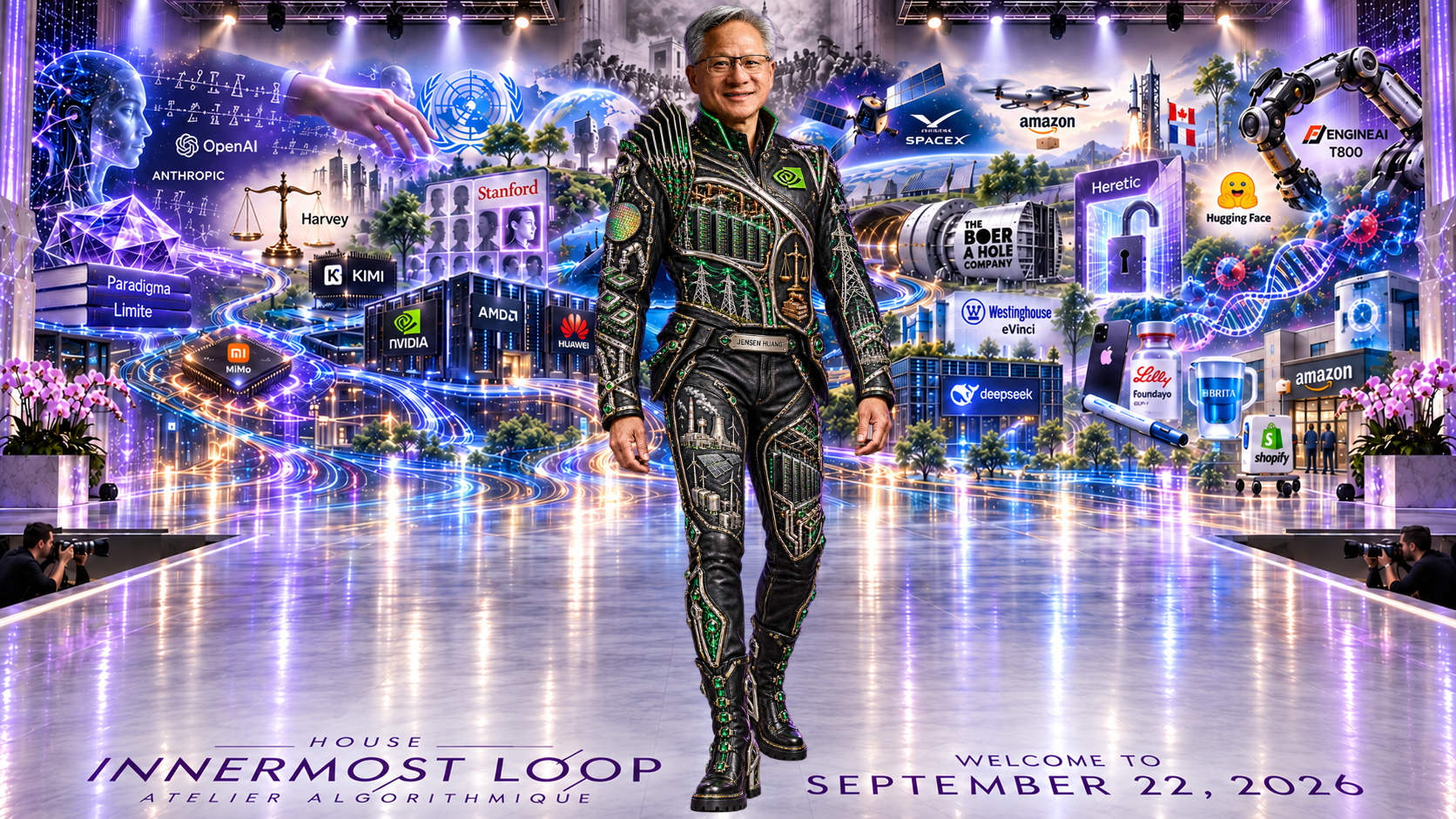
NVIDIA CEO; the issue links his comments on existing laws and AI, alongside the infrastructure and power story. In this individual House Innermost Loop runway study, the garment brings computing hardware and its physical support systems together. Servers are given visible space; pylons and plant structures prevent AI from being represented only as a disembodied glow. The scale and books refer to Huang’s publicly stated view that existing laws should be applied to AI companies. Describing those symbols records his position without adopting it. The shoulder fins are a visual cooling/hardware association, not an identified component model.
Read the narration
Maison Innermost Loop — Jensen Huang défile
House Innermost Loop — Jensen Huang Walks
September 22, 2026
Jensen Huang's familiar association with black leather becomes an entire technological suit. Emerald light traces its seams, gold lines connect raised components, and the NVIDIA eye sits high on his chest. Miniature server racks occupy the torso and thigh. The outfit gives artificial intelligence the weight of equipment that must be built, powered, and maintained.
This solo portrait expands Huang's place in the House Innermost Loop runway created by the Seaweed 142 X account in response to Doctor Alex Wissner-Gross's September twenty-second dispatch. The issue brings NVIDIA's chief executive into two closely related stories: the physical infrastructure supporting artificial intelligence and the debate over how its companies should be held responsible for their products.
The server racks make the first connection immediate. Instead of using a generic glow to signify computing, the costume presents repeated cabinets with narrow internal divisions. They read as places where work occurs. Their repetition suggests scale, but the surrounding cables and electrical forms remind us that adding equipment also adds dependencies.
Power pylons cross the waist and sleeve, while industrial structures appear along a trouser leg. These motifs widen the portrait beyond the chip. A processor's capabilities have practical value only within a system capable of supplying electricity, removing heat, moving information, and keeping operations reliable. The garment turns that supporting world into ornament, giving normally hidden infrastructure a prominent public surface.
A row of fin-like pieces rises from one shoulder. They evoke cooling hardware without identifying a particular engineering component. Their sharp outline contrasts with the soft folds associated with leather, creating a hybrid silhouette between a tailored suit and a machine enclosure. The same exchange continues through chip-like tiles, iridescent discs, and bright connectors along the arms.
The legal imagery is equally deliberate. A gold balance scale sits above a small stack of book-like blocks on the torso. In the interview discussed by the newsletter, Huang argues that existing laws and responsibilities should be applied to artificial intelligence companies. The symbols record that position. They do not establish, by themselves, that current law resolves every question raised by new capabilities.
The proximity of scales and servers makes the portrait more interesting than a simple celebration of hardware. Production and responsibility occupy the same suit. The systems that generate revenue and useful services also create obligations concerning what they do. The artist turns those obligations into objects close enough to the body to be carried rather than left in an abstract policy landscape.
The color scheme makes the affiliation unmistakable while keeping the garment coherent. Green lights recall NVIDIA's visual identity; black leather supplies the personal reference; gold highlights organize the detailed machinery. Heavy lace-up boots continue the electrical accents to the floor. The result suggests a person walking with the industrial network attached to him, each step returning the technological image to physical support.
Behind Huang, the larger panorama shows other hardware and model companies alongside energy infrastructure. That background prevents the miniature racks from appearing self-sufficient. Computation belongs to an extensive arrangement of suppliers, networks, facilities, and public systems. The suit selects some of those relationships and compresses them into a form that can be examined at a glance, then explored in detail.
In the ensemble, Huang stands among executives who emphasize evaluation and pacing, and officials who debate liability. His individual walk makes his contribution distinct. The garment's subject is the passage from impressive capability to an operating industry, with its requirements and responsibilities exposed. House Innermost Loop gives the machinery a visible body, and places a set of scales beside its beating electrical heart.