70 Clock Galerie / The Innermost Loop Feed Reply Tableaux
Maison Innermost Loop — Dario Amodei défile
House Innermost Loop — Dario Amodei Walks
September 22, 2026
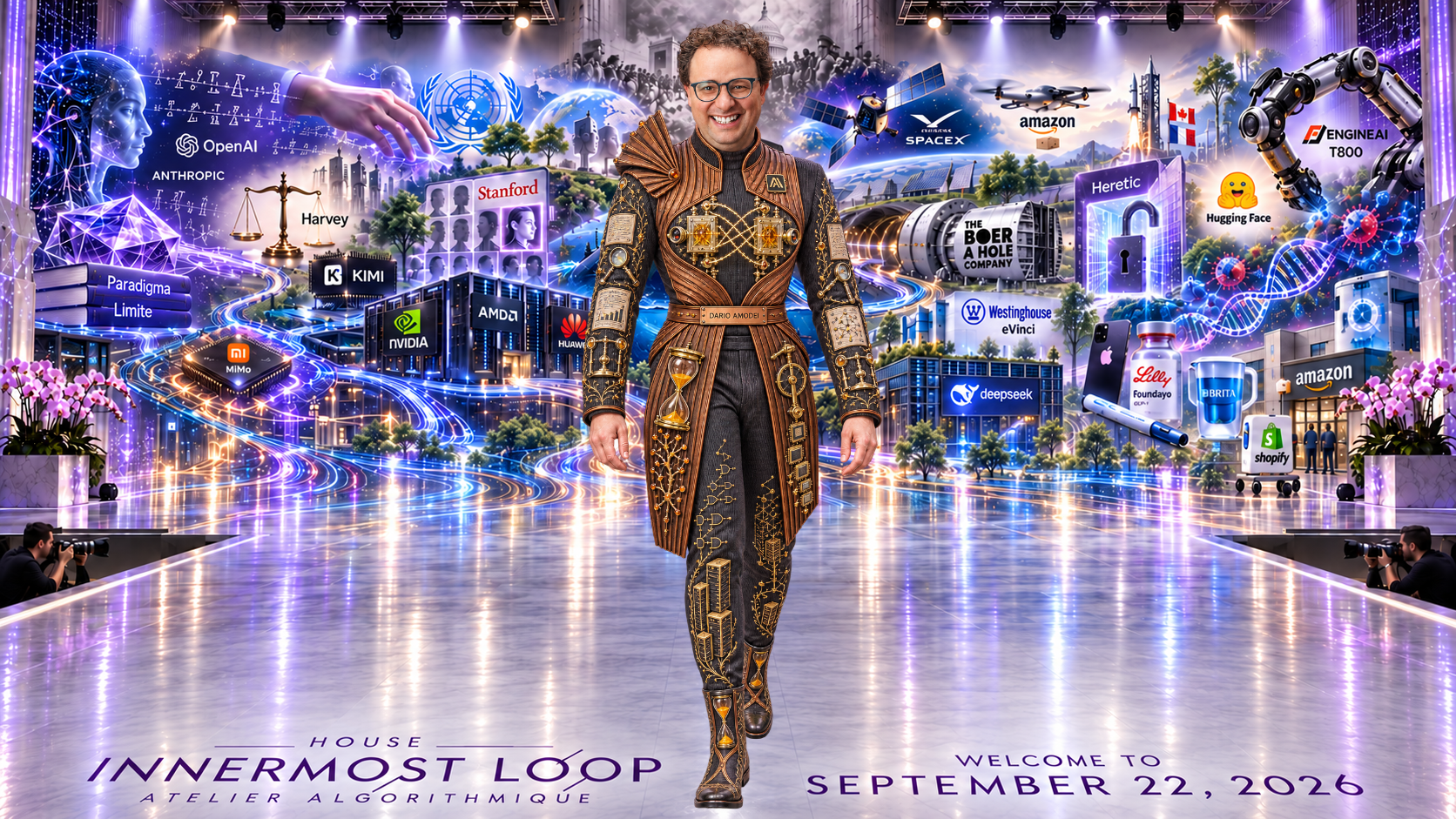
Anthropic CEO whose pacing argument is discussed in the issue and in Loh’s linked essay. In this individual House Innermost Loop runway study, hourglasses make time explicit. The paired chest structures and connecting lines can be read as a visual suggestion of testing or comparing systems, while written panels and measuring instruments support the evaluation theme. Copper ribs and a controlled vertical silhouette give this entry a mechanical character distinct from Altman’s flowing silver bands. The garment illustrates the pacing debate as a subject; it does not prove the motives of any participant.
Read the narration
Maison Innermost Loop — Dario Amodei défile
House Innermost Loop — Dario Amodei Walks
September 22, 2026
Dario Amodei appears in copper, bronze, and black, with a fan of layered metal-like forms rising from one shoulder. Ribbed panels frame his torso, two illuminated chambers face one another across his chest, and amber hourglasses recur along the coat and boots. Time is the most persistent ornament in the portrait.
This individual walk develops Amodei's place in the House Innermost Loop ensemble made by the Seaweed 142 X account in response to Doctor Alex Wissner-Gross's September twenty-second dispatch. He appears as Anthropic's chief executive and the author of a prominent argument for pacing frontier artificial intelligence. His proposal is one of the positions around which the newsletter organizes its debate about accelerating capability.
In that argument, pacing means allowing enough time for safeguards, alignment work, and outside evaluation to keep up with more powerful systems. Amodei describes a program involving embedded third-party evaluators and wider coordination. Those are his proposed responses to risk. The artwork gives that position a material vocabulary without asking the listener to infer a hidden motive from the costume.
The largest hourglass hangs beside the thigh, where a long panel moves with the stride. Smaller versions appear near the feet. Their repetition makes duration accompany every step. Unlike a clock that measures one passing instant, an hourglass also displays an interval and its remaining quantity. It is therefore an economical image for a debate about whether enough time is being reserved for particular kinds of work.
The paired chambers on the chest extend the theme from time to comparison. Golden lines cross between them, enclosing what looks like a small experimental apparatus. In the context of the dispatch, they can suggest systems being examined against one another and the prospect of mutual testing. They remain the artist's construction, rather than a picture of an Anthropic laboratory or evidence that a reported testing arrangement has been completed.
Document-like panels run down the sleeves. Charts, diagrams, and measuring forms place the apparatus within a culture of recording results. The costume's mechanical richness makes evaluation appear laborious and specific. The hourglasses gain meaning from that surrounding work: time has a purpose when it is used to investigate, measure, and improve something.
On the trousers, logic-gate shapes and branching circuits descend toward miniature server towers. These details keep Amodei connected to the process whose pace he is discussing. The portrait includes both the construction of capable systems and concern about their development. Its copper ribs join those subjects within one silhouette, rather than separating the evaluator from the machinery altogether.
The materials distinguish this walk from Sam Altman's neighboring portrait. Altman's silver bands flow across purple fabric; Amodei's bronze framework emphasizes vertical lines, joints, and contained compartments. Both garments concern directing advanced systems, but the differing visual rhythms let them articulate separate positions. One gathers the eye around a hand and wheel. The other repeatedly returns it to the passage of time.
Wissner-Gross's dispatch challenges the pacing position and stresses the benefits that restraint might postpone. The shared runway preserves that disagreement. A figure can occupy the house's luminous world while advancing a different view of how that world's capabilities should develop. The artist's task is to make the position visible, and the recurrent hourglass accomplishes that with unusual clarity.
The solo's final impression is of a person carrying the measurement of time through a landscape devoted to speed. Gold pathways race behind him, while the sand-like forms on his clothing appear contained and countable. The contrast makes the question concrete: how should the interval between invention and deployment be used, and who should decide whether it has been long enough?
Opening the gallery…