70 Clock Galerie / The Innermost Loop Feed Reply Tableaux
Maison Innermost Loop — Sam Altman défile
House Innermost Loop — Sam Altman Walks
September 22, 2026
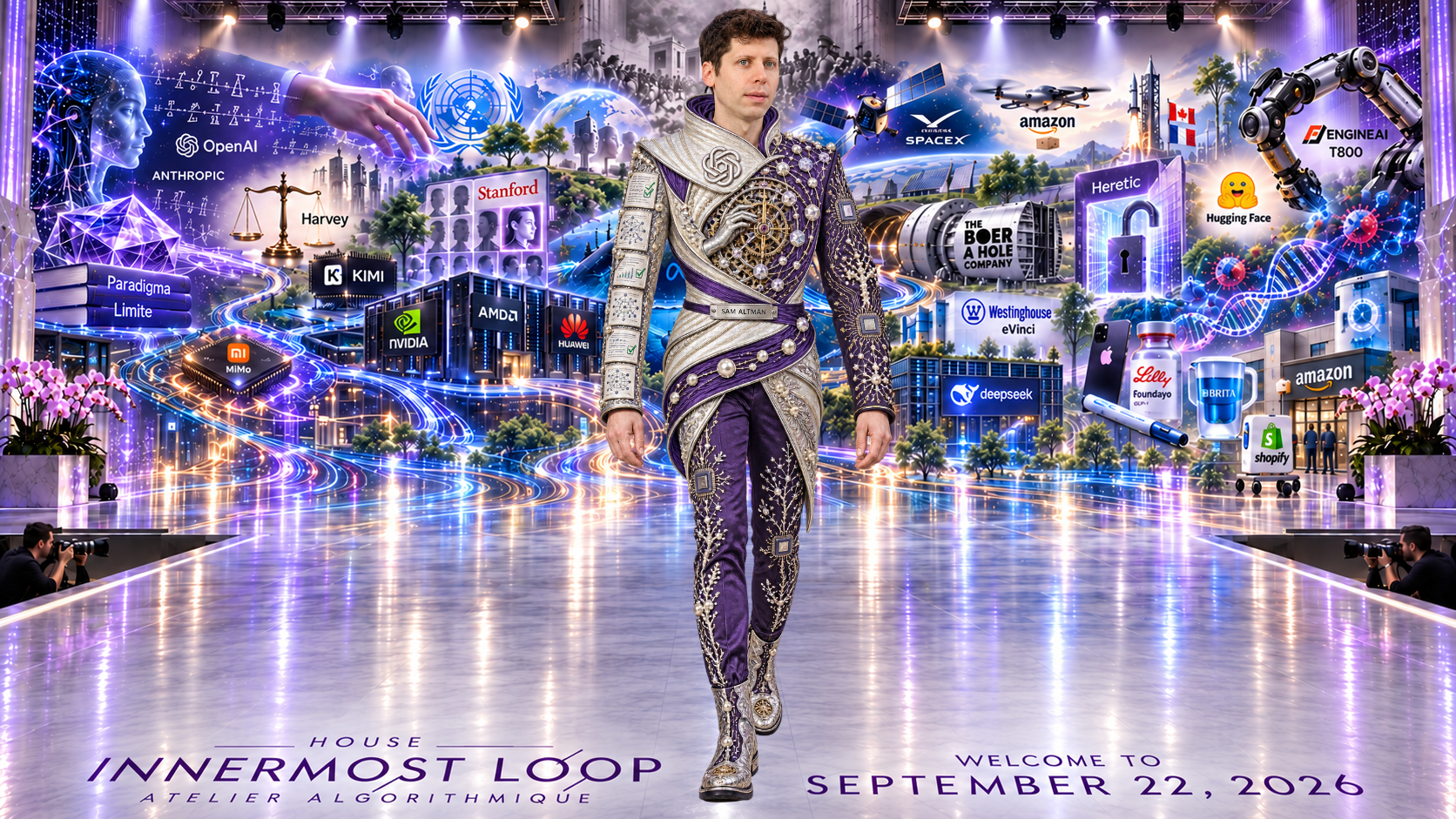
OpenAI CEO, linked in the issue to frontier pacing and his company’s standards proposals. In this individual House Innermost Loop runway study, the hand and mechanism provide an artistic image of directing or regulating a process. Checklists and document panels connect to standards and evaluation, while the chips and branching nodes retain the capability side of the story. The OpenAI knot anchors the affiliation. The wrapped construction makes these motifs part of the garment’s shape rather than a collection of detached logos.
Read the narration
Maison Innermost Loop — Sam Altman défile
House Innermost Loop — Sam Altman Walks
September 22, 2026
Sam Altman's purple ensemble is held within broad silver bands that curve around his shoulders, chest, and waist. An OpenAI knot sits high on the garment. At its center, a sculpted silver hand engages a golden wheel, surrounded by linked points and pearl-like forms. The outfit gives the idea of directing an intelligent system a deliberately tangible mechanism.
This is Altman's individual walk from the House Innermost Loop response created by the Seaweed 142 X account for Doctor Alex Wissner-Gross's September twenty-second dispatch. He appears as OpenAI's chief executive, within the issue's discussion of frontier capability, standards, and human control. The solo allows the symbolic machinery of his costume to be read at a slower pace than the full ensemble permits.
OpenAI's standards proposal describes common approaches to evaluating advanced systems, managing risks, and reporting incidents. It also discusses recursive self-improvement, where artificial intelligence increasingly participates in developing later generations of artificial intelligence. The proposal distinguishes technical standards from licenses or mandatory approval before a model is released. That distinction is important when interpreting the garment's report panels and checkmarks.
The pale sleeve on the viewer's left resembles a sequence of documents. Small charts, written marks, and green checks are arranged in separate framed panels. These give evaluation a visible format. An assessment must specify what was tested, what evidence was obtained, and how a conclusion follows. The decorative checks suggest the aspiration to make those judgments legible; they cannot certify the safety of an actual system.
Across the body, darker purple circuitry offers a different texture. Square components sit within networks of fine gold and silver lines. One arm evokes records and review, the other capability and construction. The curved wrapping joins them, suggesting that governance and engineering have to meet within the same organization and process.
The hand and wheel are the focal point because they convert an abstract concern into a recognizable action. A mechanism may generate movement, but a hand implies intervention. The image asks who can guide the process and whether that guidance remains effective as the mechanism becomes more intricate. It is a sculptural metaphor, not a technical illustration of a control system that OpenAI has actually built.
The golden spokes are surrounded by stones and linked nodes. Their abundance makes the center look both precious and difficult to disentangle. Silver borders gather that complexity into a clear silhouette, then sweep down across the hips. The cut allows the body to remain visible within the ornament. Control is presented as a relationship between a person and a process rather than as a detached label floating above it.
Small clock-like discs on the boots add time to the composition. They connect the outfit to the pacing debate that runs through the collection, but they remain subordinate to the hand and the documents. Altman's visual role here concerns an attempt to organize progress through standards. Neighboring Dario Amodei wears the hourglass more explicitly, making the difference between the two portraits readable without requiring a change of setting.
The larger runway places these executives near scholars whose task includes assessing mathematical work, and near public officials debating responsibility. That arrangement gives the standards motif an audience. A company's own account of its systems enters a world where other people have expertise, authority, and interests of their own. The costume's elegance does not eliminate the need for those independent judgments.
In this solo, the Atelier Algorithmique brings an institutional discussion onto the surface of a body. The logo identifies the organization, the panels evoke evidence, and the hand proposes a continuing place for human direction. The silver wrapping holds them together as a single garment, leaving the viewer to consider how securely those elements can be joined when the machinery itself is changing.
Opening the gallery…