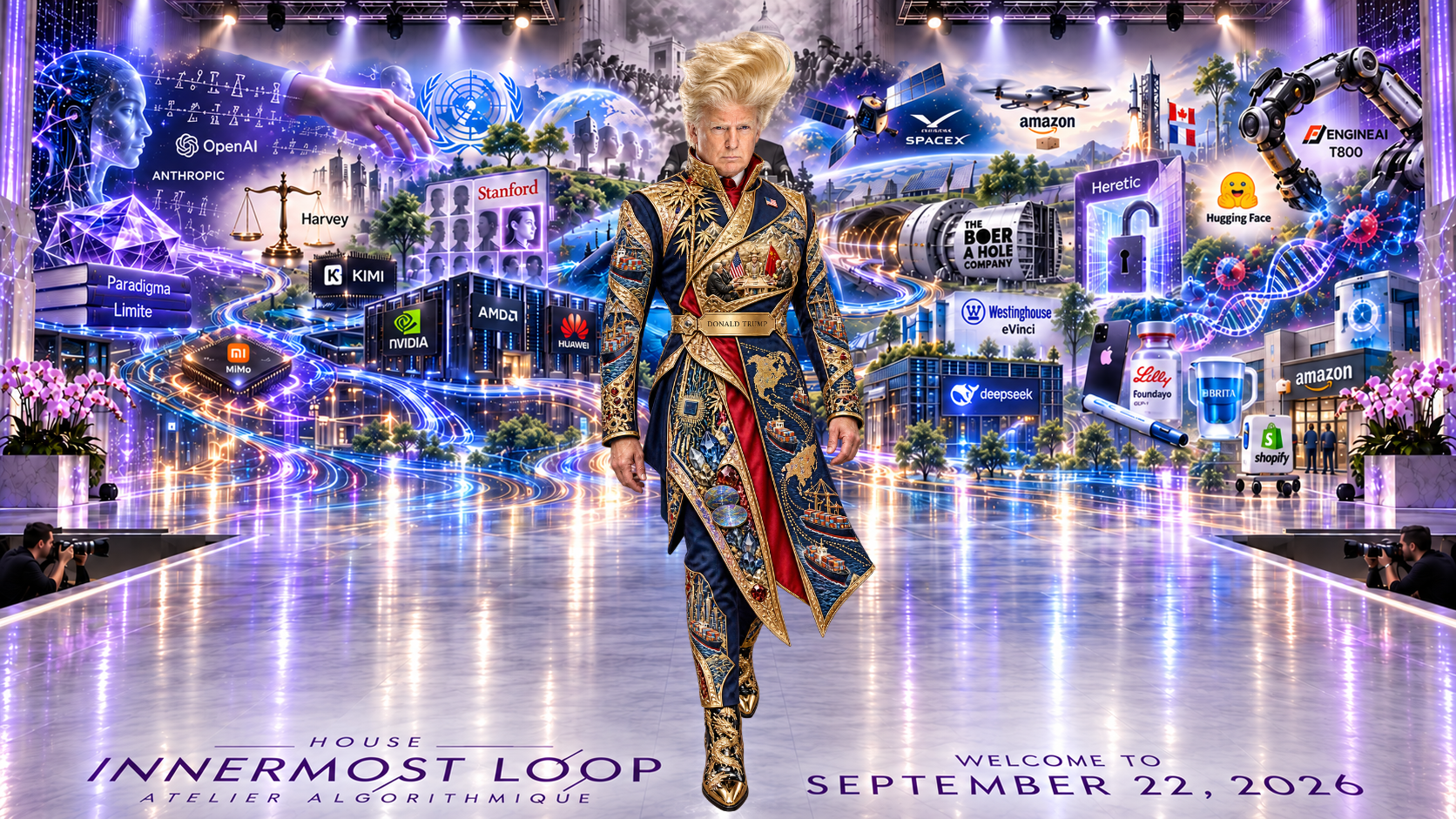
US president whose planned meeting with Xi Jinping provides the summit context for the bilateral talks. In this individual House Innermost Loop runway study, the meeting scene provides the direct connection to the planned summit. Maps and cargo imagery expand the surrounding trade subject into a garment-wide narrative. Chips and minerals refer to the broader technological context, not to a specific agreement established by the image. The high hair and ornate presentation are the commissioned artwork’s stylization of a recognizable public figure; they should be described as such, without treating them as evidence about his character or policy merits.
Read the narration
Maison Innermost Loop — Donald Trump défile
House Innermost Loop — Donald Trump Walks
September 22, 2026
Donald Trump advances beneath an extravagant sweep of blond hair, wearing navy, gold, and red. Broad metallic bands cross his coat, and sharply pointed panels descend around a vivid red center. The enlarged hair is a deliberate reference to the artist's recurring use of the artificial intelligence hair meme, carrying social media's taste for flamboyant transformation onto the runway.
This individual portrait develops Trump's appearance in the House Innermost Loop ensemble created by the Seaweed 142 X account for Doctor Alex Wissner-Gross's September twenty-second dispatch. He enters the issue as the United States president preparing to meet Xi Jinping. The clothing takes the anticipated summit and the surrounding economic discussions as its subjects.
At the center of the chest sits a miniature meeting scene, framed in gold and flanked by United States and Chinese flags. The tableau within the tableau is the key to the entire outfit. It supplies a recognizable human action, people gathered around a table, through which the surrounding maps, ships, and industrial forms acquire their relationship to one another.
The meeting image is anticipatory. It does not document a successful agreement or reveal the outcome of the planned summit. The earlier talks involving Scott Bessent and He Lifeng supply the immediate diplomatic context. The garment gathers the issues around that context into ceremonial dress, allowing the viewer to see a presidency represented through the systems with which it is negotiating.
Cargo ships and port cranes occupy the sleeves and lower panels. A large gold map brings geography close to the body, while wafer-like discs and mineral clusters suggest the material world beneath the technology debate. The mixture is instructive. Artificial intelligence may be described through software and models, but its development depends on objects that are made, transported, financed, and governed.
The outfit organizes those objects through emphatic diagonals. Gold strips cut across the navy surface and lead toward the chest scene, then down through the pointed coat panels. Red appears as a strong interior line. The construction resembles a ceremonial display whose ornament has become an illustrated briefing. Its grandeur comes partly from the way small scenes are enclosed within large, confident borders.
The exaggerated hair belongs to the same visual rhetoric. It rises above the already elaborate costume, giving the figure an unmistakable silhouette. The device is playful and knowingly artificial. It references the circulation of stylized public images online, where recognizability is often intensified through a single repeated feature. The narration need not turn that formal choice into a diagnosis of the person depicted.
Trump's placement beside Xi Jinping in the larger ensemble makes the two garments a pair. Both carry flags, tables, shipping, and technological resources, but the cuts and palettes give them different presences. Their shared motifs indicate a common field of negotiation. Their distinct designs preserve the fact that the people and governments involved approach that field from different positions.
The broader stage brings those positions into contact with scholars, industry leaders, and a student affected by artificial intelligence imagery. It is a useful curatorial move. A summit can dominate a news cycle, yet its decisions develop within a world of research, commerce, public argument, and ordinary lives. The runway places that world beside the diplomatic spectacle rather than leaving it outside the frame.
Above the scene, Roosevelt's black-and-white image supplies an earlier chapter in the performance of public leadership. The connection comes through the dispatch's closing adaptation of his language about fear. Trump's saturated gold couture belongs to a different visual moment, but the shared setting asks how political figures help societies imagine economic change. The artwork preserves that question within the spectacle of a single walk, where a meeting table sits at the center of a map and every ship carries the story outward.