Maison Innermost Loop — Billy Ramirez (Stanford, promotion 2027) défile
House Innermost Loop — Billy Ramirez Stanford ’27 Walks
September 22, 2026
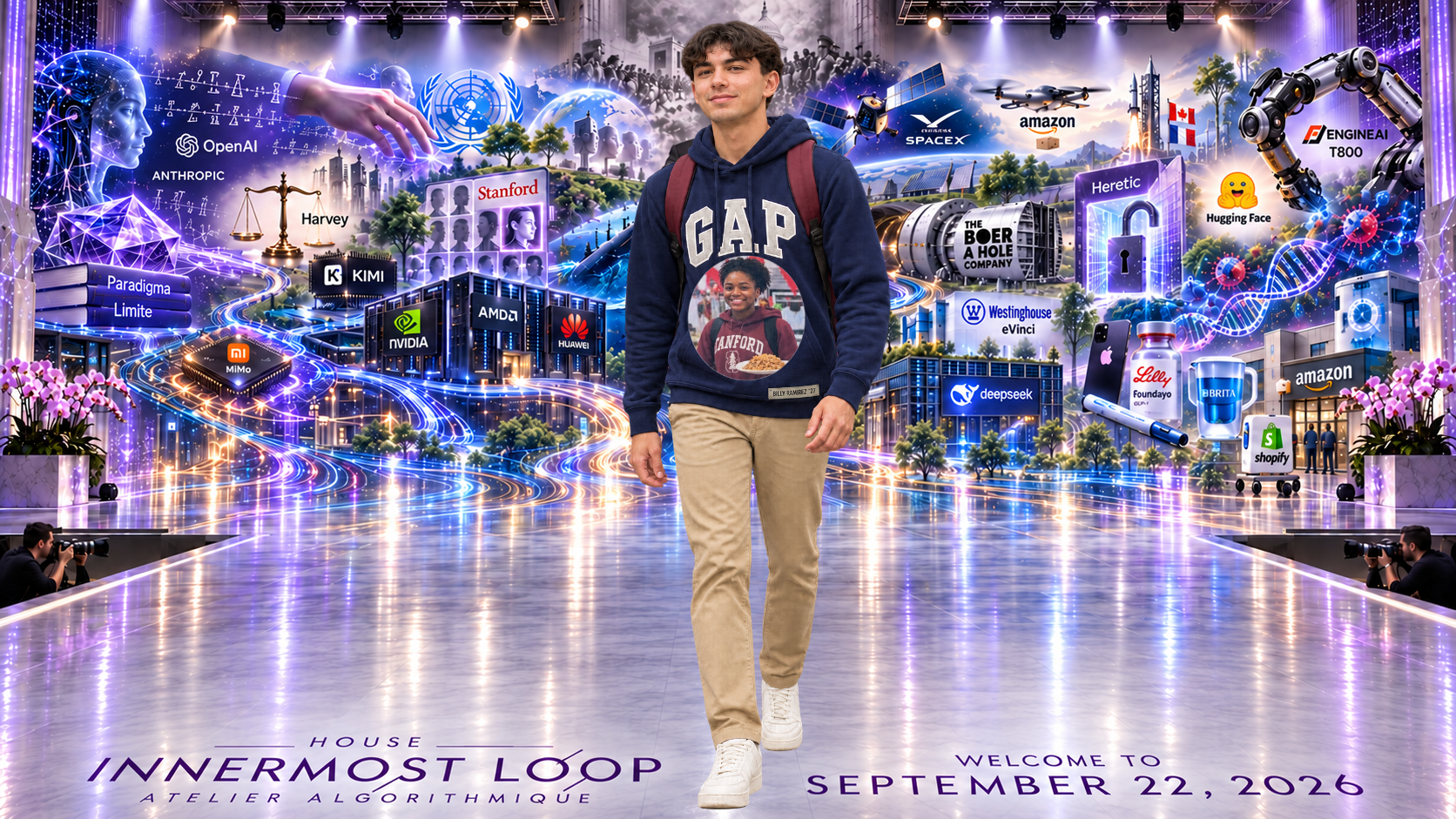
Stanford student, class of 2027, identified in The Stanford Review’s report about an AI-altered dining advertisement. In this individual House Innermost Loop runway study, the ordinary campus clothing is an explicit exception to the collection’s ornate couture. The circular insert brings the altered advertising image back into the same frame as the student whose place it occupied. This is an artwork-specific juxtaposition, not a claim that Billy actually wore this printed hoodie. GAP belongs because it was present in his reference clothing; it is not a company implicated in making the altered advertisement. Center placement makes his image easy to locate among the elaborately dressed public figures.
Read the narration
Maison Innermost Loop — Billy Ramirez (Stanford, promotion 2027) défile
House Innermost Loop — Billy Ramirez Stanford ’27 Walks
September 22, 2026
Billy Ramirez enters the runway in a navy GAP hoodie, khaki trousers, white sneakers, and a burgundy backpack. Among the collection's elaborate coats and metallic ornament, his clothing remains recognizably that of a student. The decisive addition sits beneath the large GAP letters: a circular portrait of a generated woman wearing a Stanford sweatshirt and holding a plate of food.
This solo tableau follows Billy's central position in the Seaweed 142 X account's House Innermost Loop ensemble, made in response to Doctor Alex Wissner-Gross's September twenty-second dispatch. His place in the newsletter concerns Stanford dining advertising. The Stanford Review reported that an original photograph containing Ramirez had been altered so that a generated woman appeared in his place, while other students' appearances were also changed.
The publication identified him as a member of the class of twenty twenty-seven and described his objection to the way he had been represented. The artwork brings that report back to an individual person. It gives him a visible name near the hem and places the substituted image on the body of the person it replaced. What might have remained a before-and-after comparison becomes a single, deliberately uncomfortable juxtaposition.
The ordinary hoodie is essential to the effect. It preserves the language of everyday campus life: something practical, familiar, and personal. The GAP mark belongs to that clothing reference; it is not an accusation that the company participated in altering the advertisement. The generated portrait below it is the artwork's narrative intervention. One addition carries the entire story without needing to cover the trousers or backpack with repeated symbols.
The circular frame also matters. It resembles a badge, a souvenir portrait, or an image chosen for a custom shirt. Such objects usually express affiliation or preference. Here it holds a representation imposed in another context. That reversal gives the portrait its tension: a likeness associated with someone's disappearance from an advertisement has become the means by which the artwork asks us to see him.
The ethical question does not depend on the generated person's race or gender being treated as a problem in itself. It concerns the substitution of a fabricated identity for an identifiable participant in a scene presented as campus life. Who decides how a person's image may be used? What does the audience assume it is seeing? A small advertising alteration opens onto those larger questions about representation and control.
The backdrop repeats the subject through the Stanford panel of faces. In the background, faces become a grid, suggestive of a system capable of producing variations. In the foreground, Billy has a name, a body, and a particular place in the story. The contrast is more revealing than a generic image of an all-powerful machine. It locates the consequences of a technical capability in the experience of someone who did not design the system.
His central position in the ensemble gives that experience unusual prominence. The surrounding public figures debate capability, oversight, resources, and liability. Billy stands where those debates become personal. The Tyson robot rises behind him in the group scene, adding a spectacular example of embodied technology, but the student's own story requires no dramatic confrontation. The significant event happened through an image being changed.
This solo retains the bright runway and the photographers at its edges. That setting creates a deliberate visual echo: another image is being made, another public representation is being offered. The tableau is openly an artistic reconstruction, allowing its viewer to understand the transformation as part of the work. The distinction between a declared fiction and an apparently documentary advertisement becomes part of its meaning.
Billy's relaxed forward step and unadorned trousers keep the portrait grounded. The house's most economical outfit becomes one of its most pointed. A single printed circle asks us to consider the distance between making an image more useful to an institution and remaining faithful to the people who were actually there.