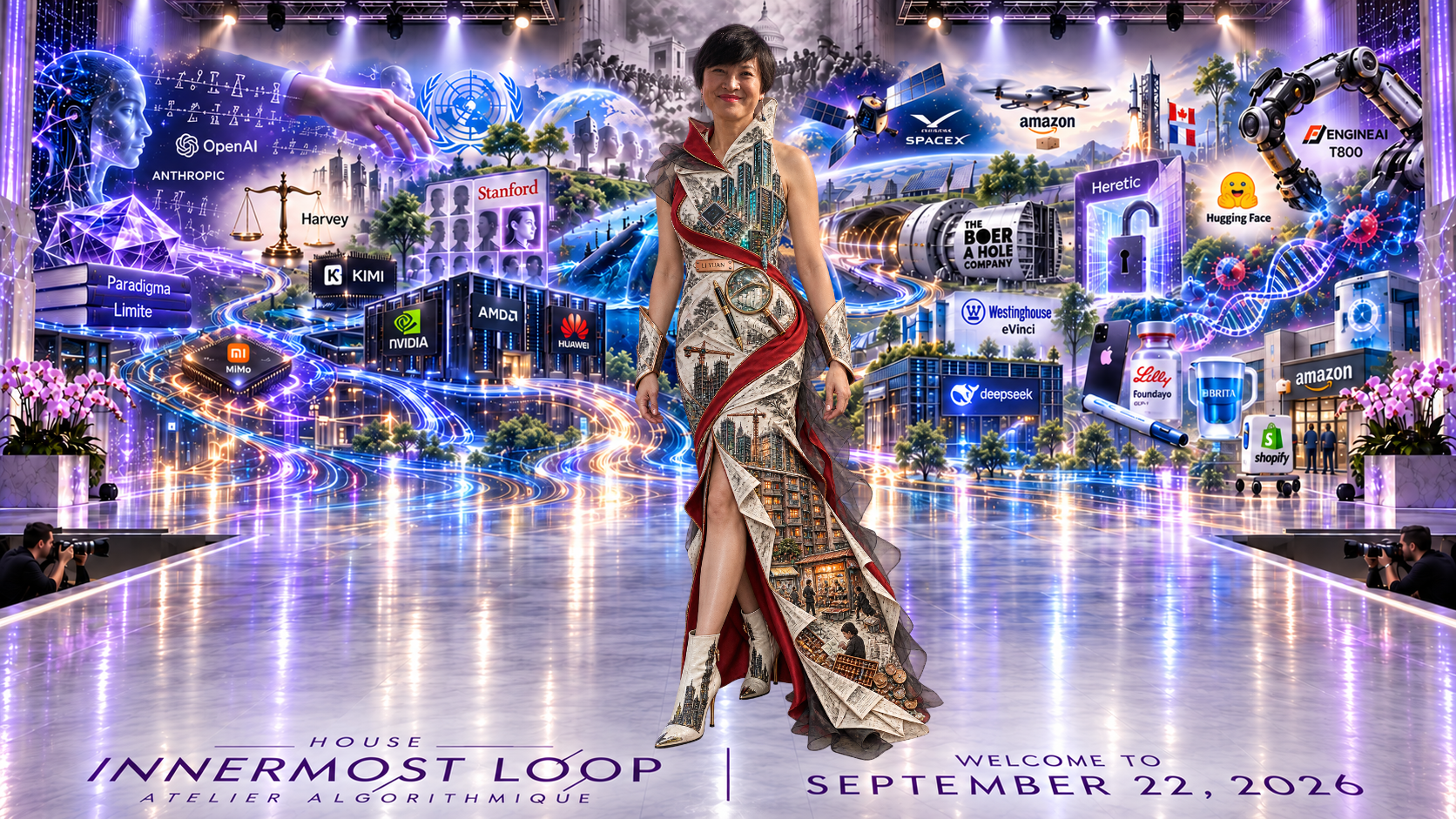
New York Times columnist whose reporting contrasts China’s AI expansion with strains in the wider economy. In this individual House Innermost Loop runway study, the newspaper construction identifies her as the person reporting on the story. The magnifying glass is a journalistic tool, while the contrasting technological towers and everyday urban scenes carry the contrast explored in the article. The red strip serves as a continuous compositional thread through otherwise fragmented pages. This outfit is particularly suited to a slow narration because the viewer can read it as a sequence from the upper body down to street-level scenes near the hem.
Read the narration
Maison Innermost Loop — Li Yuan défile
House Innermost Loop — Li Yuan Walks
September 22, 2026
Li Yuan walks in a gown that resembles a newspaper unfolding into a city. Cream surfaces carry columns of print and miniature buildings, while a red ribbon winds from the sculptural collar through the length of the dress. Teal server-like forms rise across the bodice. A magnifying glass at the waist announces the activity that brings these different scales together: looking closely.
This individual tableau belongs to the House Innermost Loop response created by the Seaweed 142 X account for Doctor Alex Wissner-Gross's September twenty-second dispatch. Li Yuan appears as a New York Times columnist whose reporting examines the relationship between China's artificial intelligence ambitions and its wider economic condition. Her role in the collection is that of an observer and interpreter, rather than a government representative or technology executive.
The column discussed in the newsletter places substantial investment in artificial intelligence alongside pressures affecting the broader economy. The point is that technological expansion and everyday economic confidence need not move together. A country can add computing capacity while households and workers experience insecurity. The dress gives that divergence a visual form by placing polished technological structures above streets, housing, and individual human scenes.
The red band is the design's most forceful organizing device. It joins areas that could otherwise read as separate illustrations. Passing diagonally across the bodice and spiraling toward the hem, it resembles an editorial line carried through a complex story. Its color catches the eye, but its deeper function is to guide attention from one scale to another.
At the top, chips and tall metallic forms evoke the concentrated intensity of investment. Farther down, cranes and unfinished-looking structures give way to dense windows, shopfronts, and a seated figure. Coins and counting imagery appear near the lower edge. The viewer is led from announcements about national capability to the conditions in which people earn, spend, and make plans. Those are connected worlds, even when the language used to describe them differs.
The magnifying glass interrupts the gown near its center. It is both an ornament and a method. It suggests that a large economic narrative should be brought close enough to inspect its particulars. A technological achievement can be impressive on its own terms while leaving questions about distribution, demand, and daily life unanswered. The portrait gives those questions a visible place within the collection's otherwise exuberant abundance.
The asymmetrical cut strengthens this reading. One side rises into a folded collar; the other opens at the shoulder. The skirt separates during the walk, exposing successive layers like pages being turned. Printed cuffs and pointed boots carry the newspaper texture beyond the main dress. Journalism becomes the construction of the whole silhouette, rather than a small emblem attached to a generic outfit.
Its miniature text functions as the visual texture of reportage. The image does not offer legible paragraphs that can be treated as quotations from Li Yuan's article. What it preserves instead is a relationship among observation, evidence, and public explanation. The buildings and people supply things to look at; the print proposes that looking can become a shared account.
The placement of this gown within the runway is particularly effective. Around Li Yuan, policymakers wear resources and diplomatic tables, while executives wear models and hardware. Her clothing asks what those systems look like from the street. In the solo portrait, the shared industrial panorama remains behind her, but the foreground gives equal visual dignity to a worker, a storefront, and an unfinished building.
House Innermost Loop has dressed a journalist in the act of connecting consequences to claims. The red ribbon keeps the story moving, and the magnifying glass keeps it from moving too quickly. Her walk contributes a necessary form of attention to the day's chronicle: the ability to admire a new capacity while still asking where, and for whom, its benefits become tangible.