70 Clock Galerie / The Innermost Loop Feed Reply Tableaux
Maison Innermost Loop — Ro Khanna défile
House Innermost Loop — Ro Khanna Walks
September 22, 2026
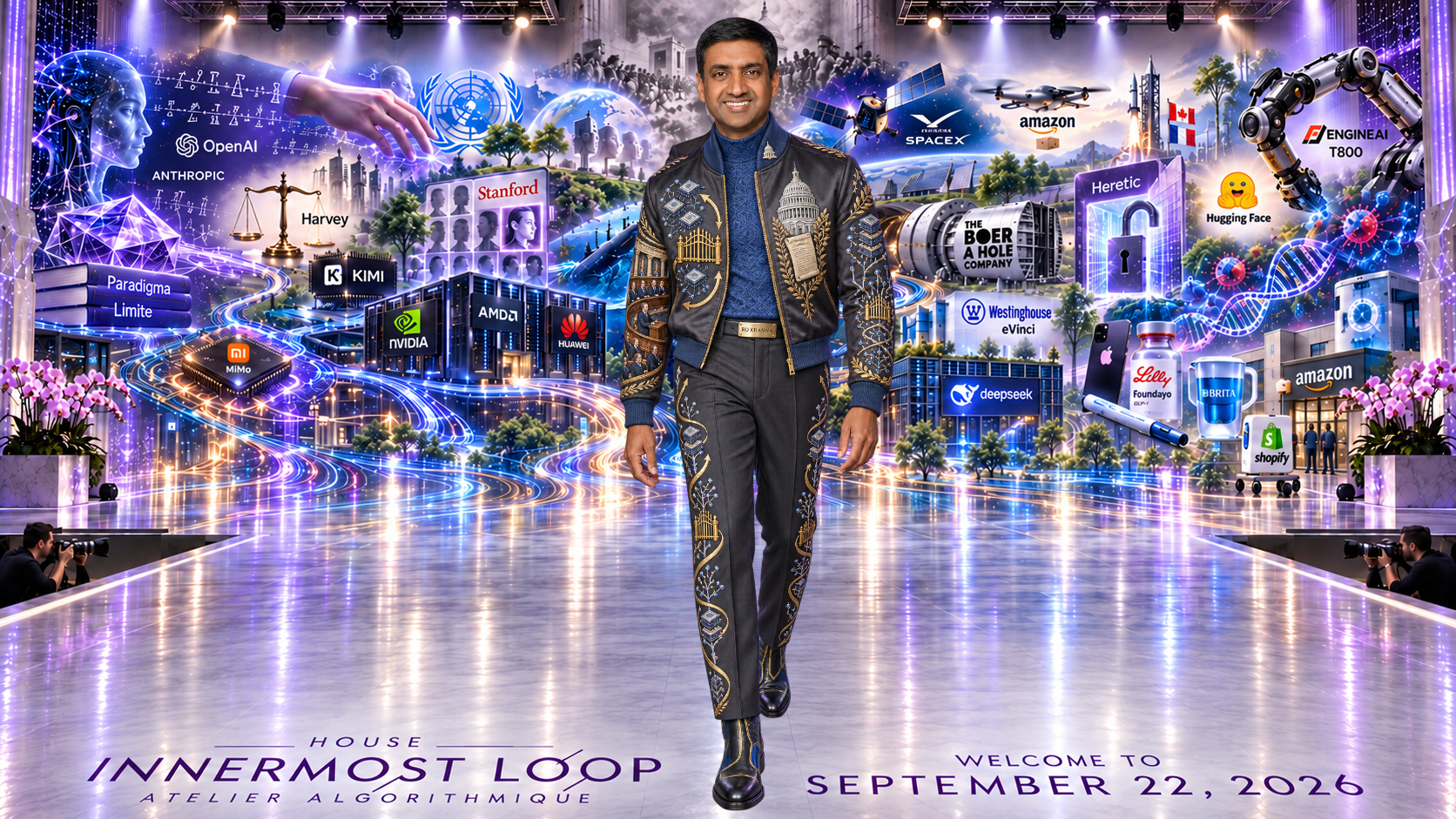
US representative associated in the linked Reuters report with a call for an international ban on self-improving AI. In this individual House Innermost Loop runway study, this is a legislative visual vocabulary: the Capitol, documents, chamber scenes, and gates mark the subject as a lawmaker and link the outfit to the reported proposal. Looped arrows around chips provide an image for repeated improvement; gates turn the idea of restricting that process into a visible shape. The clothing records the subject of the policy debate without declaring the proposal desirable or undesirable.
Read the narration
Maison Innermost Loop — Ro Khanna défile
House Innermost Loop — Ro Khanna Walks
September 22, 2026
Ro Khanna's garment begins with a familiar silhouette: a charcoal bomber jacket, blue high collar, fitted trousers, and dark boots. Gold edging turns that everyday outline into ceremonial dress. Across it, miniature chips follow curving arrows toward gates, while the dome of the United States Capitol rises above a document on his chest. The subject is the meeting of technological momentum and public authority.
The portrait is one of the individual walks developed from the Seaweed 142 X account's House Innermost Loop response to Doctor Alex Wissner-Gross's September twenty-second dispatch. Khanna enters the issue as a member of Congress advocating restrictions on self-improving artificial intelligence. His position appears within a wider argument about whether the development of increasingly capable systems should be slowed, governed differently, or allowed to advance through competition.
Recursive self-improvement describes a feedback process in which artificial intelligence contributes to developing more capable successor systems, which may then contribute to further improvement. The phrase covers questions about degrees of automation and human supervision. It should not be treated as proof that an entirely independent intelligence explosion has already occurred. Khanna's proposed restriction addresses the possibility of losing effective human control as that process becomes more autonomous.
The garment makes the feedback idea legible through repetition. Chips lead into curved arrows, arrows return toward chips, and branching circuits connect one section to another. Gates interrupt these sequences. Their familiar bars translate a disputed policy boundary into a shape the viewer can understand immediately. In the artwork, they mark a proposed limit, rather than an already enacted law.
The Capitol and written panel place that limit in an institutional setting. A proposal must be debated, defined, and given an accountable form. Small chamber-like scenes on the sleeves extend this idea from a building to the people who deliberate within it. The jacket carries both the symbol of legislative power and the less spectacular work of hearings, argument, and public explanation.
That is an especially interesting choice in a collection built around acceleration. The body moves forward, but the garment repeatedly depicts points where movement can be checked. The two are not visually incompatible. A person can participate in a technological society while arguing that some processes require limits. The tableau allows that position to occupy the same runway as advocates of faster development, without making the shared stage a statement of agreement.
The bomber cut gives the portrait a different register from the long scholarly coats and the diplomatic brocades. It is concise, mobile, and recognizable. The gold laurel motifs confer ceremony, but the ribbed cuffs and short hem preserve the everyday outline. Public policy has been dressed for a world of working systems, where technical decisions move quickly beyond the laboratory.
The backdrop's United Nations emblem expands the question beyond Congress. Artificial intelligence research crosses borders, while governments exercise authority through particular jurisdictions. A gate embroidered on one sleeve can appear complete and decisive. An effective international boundary would require definitions, participation, verification, and consequences. The visual simplicity of the symbol invites the listener to notice the greater complexity of the real task.
The surrounding machinery supplies the other side of the discussion. Computing systems can support discovery, services, and new forms of productive work. Limits therefore concern opportunities as well as hazards. Wissner-Gross's dispatch strongly emphasizes the capacity that might be lost through excessive restraint. Khanna's presence makes the collection a record of a contested moment, with disagreement stitched into its shared design.
In this solo, gold gates and looping arrows become a concise portrait of a policy problem. The arrows ask how a process keeps gaining momentum. The gates ask where society might decide to intervene. The figure between them carries a legislator's particular responsibility: helping turn public concern into choices that can be stated, debated, and examined.
Opening the gallery…