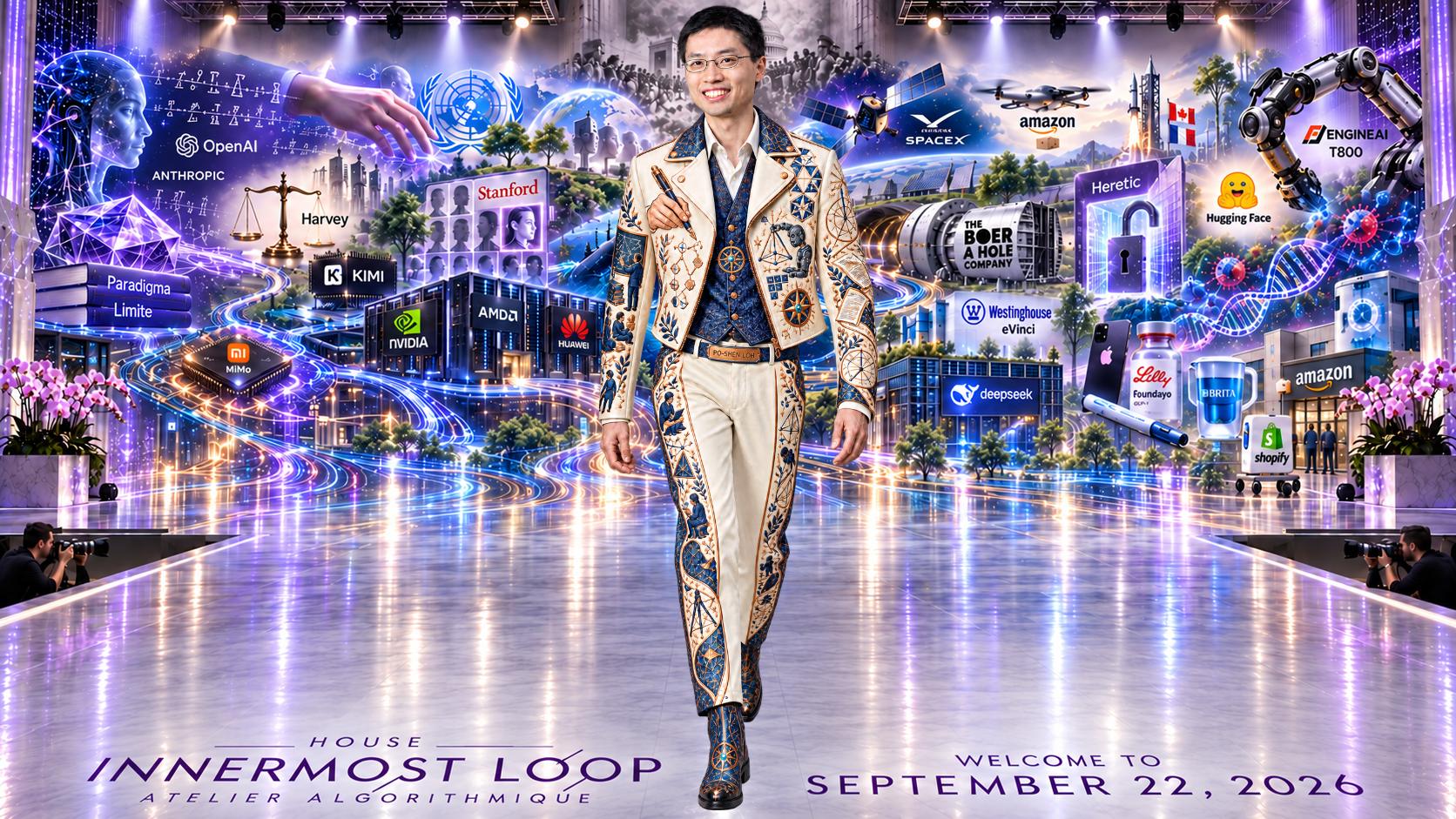
Mathematician and educator whose guest essay argues for skilled human direction of increasingly capable AI. In this individual House Innermost Loop runway study, the steering devices refer to the essay’s central concern with retaining human direction. The writing hand, learners, books, and robot put teaching and technical expertise in the same garment. The small human scenes make this look about people practicing and supervising knowledge, rather than merely displaying abstract mathematics. Cream fabric and a shorter jacket provide an intentional visual break from the preceding scholars while preserving the continuous head-to-boot imagery.
Read the narration
Maison Innermost Loop — Po-Shen Loh défile
House Innermost Loop — Po-Shen Loh Walks
September 22, 2026
Po-Shen Loh steps onto the runway in ivory and cobalt, with gold-orange borders giving his cropped jacket a bright, decisive outline. Books, geometric figures, small human forms, and a writing hand inhabit the fabric. A wheel-like ornament sits among them. The design has the clarity of a lesson assembled to be explored, with enough open space for the eye to find its way.
The Seaweed 142 X account created this individual walk as part of its House Innermost Loop response to Doctor Alex Wissner-Gross's September twenty-second dispatch. Loh appears because the newsletter links his essay asking why human mathematicians are still needed. Terence Tao hosted the guest essay, but its argument and prose are Loh's. The portrait places the author of that argument directly before the viewer.
Loh is a Carnegie Mellon mathematics professor whose work also reaches into education and public problem-solving. His research includes combinatorics, probability, and algorithms. That combination matters to the garment: it presents mathematics as something people do, teach, and use together. Small figures and open books appear beside the formal constructions, giving the abstractions a human setting.
His essay begins from a commitment to human flourishing and asks what work follows from keeping human beings meaningfully involved as artificial intelligence grows more capable. The important activity becomes directing and evaluating increasingly powerful processes. On his account, greater technical capacity can create more points where skilled human judgment is needed. This is a proposed account of the future of expertise, rather than an established guarantee about employment.
The wheel supplies the most concise visual expression of that idea. Speed alone cannot choose a destination. Someone must decide which questions deserve attention, what a result is for, and whether an intended benefit has actually reached people. Placed among books and miniature learners, the wheel associates direction with understanding. The imagery lets a technical debate acquire the familiar gesture of steering.
The writing hand on the upper jacket develops the same theme. It holds a pen rather than a trophy. The body is already in motion, but the ornament preserves the moment of working something out. Along the sleeves and trouser borders, little figures, diagrams, and branching blue foliage continue that activity. Knowledge appears as a cultivated environment, one that can grow through instruction and exchange.
A small robot shares this field with the human motifs. Its inclusion prevents the portrait from becoming a simple retreat into pre-digital scholarship. The machine belongs in the lesson. The question is how the relationship should be arranged so that expanding capability supports the people who learn, reason, and make choices. The garment offers coexistence as a composition that must be actively designed.
Its cut reinforces the point. Compared with the long scholarly coats elsewhere in the ensemble, Loh's cropped jacket exposes more of the waistcoat and leaves a broad, quiet field through the center of the pale trousers. The viewer can distinguish one scene from the next. The design behaves like good exposition: it gives each part a place and does not require every available surface to compete at once.
In the shared backdrop, model emblems and streams of light promise accelerating production. The solo draws attention to what happens after production: interpretation, teaching, selection, and responsibility. These are different activities, each requiring its own kind of competence. The artwork makes them visible through objects whose purpose can be grasped without reading the miniature inscriptions.
Loh's smiling expression contributes warmth to this account of expertise. The portrait presents learning as a public invitation, consistent with a mathematician who brings the subject to audiences beyond a research department. In the full runway he was one participant among many. Here his garment becomes a small educational world, proposing that the future of intelligence should still have room for a teacher, a learner, and a hand on the wheel.