70 Clock Galerie / The Innermost Loop Feed Reply Tableaux
Maison Innermost Loop — Edward Witten défile
House Innermost Loop — Edward Witten Walks
September 22, 2026
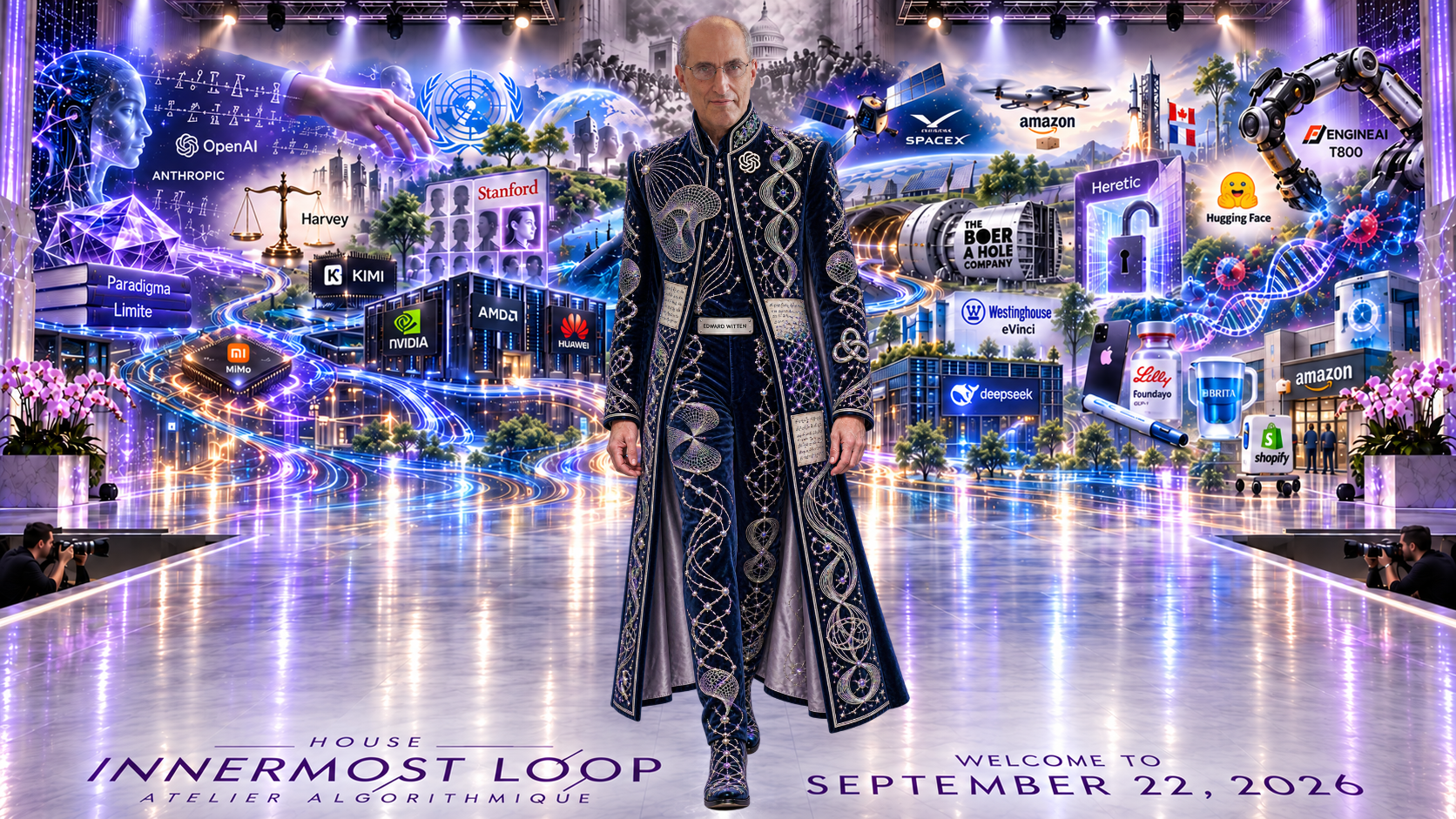
Mathematical physicist named in the independent mathematics advisory group. In this individual House Innermost Loop runway study, the distinctive vocabulary is curved space rather than flat graph paper. Loops, mesh surfaces, and knots give the portrait a mathematical-physics character. The pale lining and written panels connect it to the other scholarly garments, but its major forms are continuous and spatial. The outfit is an artistic rendering of a research identity within the advisory-group story; it is not a literal diagram of AI discovering a particular physical theory.
Read the narration
Maison Innermost Loop — Edward Witten défile
House Innermost Loop — Edward Witten Walks
September 22, 2026
Edward Witten advances in midnight blue, wrapped in loops, folded surfaces, and luminous meshes. Violet points punctuate the silver ornament. A broad wire-like form bends across one side of his chest, while linked curves descend along the other. The long coat resembles a portable atlas of spaces that cannot be understood from a single flat diagram.
This is Witten's individual walk within the House Innermost Loop response to Doctor Alex Wissner-Gross's September twenty-second dispatch. The Seaweed 142 X account first placed him among the full runway cast. His presence follows the announcement of an independent mathematics advisory group associated with OpenAI, bringing mathematical physics into the day's discussion of machine-generated discovery.
Witten's work has profoundly connected theoretical physics and mathematics, including quantum field theory, string theory, and topology. Topology studies features of shape and connection that persist through continuous deformation. In an informal example, stretching a loop changes its appearance without necessarily changing the kind of loop it is. That attention to underlying relationships makes the coat's recurring knots and curved frameworks an especially fitting artistic language.
The embroidery keeps asking the viewer to imagine depth. A mesh swells outward, narrows, and returns. Rings cross one another; strands turn before continuing down a sleeve. The forms never settle into the regularity of a tiled pattern. Instead, they propose that an apparent complication might be a simpler structure seen from an unfamiliar angle. This is an interpretation of the design, not the identification of a particular manifold sewn onto the fabric.
Its jewel-like nodes serve as visual anchors. They give the eye a place to pause before following another curve. Some of the lines read as trajectories; others define surfaces or enclose small volumes. Together, they turn the body into a three-dimensional display, using the coat's folds and the movement of the legs to reinforce the subject. The garment does not merely carry pictures of geometry. Its own changing shape helps present them.
Pale manuscript panels near the waist and along the coat interrupt this celestial appearance. They return the imagery to the work of writing, checking, and sharing an argument. Physics and mathematics gain strength from different kinds of evidence, and their productive exchanges require care about what each claim means. The pages suggest that disciplined translation between ways of thinking, rather than allowing the beautiful mesh to stand in for explanation.
The OpenAI emblem is comparatively small. Its position identifies why this particular portrait belongs to the September collection, while the surrounding symbols refer to a much longer intellectual career. The advisory group's work concerns how emerging mathematical results should be assessed and communicated. Witten's inclusion expands the range of expertise available to that conversation; it does not make the outfit an endorsement of every forecast circulating around artificial intelligence.
The collection's scholarly sequence becomes clearer when this solo is placed beside its companions. Gowers's garment emphasizes networks and written pages. Hairer's emphasizes rough traces and branching forms. Witten's gives the viewer continuous spaces, loops, and transformations. Their shared long-coat silhouette creates a family resemblance, while their ornaments resist the idea that mathematics is one interchangeable body of symbols.
The background supplies a second scale of connection. Satellites, undersea routes, hardware buildings, and institutional emblems surround the solitary walker. Across the tableau, curves connect objects that initially appear far apart. That visual continuity makes the physicist's coat feel at home in the larger scene, although the real intellectual links must still be established rather than inferred from decorative resemblance.
Witten's restrained expression keeps the portrait grounded amid its elaborate surfaces. The wonder belongs to the work and to the shapes that invite us to imagine it. His walk offers the viewer a way into an abstract world: follow the line, watch it turn, and consider which relationships survive when the form changes.
Opening the gallery…