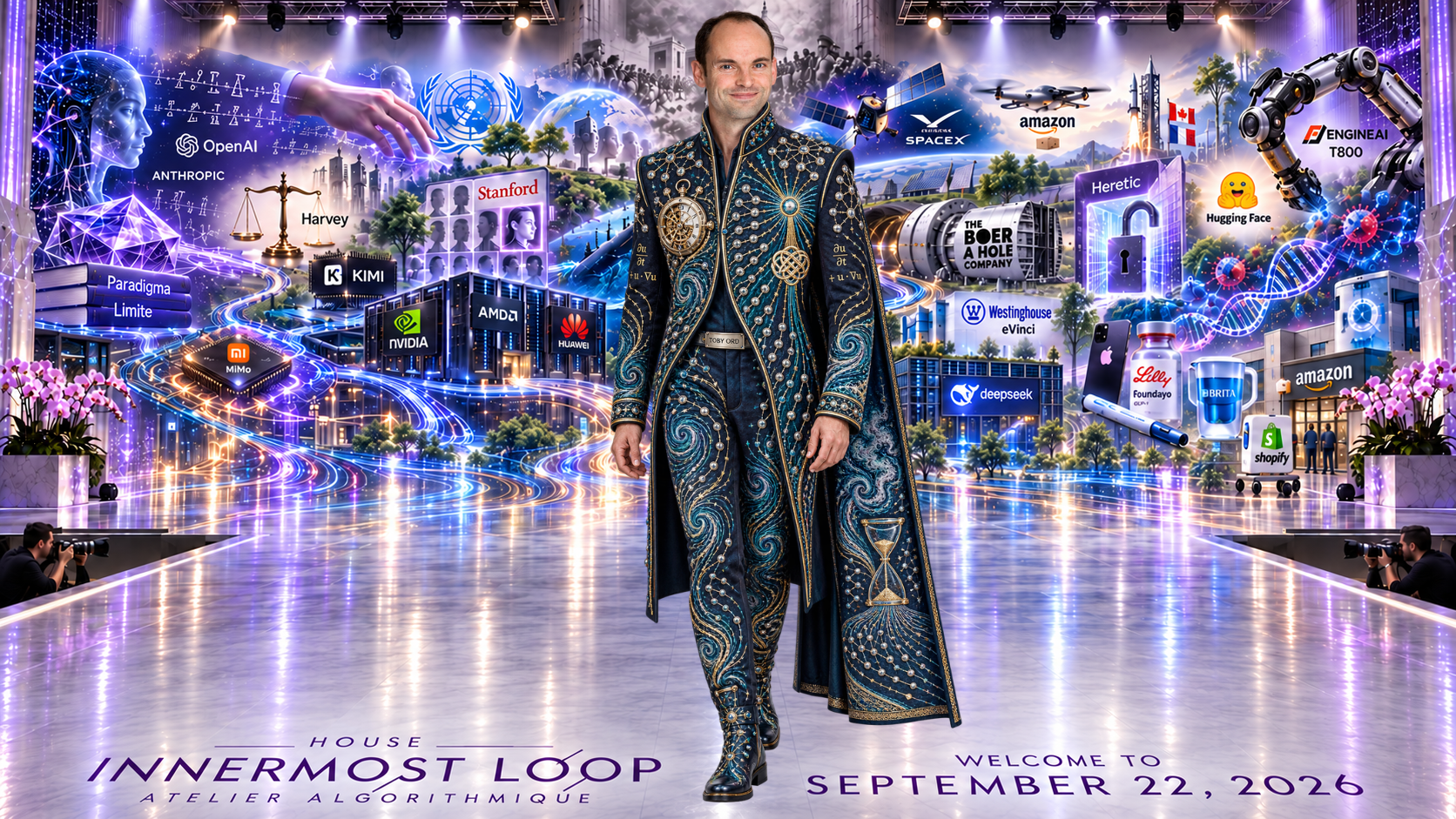
Philosopher and AI researcher; the issue links his analysis distinguishing swarm speed from underlying capability. In this individual House Innermost Loop runway study, the clock and hourglass give the argument a visible time dimension. The branching chains turn many cooperating agents into a wearable network, while the swirling blue forms refer to fluid-flow imagery associated with the Navier–Stokes discussion. These motifs were chosen to distinguish doing work sooner from possessing a fundamentally different capacity to solve it. The long panel provides room for the hourglass without becoming an enormous lateral cape. Dark blue keeps the gold instruments and fine silver nodes legible.
Read the narration
Maison Innermost Loop — Toby Ord défile
House Innermost Loop — Toby Ord Walks
September 22, 2026
Toby Ord steps forward in midnight blue, carrying a small constellation of clocks, currents, and connected points. His long coat opens around a matching embroidered suit. Gold lines travel down the fabric like channels in a map, while pale jewel-like nodes divide and rejoin across his shoulders. The garment gives a philosopher's question a physical form: when more minds work together, what exactly has increased?
This solo tableau grows out of the House Innermost Loop runway created by the Seaweed 142 X account in response to Doctor Alex Wissner-Gross's September twenty-second dispatch. Ord appears because the newsletter discusses his analysis of agent swarms. Here, away from the full ensemble, his clothing becomes an instrument for distinguishing elapsed time, computational expenditure, and intellectual capability.
Ord's essay, Swarm Scaling, examines evidence about increasing the number of collaborating artificial intelligence agents. Its central distinction is useful well beyond artificial intelligence. A larger team can finish earlier while consuming more total work. The gain in speed does not necessarily imply that each participant has become more capable, or that the same result could never have been reached through a slower process. Ord treats the available measurements as limited evidence, rather than a universal law for every future swarm.
The ornate timepiece high on the coat and the hourglass near its lower edge turn that distinction into the design's organizing rhythm. One presents time as a finely divided mechanism; the other makes duration visible as something passing. Between them, branching strings of bright nodes offer the suggestion of many workers operating at once. The eye moves across the networks before descending toward the hourglass, following a collaboration back to its cost in time.
Blue spirals sweep through the torso, knees, and trailing panel. They evoke fluid motion and therefore the Navier–Stokes discussion that brought swarm scaling into the dispatch. Those equations describe the motion of fluids. The embroidery borrows their world of currents, eddies, and interacting flows; it does not offer a readable mathematical proof. That distinction allows the clothing to remain intellectually suggestive without pretending that every flourish is a verified formula.
The coat's construction adds another layer. Narrow gold borders organize a field that might otherwise appear restless. Individual streams remain visible even as they merge into larger patterns. In this reading, the tailor performs the work of an orchestrator, arranging separate contributions so that they can become a coordinated whole. The jewel chains make multiplicity beautiful, while the carefully ordered seams suggest that multiplicity still needs organization.
Ord is a moral philosopher whose work considers humanity's long-term future. His presence gives this technological collection a measure of reflective distance. A dazzling demonstration invites admiration, but the philosopher asks what the demonstration establishes and which assumptions connect it to a larger forecast. The gentle expression and upright, unhurried stride suit that role. The visual energy resides in the fabric, leaving the wearer composed enough to examine it.
Behind him, luminous routes connect chips, buildings, and institutions. The contrast is instructive: a swirl on a coat can be apprehended instantly, whereas an actual swarm depends on energy, hardware, software, and the difficult business of coordinating work. The runway brings those dependencies into the same field of view. Its surface shines with apparent ease, while its imagery keeps the machinery of that ease close at hand.
In the group tableau, Ord begins a sequence of people concerned with mathematical discovery. His solo introduces the question that accompanies them down the runway: how should progress be measured? The clock, hourglass, and flowing networks provide three ways of looking before any verdict is delivered. House Innermost Loop dresses him as a reader of acceleration, attentive to the difference between a result arriving sooner and a horizon moving farther away.