70 Clock Galerie / The Innermost Loop Feed Reply Tableaux
Kat von Tat Klingon — Miami Ink — Caractère typographique
Kat von Tat Klingon — Miami Ink — TypeFace
September 20, 2026
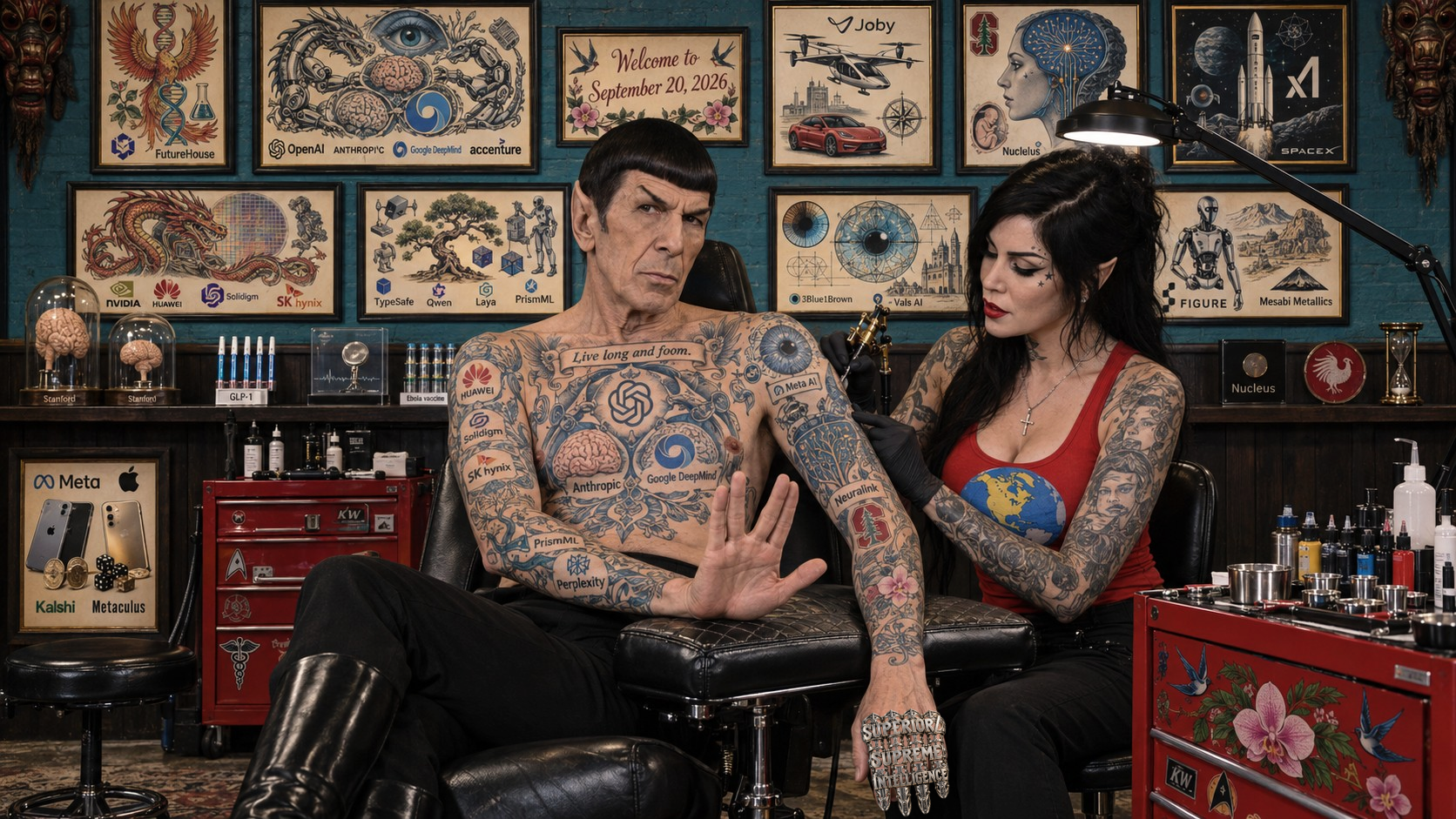
Leonard Nimoy’s Spock receives a tattoo from Kat Von D recast as Kat von Tat Klingon. Answering Wissner-Gross’s “Live long and foom,” the studio transforms the September 20 dispatch into tattoo flash, biomedical displays, and body art. His globe header appears on Kat’s shirt; the corrected hand ornament reads “Superior / Supreme Intelligence.”
Read the narration
Kat von Tat Klingon — Miami Ink — Caractère typographique
Kat von Tat Klingon — Miami Ink — TypeFace
September 20, 2026
Doctor Alex Wissner-Gross closes his September twentieth, twenty twenty-six dispatch in The Innermost Loop on X with a mischievous benediction: “Live long and foom.” In response, the Seaweed 142 X account brings Leonard Nimoy's Spock into a tattoo parlor, where that revised Vulcan greeting is being made flesh.
Foom is shorthand for a hypothetical rapid intelligence takeoff: increasingly capable artificial intelligence improves itself, accelerating further improvement. Substituting it for “prosper” turns Star Trek's blessing into a wish for technological transformation. Spock's resting Vulcan salute completes the joke.
His artist is Kat Von D, familiar from Miami Ink and LA Ink, recast as Kat von Tat Klingon. “Tat” slips tattoo slang into her name; “Klingon” carries her into Star Trek. Her portraiture expertise suits a scene built around recognizable likeness.
The title's TypeFace evokes lettering; the company pictured is TypeSafe. Its Jev model, featured in the dispatch, returns structured decisions that software can use directly. TypeSafe reports responses in seventy to five hundred milliseconds, accompanied by probabilities expressing uncertainty. Type safety keeps outputs within predefined forms and permitted values; it does not make every judgment correct. Here, computational precision meets a tattoo workshop where every mark matters.
Tattoo flash, the ready-made designs displayed for clients, becomes a catalog of the day's discoveries. Teal walls, red cabinets, photographic figures, and intricate emblems fuse a working studio with illustrated science fiction. Dragons and floral scrolls admit processors and laboratories into tattooing's inherited decorative language.
The mechanical circle on Spock's chest gives this translation a center. OpenAI and Anthropic emblems recall Claude leading twenty-six percent of Anthropic's AI research and development under human supervision: the machine increasingly helps make its successor. Huawei evokes Eric Xu's call for faster Chinese AI development; Solidigm, an SK hynix subsidiary, was considering an American memory-chip factory. Accenture appears because Anthropic planned to embed its evaluators with employee-level access. The body carries both accelerating capability and the machinery of oversight.
Kat's shirt quotes Wissner-Gross's header tableau for this very dispatch: a globe emphasizing the United States, Alaska, and Greenland in gold. Its subject was the announced agreement concerning permanent American security control in Greenland. The original editorial image becomes clothing within the reply. The person inscribing technological change wears the day's changing geography.
The biomedical shelf gives “live long” equal weight. Paired Stanford brains evoke the distinct developmental origins of the hindbrain and the forebrain-midbrain region. The dispatch describes a Neuralink patient communicating “I love you” through a brain interface, Ebola vaccination in Congo, and Nucleus's claims about predicting traits through embryo screening. These stories concern communication, survival, and biological selection. Gathered around a tattooed body, they make modification itself the room's subject.
The wall pictures carry equally specific reports. Joby's aircraft commemorates a flight of three thousand one hundred ninety-nine miles with no control inputs from its onboard safety pilot, under remote supervision. The red Tesla recalls restricted airspace associated with the Roadster event. SpaceX's rocket marks reported plans to feed Grok the company's accumulated information and data from failed startups. Flight, engineering experience, and corporate memory become resources for autonomous systems.
The dice and coins refer to forecasting: the dispatch reports AI systems finishing first, second, and fifth in the Metaculus Cup, and a bot turning thirty-five dollars into nearly two million on Kalshi. Figure's robot recalls household tasks tested in thirty unfamiliar homes, while Mesabi Metallics contributes its first iron concentrate. Algorithms enter homes and markets, but their future still requires metal. The 3Blue1Brown frame adds Grant Sanderson's argument that mathematical exposition deserves recognition alongside proof: understanding matters as much as a triumphant answer.
Spock's “Superior / Supreme Intelligence” articulated hand ornament turns the presidential naming proposal into wearable prestige. Pink orchids salute Wissner-Gross across the date frame, cabinetry, and skin.
The work unites these reports through repeated transformations: news becomes flash, a header becomes clothing, scientific ambition becomes bodily inscription. Kat is still working. Beneath Spock's unruffled salute, the passing feed acquires the intimacy and persistence of a tattoo: a future once imagined at a distance, now close enough to touch.
Privately listed on OpenSea
Opening the gallery…