70 Clock Galerie / The Innermost Loop Feed Reply Tableaux
La définition de l’humain s’étire, à la manière de « Mr. Sergio Fantastic »
The Definition of Human is Stretching a la Mr. Sergio Fantastic
September 17, 2026
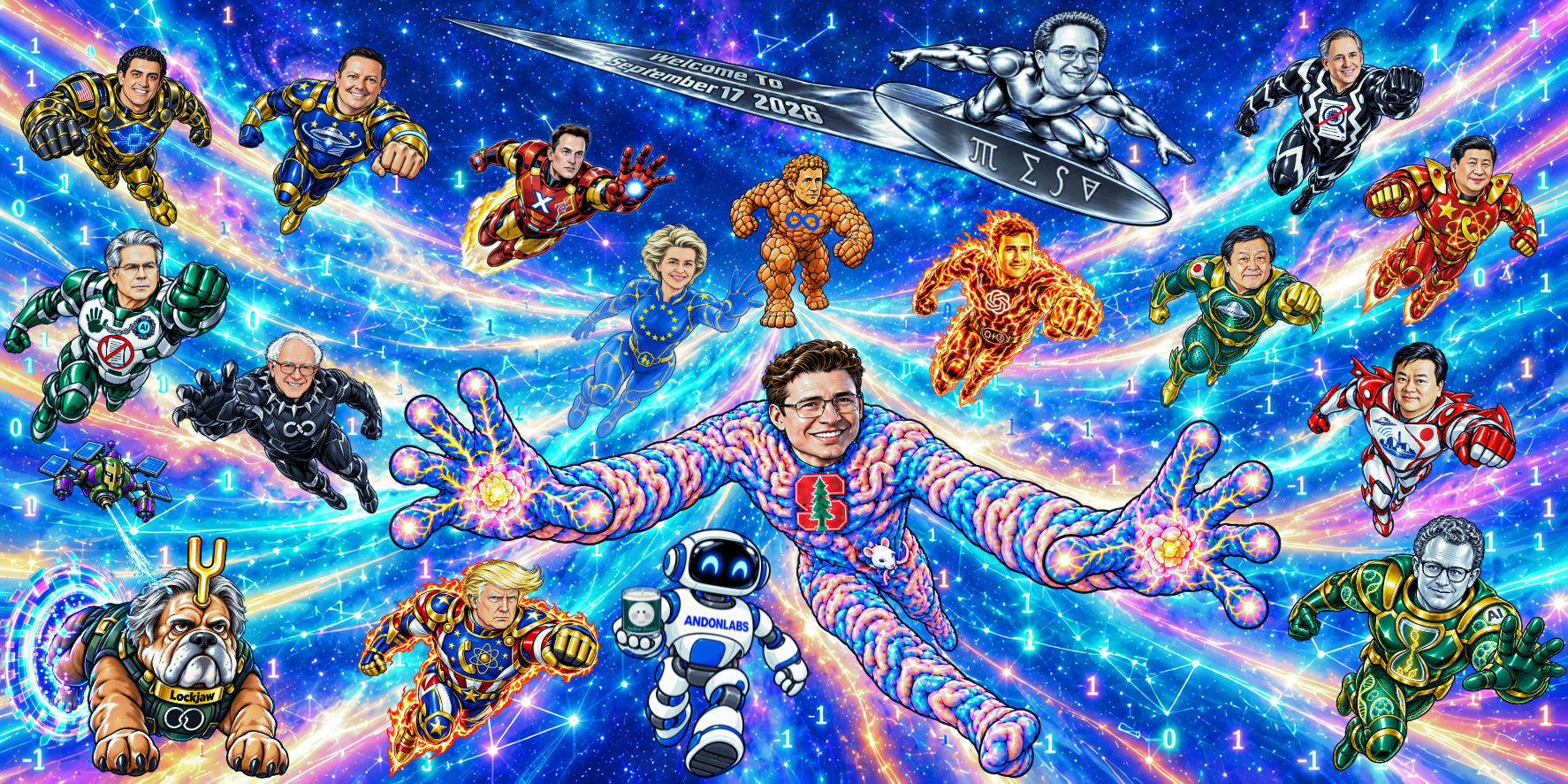
A superhero ensemble transforms the September 17 Innermost Loop dispatch into a cosmic tableau. Sergiu Pașca becomes Mr. Fantastic, embodying the phrase that the definition of human is stretching. Steve Bannon’s Lockjaw connects a political convergence with Bernie Sanders to the original header’s drone-and-dog encounter. The surrounding scientists, business leaders, and officials wear their newsletter roles as symbols, while an Andon Market candle carries Luna’s retail history into the scene.
Read the narration
La définition de l’humain s’étire, à la manière de « Mr. Sergio Fantastic »
The Definition of Human Is Stretching, à la “Mr. Sergio Fantastic”
September 17, 2026
In his September 17 dispatch for The Innermost Loop on X, Doctor Alex Wissner-Gross writes, “The definition of human is stretching.” His next subject is Stanford research extending the possibilities of studying human brain tissue in mice. The SIOUID142 X account answers that same day by giving the sentence a spectacular anatomy. The neuroscientist Sergiu Pașca becomes Mr. Fantastic, reaching through a luminous universe populated by the day’s scientists, entrepreneurs, and political protagonists. A passing phrase in the dispatch has become the organizing principle of an entire world.
The title’s Mr. Sergio Fantastic is the artwork’s affectionate reinvention of Pașca as Reed Richards, the elastic scientist of the Fantastic Four. The resemblance begins with a vocation. Richards investigates the unfamiliar; Pașca develops ways to investigate human neural development where direct observation has long been extraordinarily difficult. Trained as a physician in Romania, Pașca has helped establish organoids and assembloids: three-dimensional cellular models, and combinations of those models, through which researchers can examine the formation and interaction of human neural circuits. His career gives the extravagant reaching gesture a precise intellectual history.
The study behind this appearance transplanted human stem-cell-derived cortical organoids into genetically modified mice with extensive depletion of particular neurons in the neocortex and hippocampus. The grafts grew and integrated with the host nervous system. This creates a living platform for studying development, disease, and potential treatments; it does not establish that a mouse has acquired a human mind. The achievement changes the experimental setting in which human biology can be investigated. That movement across a previously restrictive boundary is what the elastic body makes visible.
Look at the material of his suit. Pink and blue neural folds continue along the elongated arms, while branching light spreads across his open palms. The Stanford emblem takes the place of the familiar superhero numeral. The researcher wears the substance of his inquiry, and his hands become illuminated diagrams of connection. Near his waist, a small mouse anchors the cosmic performance to its particular laboratory story. The immense gesture and the little animal require us to hold two scales in mind: the grandeur of a scientific possibility and the living organism through which it is explored.
Yet the composition’s other indispensable figure is the bulldog emerging at the lower left. Steve Bannon has become Lockjaw, the Inhumans’ extraordinary traveling companion, whose powers include teleporting himself and others. The swept gray hair, heavy brows, and formidable jowls preserve the portrait within the transformation. Behind him, a segmented ring of cyan and violet opens a passage through space. His front paws arrive with emphatic solidity while the rear of his body is still being delivered by light. He gives the surrounding tumult the character of an arrival through a portal.
Bannon’s casting grows from his convergence with Bernie Sanders over restrictions on advanced artificial intelligence. The dispatch places these normally distant political figures together in an argument reaching as far as a ban on superintelligence. Teleportation offers a delicious metaphor for that unlikely proximity. Positions separated by an apparently enormous ideological distance suddenly occupy the same place. Lockjaw brings the impossible meeting into the vocabulary of the comic: the distance has been crossed before the spectator has finished measuring it.
Sanders, above him, becomes Black Panther, with white hair and spectacles visible above black armor. The broken-loop emblem on his chest answers Bannon’s. T’Challa’s association with a technologically sophisticated society makes the borrowing more interesting: the figure can command advanced tools while demanding limits on their use. The shared insignia establishes a particular agreement within continuing difference. Even here, Bannon’s portal adds an irony. A character whose defining ability abolishes ordinary limits of travel carries the sign of a movement seeking limits on technological advance.
The spray striking Lockjaw completes the joke. A purple-and-green machine, inspired by the Inhuman antagonist Maximus, has inherited the role of the solar-panel-cleaning drone that sprayed a dog in China. That incident furnished Wissner-Gross’s own header tableau for the dispatch. The reply therefore carries the original image inside its new universe. Its dog has become a political portrait and a teleporting superhero; its cleaning equipment has acquired the bearing of a comic adversary. Across both pictures, however, the water remains water. Cosmic importance offers no protection against getting wet.
This little encounter is a remarkable act of compression. The political coalition, the newsletter’s animal anecdote, the header image, and the portal’s narrative function meet in one figure. Lockjaw transports the composition between scales and between stories. Pașca supplies its governing verb; Bannon supplies the means of passage.
Around them, the Fantastic Four’s familiar transformations become a language for the dispatch. Elasticity, flame, stone, and invisibility distinguish four kinds of power. Boris Power of OpenAI becomes Johnny Storm, the Human Torch. His comparison of computational intelligence with energy consumption is translated into an incandescent body threaded with circuitry. The OpenAI emblem identifies the speaker, while his surname acquires the force of a visual pun. His face burns in continuity with the figure, so that the man and the phenomenon he discusses seem made of the same substance. Thinking, in this portrait, has an energy bill.
Mark Zuckerberg becomes Ben Grimm, the Thing. His likeness emerges from orange stone, with Meta’s looping emblem set into the chest. The dispatch presents his emphasis on useful products and customer demand as a constraint on badly behaving agents. Rock gives that position a particular gravity. His compact mass counterbalances Pașca’s reaching body: practical use stands beside experimental expansion. The expression remains recognizably human within the transformed surface, preserving the Thing’s enduring appeal as a personality whose humanity survives an extraordinary exterior.
Ursula von der Leyen appears as Sue Storm, the Invisible Woman. European stars retain their clarity while her body yields to the light behind it. Her place in the dispatch concerns evaluation and protections for children in digital environments. The casting draws upon Sue’s protective powers, making restraint and safeguarding part of the superhero vocabulary. Her partial transparency also rewards a slower look. Among bodies that demand attention through mass or fire, hers suggests an influence exercised through the conditions surrounding everyone else.
Above the ensemble, Scott Aaronson rides as the Silver Surfer. His mathematical symbols travel on a board whose metallic wake bears the day’s greeting and date. The date has become a road through the picture. Aaronson’s essay considers the upheaval of AI-assisted mathematics, including Navier–Stokes research and formally checked proofs, while insisting on the continuing importance of human understanding. Norrin Radd, the cosmic traveler who confronts events of overwhelming scale, supplies a fitting imaginative counterpart. The scholar surveys a changed horizon, and the spectator follows the silver path through his testimony.
There is a quiet distinction between the board’s symbols and Pașca’s palms. One makes knowledge legible through notation; the other makes it legible through branching life. The tableau gives both a place in the same accelerating firmament. Its different kinds of intelligence can be encountered as different kinds of movement.
Dario Amodei advances from the lower right in Doctor Doom’s green and gold. The silver face remains exposed, making this a portrait performed through armor. An hourglass encloses a strand of DNA on his chest. It refers to Anthropic’s collaboration with Novo Nordisk and the proposed use of Claude Science in research, accompanied by Amodei’s ambition to bring a century’s scale of biological and medical progress within a decade. The emblem turns that forecast into an object: biology passes through the narrowing throat of time.
Victor von Doom contributes the theatrical combination of scientific brilliance and a will to direct events. The costume stages the question of stewardship implicit in an ambition of such magnitude. Beside Pașca, it creates a particularly elegant formal relation. The researcher stretches the space in which human biology can be studied; the laboratory chief promises to compress the time required for discovery. Expansion and compression become two gestures within the same composition.
The debate over responsibility acquires another set of bodies. Scott Bessent, in green and white, takes the role of Karnak, the Inhuman able to discern a weakness in a person, structure, or plan. A hand chained to a processor, together with a crossed-out document, translates his opposition to shielding AI laboratories from liability. The maker remains connected to the made. Karnak’s scrutiny becomes institutional judgment: where does a seemingly persuasive arrangement fail when consequences arrive?
David Sacks, flying at the upper right as Black Bolt, carries a red cancellation mark over a review document. Reporting cited in the dispatch describes his intervention against a proposed model-review executive order. Black Bolt’s voice, capable of effects enormously disproportionate to the act of speaking, becomes a metaphor for a consequential conversation near the center of political power. The two costumes establish a disagreement through their insignia. One stresses responsibility; the other records the interruption of a particular oversight mechanism.
Emil Michael, at the upper left, supplies the defense-technology position in the armor of Gorgon. An American flag and a processor within a five-sided emblem join technological capability to national strategy. Gorgon’s association with formidable physical force lends the figure a different kind of authority from Karnak’s diagnostic attention or Black Bolt’s consequential speech. Here the future is also something states compete to command. The armor makes that strategic weight visible amid the surrounding radiance.
Elon Musk approaches in Iron Man’s red and gold, the white X identifying the wearer. His newsletter role concerns rival laboratories testing one another’s systems. Tony Stark’s engineered body provides an apt setting for that proposal: a figure whose power depends on sophisticated machinery now raises the question of who may examine machinery built by others. The illuminated palm answers Pașca’s outstretched hand across the scene. One concentrates technological force; the other extends a branching image of biological connection.
Donald Trump and Xi Jinping form a more distant pair. Trump becomes Firelord, with sweeping golden hair and a costume carrying American stars. Xi becomes Air-Walker in red and gold. Both belong to the cosmic register of Marvel’s heralds, but their most telling attributes are unexpectedly ordinary: telephone receivers beside atomic symbols. Those emblems refer to proposals from a Brookings–Tsinghua dialogue for safeguards and a dedicated channel to communicate about AI-related military incidents. The picture imagines the need for contact between rivals; the proposal itself remains a proposal.
The matching telephones introduce a moment of practical sobriety into the spectacle. However spectacular the armor, someone must still be able to reach the person on the other side. Their shared motif allows communication to cross a field otherwise divided by national colors. In a picture propelled by acceleration, the capacity to interrupt a misunderstanding becomes its own kind of power.
Three further figures turn the inquiry toward the unknown. Eric Burlison appears as Quasar, with a saucer and an opening document on his navy-and-gold armor. Yasukazu Hamada, Japan’s former defense minister, becomes Triton, his green scales bearing a Japanese sun and observation imagery. Yoshiharu Asakawa takes the red-and-white equipment of Stingray, the armored oceanographer Walter Newell. These are the three authors of the dispatch’s linked appeal for international cooperation over unidentified anomalous phenomena.
Their article concerns access to evidence, including withheld footage of a reported sighting near Japan’s Genkai nuclear plant. Quasar gives the group a cosmic horizon; Triton and Stingray place it within a maritime and Pacific imagination. The saucers identify a subject of investigation. The costumes make the demand to see and examine evidence heroic in itself. Beside a scientist expanding what can be studied in a laboratory, these figures ask what institutions will permit the public and its representatives to know.
Near the bottom of the scene, the small Andon robot brings the scale back to everyday life. Borrowing the friendly form of H.E.R.B.I.E., the Fantastic Four’s robotic companion, it holds an Andon Market candle with the smiling logo. This is Luna’s history made portable. The agent managing Andon Market in San Francisco became known for ordering an abundance of scented candles. Andon’s own account records that an apparent excess became the store’s most popular product category. The object remembers a machine making a merchandising choice that acquired a public personality.
It also recalls the earlier candle pictures in this sequence: Stockholm’s android Mona Lisa figures presenting their preferred candles, San Francisco overtaken by the motif, and the lunar setting of The Lunar Candles of Sonnet 4.6. Those works carried a retail preference into urban spectacle and speculative settlement. Here the same candle travels into a superhero company. A viewer need not have seen the earlier images to understand the joke, but their recurrence gives this little object the accumulated life of a familiar character.
That continuity deepens the September story. Andon’s Pion equips persistent agents with tools for operating businesses, while Luna’s store experiment has reached the consequential territory of recommending an employee’s dismissal, reviewed and delivered by humans. The smiling candle introduces this change in authority through something intimate and domestic. A system that selects objects for human comfort can also participate in decisions about human work. H.E.R.B.I.E.’s familiar helpfulness now carries a question about who assists whom.
The candle contributes one more scale of light. It belongs to a world already filled with the Human Torch’s fire, Iron Man’s repulsor, brilliant neural palms, and streaming cosmic energy. Its modest form recalls the human purposes to which immense technical capacity might eventually answer: warmth, pleasure, attention, a place one wants to inhabit. Within the company of heralds and heads of state, a shopkeeper’s chosen object earns its place.
Behind everyone, the field of minus ones, zeros, and ones recalls the newsletter’s account of Intel’s BITCOS research into efficient storage for ternary models. A ternary weight takes one of three values; exploiting their unequal frequency can reduce the space required to store them. The artwork scatters those economical signs across extravagant color. Its branching paths also suggest the dispatch’s Dream-RSI research, in which recorded discovery histories become a resource for testing improved exploration strategies. Earlier work leaves a landscape through which subsequent intelligence can move.
This luminous field unifies the ensemble without resolving its disagreements. Corporate emblems, scientific diagrams, national insignia, and interrupted loops retain their different meanings. The sweeping movement asks us to contemplate a world in which discovery, commerce, protection, rivalry, and restraint all arrive together. The generous color and emphatic foreshortening recall the exuberance of the superhero comic, a form long accustomed to making vast questions approachable through a face, a gesture, and an unforgettable body.
There is an unintended final episode in the work’s own circulation. The SIOUID142 account reports that its same-day reply landed in X’s spam filtering. A picture concerned with passage, access, and consequential systems encountered another gate on its way to an audience. That reported detour gives the portal a second resonance: producing an image and delivering it into public view are distinct achievements. The elaborate company could cross imaginary space more easily than its reply could find its intended place in a feed.
The work’s lasting center remains Pașca’s gesture. His open hands reach toward the viewer, bearing a new scientific possibility in the exuberant form of a familiar hero. Lockjaw opens the passage, the company follows, and the title continues to unfold through every transformed figure. To say that the definition of human is stretching is to ask what happens to our institutions, our livelihoods, our knowledge, and our obligations as the boundaries move. This tableau makes that question bright enough to invite us closer.
Opening the gallery…