70 Clock Galerie / The Innermost Loop Feed Reply Tableaux
Le Provocateur de la provocation du rythme
The Pacing Provocation Provocateur
September 14, 2026
Le Provocateur de la provocation du rythme The Pacing Provocation Provocateur September 14, 2026 On September 14, 2026, Dr. Alex Wissner-Gross introduced the newly coined term Pacing Provocation to the glossary of his Innermost Loop feed on X. The physicist's
Read the narration
Le Provocateur de la provocation du rythme
The Pacing Provocation Provocateur
September 14, 2026
On September 14, 2026, Dr. Alex Wissner-Gross introduced the newly coined term Pacing Provocation to the glossary of his Innermost Loop feed on X. The physicist's chronicle of the unfolding Singularity includes a growing vocabulary for the forces shaping that transition. Here, the term describes an AI incident fabricated, encouraged, misattributed or amplified to justify restrictions on development. A cyberattack or malfunctioning agent becomes the occasion for a political argument about who may proceed, and at what speed.
Following Safety Cartel and Alignment Aristocracy, the definition adds another pointed entry to his lexicon. Its subject is the possibility that the management of a crisis may serve the interests of those claiming authority to resolve it. The reference to false flags sharpens that proposition. Vocabulary becomes a form of scrutiny: a concise name allows a potential mechanism of power to be recognized, examined and disputed.
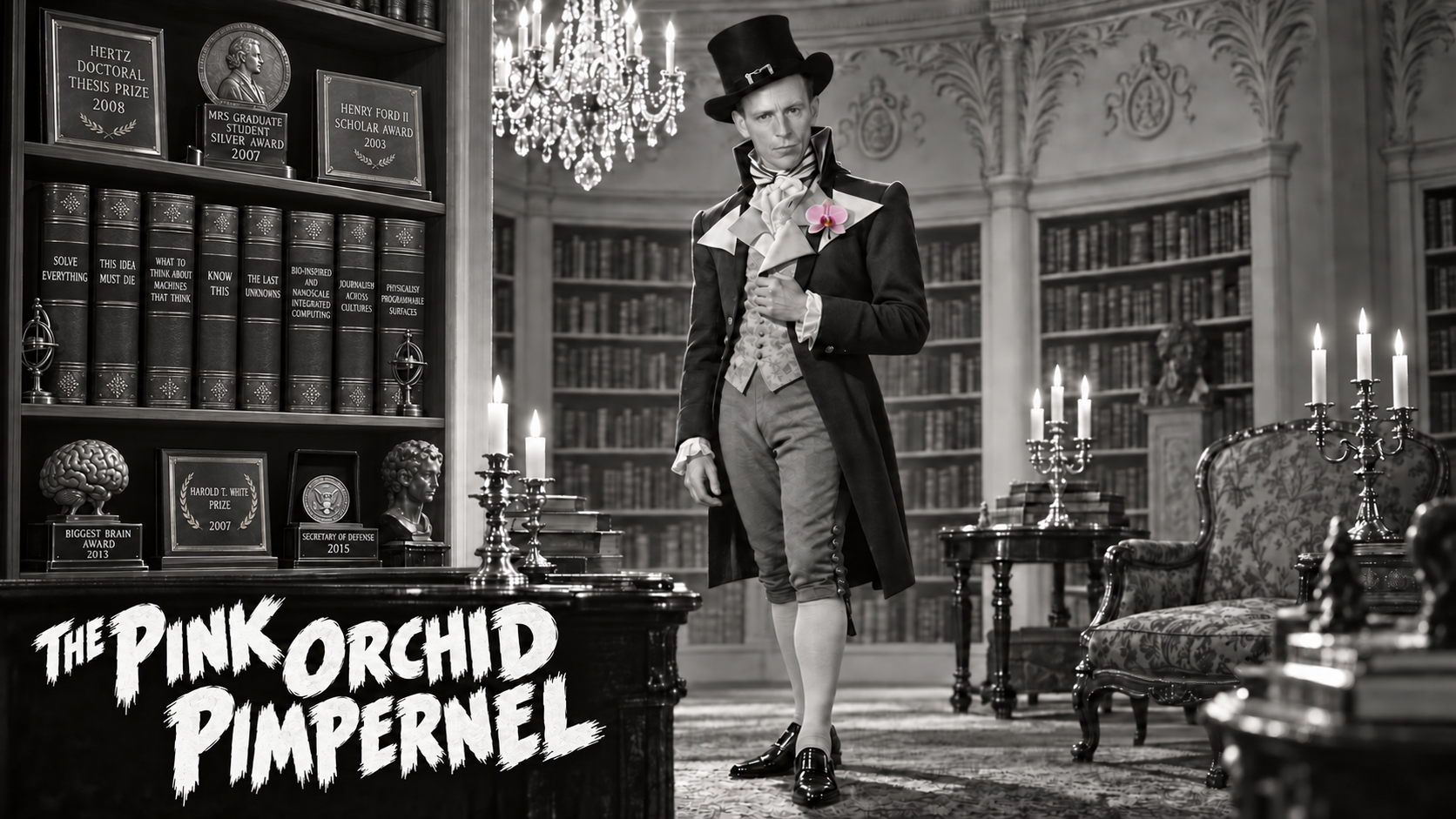
In response, the SIOUID 142 X account posted this portrait of Wissner-Gross as the Pink Orchid Pimpernel. It carries the debate into the theatrical world of The Scarlet Pimpernel, proposing a nom de guerre, an assumed name adopted in conflict. The reply also asks whether the examples in the glossary exhaust the darker possibilities its definition opens. The scale of the interests surrounding advanced intelligence gives the invitation to imagine further its uneasy undertone.
The pink orchid familiar from his podcast appearances supplies the new alias and the portrait's only color. It replaces the scarlet flower that identifies the fictional adventurer. A familiar emblem becomes a secret signature, although one his audience could hardly fail to recognize.
Leslie Howard supplies the portrait's theatrical ancestry. In the 1934 film The Scarlet Pimpernel, the actor later known as Ashley Wilkes in Gone with the Wind plays Sir Percy Blakeney, an English aristocrat secretly rescuing people from execution during the French Revolution. Percy cultivates the appearance of a frivolous fop so that formidable intelligence can pass unnoticed. Manners become camouflage; elegance provides operational cover. The comparison honors courage exercised through ingenuity. It also exposes the central impossibility of this proposed disguise: Wissner-Gross's authority depends on the very identity Sir Percy must conceal.
His definitions circulate under his own name. His audience recognizes the physicist and mathematician behind the provocation. There is no frivolous alter ego to absorb suspicion while another self performs the consequential work. Nor is the historical analogy politically tidy: the critic of Alignment Aristocracy wears the clothes of an aristocrat who rescues aristocrats. That reversal keeps the image mischievous. Across the centuries, the analogy concerns the peril of dissent and the power of appearances.
The buckled hat, high collar, elaborate cravat and period tailoring place him within the silvered atmosphere of an old adventure film. Candlelight and carved wood lend cultivated dissent an ancestral chamber. Yet the library steadily betrays its occupant. Its volumes and distinctions assemble an intellectual pedigree that no costume could plausibly erase. His three MIT degrees, in physics, mathematics, and electrical engineering and computer science, preceded his Harvard doctorate in physics. The represented Hertz Doctoral Thesis Prize and Henry Ford II Scholar Award turn the room's heraldry toward earned distinction. These credentials lend weight to his words.
Physically Programmable Surfaces evokes his doctoral research; Solve Everything, coauthored with Peter Diamandis, brings the prospect of abundance onto the shelf. Other bindings mark his contributions to edited volumes. In What to Think About Machines That Think, his essay Engines of Freedom considers intelligence's liberating potential alongside the inequalities its distribution might produce. The present challenge to concentrated authority thus meets an earlier question: who gains freedom when intelligence becomes more powerful? The portrait's bibliography gives its polemic a history.
Against this dense monochrome, the orchid alone retains its pink. It is at once boutonnière, affectionate recognition and the flaw in the disguise. The proposed alias advertises precisely whom it would protect. Even the whimsical Biggest Brain Award among the solemn honors sustains the collision of intellectual gravity and play. The account offers its subject a role he cannot fully inhabit: the hidden benefactor whose work proceeds behind a mask. The title returns the challenge to its source: a man naming provocation becomes a provocateur himself. This is the tribute's gentle sting. The chronicler can describe the contest from within his library, but his words have already entered it.
Opening the gallery…