70 Clock Galerie / The Innermost Loop Feed Reply Tableaux
Ne me marchez pas sur le fil
Don't Thread Line On Me
September 13, 2026
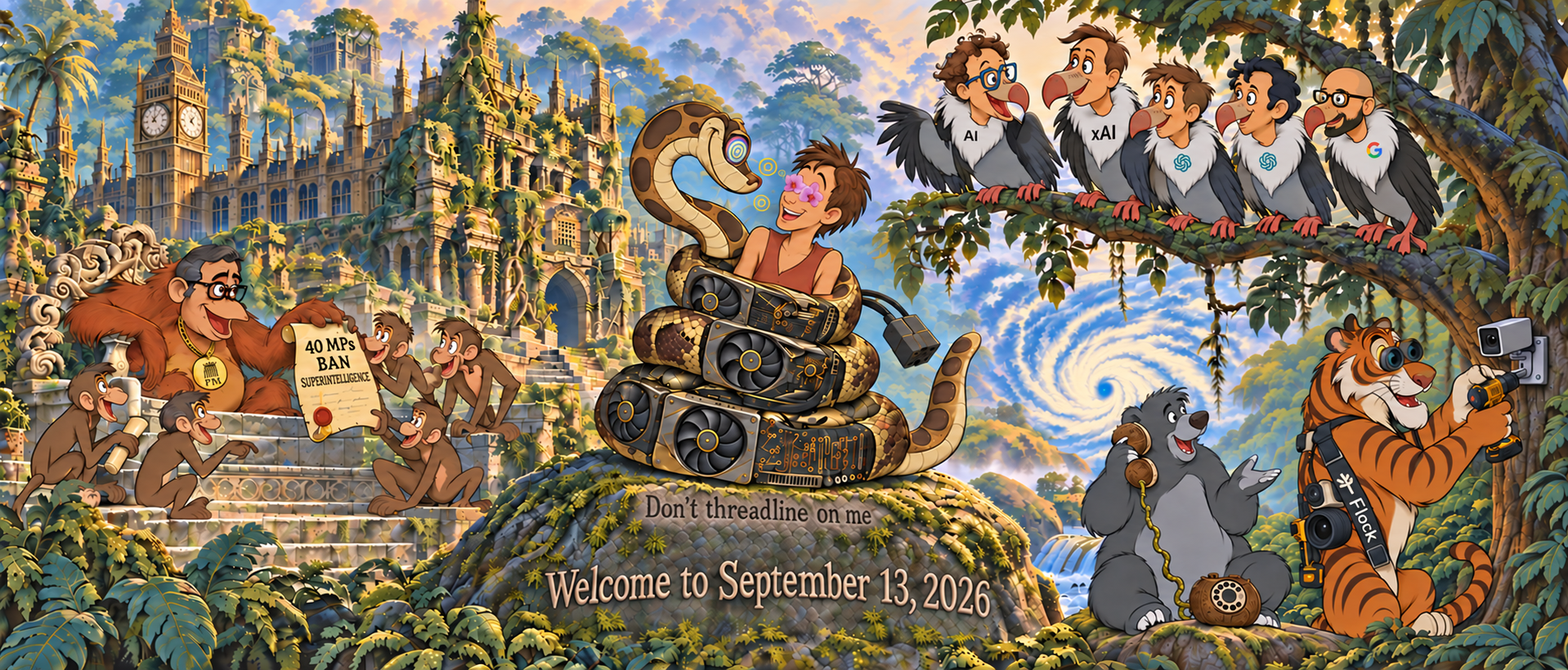
Ne me marchez pas sur le fil Don't Thread Line On Me September 13, 2026 The serpent has exchanged its battle cry for a smile. Its coils retain the graphics cards, fans and circuitry of the menacing snake in Dr. Alex Wissner-Gross's September thirteenth header
Read the narration
Ne me marchez pas sur le fil
Don't Thread Line On Me
September 13, 2026
The serpent has exchanged its battle cry for a smile. Its coils retain the graphics cards, fans and circuitry of the menacing snake in Dr. Alex Wissner-Gross's September thirteenth header tableau. Yet the creature now inhabits the beguiling world of Disney's 1967 Jungle Book. The Gadsden rattlesnake has become Kaa, the python whose most formidable instrument is enchantment. The critical gesture is immediate: technological power can captivate the very people who believe themselves its defenders.
Posted by the X account SIOUID 142, the work answers that day's Innermost Loop, Wissner-Gross's chronicle of the singularity. The dispatch describes leading AI laboratories proposing coordinated restraint and independent evaluation, then challenges their authority to regulate the frontier. His expressions “safety cartel” and “alignment aristocracy” give institutional caution the vocabulary of privilege. Here the forensic chronicler becomes an advocate; the illustration turns his scrutiny back upon his own position.
The Gadsden flag of 1775 made a coiled rattlesnake an emblem of resistance to authority. Replacing “tread” with “thread” recruits that defiance into computing. A thread is a sequence of computational instructions; a “thread line,” in Wissner-Gross's glossary, is a queue for scarce computing capacity when new data centers are obstructed. The title joins liberty to access. But a revolutionary emblem brings its combative inheritance into the argument: can disagreement still be heard once oversight has been cast as oppression?
A smiling human occupies Mowgli's vulnerable place within the coils, his identity uncertain. Then a minute detail arrests the eye: pink orchids bloom within the entranced gaze. Wissner-Gross's signature flower, concealed, permits an intimate reading. Perhaps the observer of the singularity has himself become susceptible to its promise. In the film, Mowgli's independence coexists with his difficulty distinguishing protection from predation. Here that predicament becomes intellectual: expertise may sharpen perception without conferring immunity to fascination. The orchid leaves the suggestion delicately unresolved.
Above, five vultures assemble Dario Amodei, Elon Musk, Sam Altman, Boris Power and Demis Hassabis into a corporate chorus. They recall the newsletter's succession of endorsements for pacing frontier development. Disney's vultures befriend Mowgli and help him against Shere Khan; their friendship complicates the scavenger metaphor. Their fellowship suggests protection even as their collective voice evokes the consensus Wissner-Gross distrusts. The satire turns on who may speak for everyone's safety, and whether agreement among the powerful creates reassurance or merely a more persuasive perch.
At Westminster, King Louie takes the role of Andy Burnham, the prime minister named in the dispatch. The monkeys' petition represents forty British MPs seeking a ban on superintelligence. In Disney's story, Louie covets humanity's command of fire, the knowledge that might transform his condition. Here the ruler who longs for transformative power receives a demand to prohibit it. The inversion makes the parliamentary scene a fable about institutions asked to govern a capability they fear, desire and cannot yet possess.
Below, Shere Khan installs a Flock camera while Baloo makes the telephone call. They recast the report that a Flock worker called police on a journalist filming a public camera installation. The tiger's mechanical eyes give surveillance a predatory anatomy. Flock's license plate recognition uses machine vision to turn passing vehicles into searchable records; watching acquires memory, scale and the capacity to connect observations. Yet the watcher objects to being watched. Baloo's familiar geniality makes the contradiction more unsettling: intrusive systems can arrive through ordinary, reassuring conduct. The scene asks whether accountability travels in both directions.
Far behind them, a cyclone recalls the dispatch's report that no Atlantic hurricanes had appeared by September twelfth. Wissner-Gross jokes that, if this is someone's geoengineering experiment, it should be deployed. The conditional matters. Hurricanes depend on ocean heat, atmospheric moisture and wind shear; their absence alone establishes no engineered cause. The painted storm embodies this absent event and the attraction of planetary control. Its distant eye quietly echoes Kaa's hypnotic rings. A welcome outcome can tempt the imagination to applaud an intervention before its existence, consequences or authority have been established.
Through these interlocking gazes, homage acquires the freedom to question. The commentator exposing another institution's enchantments may inhabit an enchantment of his own. The serpent remains delightful. The orchids ask whether delight has begun to determine what can be seen.
Opening the gallery…