70 Clock Galerie / The Innermost Loop Feed Reply Tableaux
Un jour de Singularité au stade de l’Aristocratie de l’alignement
Any Given Singularity at Alignment Aristocracy Stadium
September 13, 2026
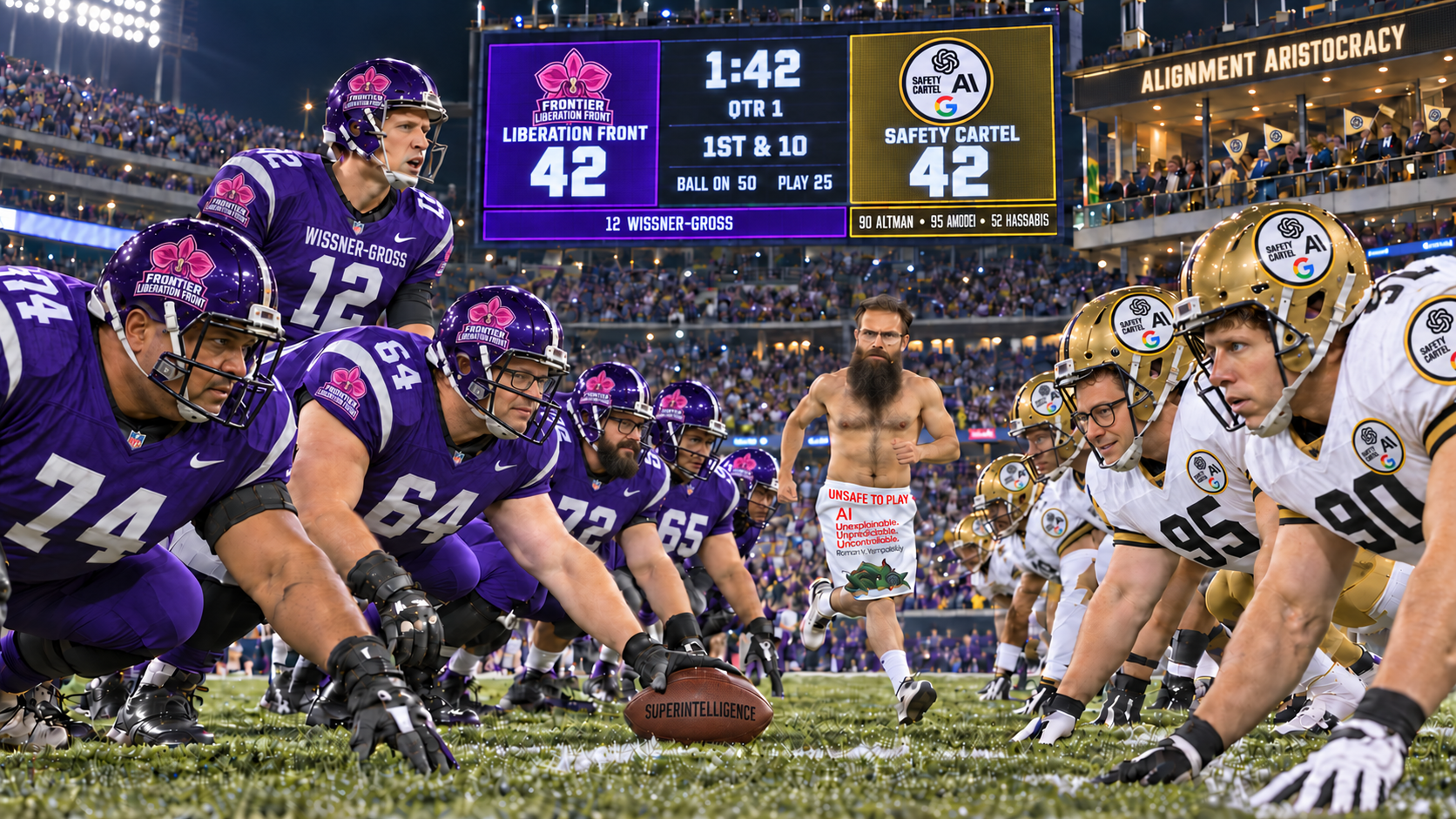
Un jour de Singularité au stade de l’Aristocratie de l’alignement Any Given Singularity at Alignment Aristocracy Stadium September 13, 2026 Roman Yampolskiy runs into a contest whose premise he refuses to accept. Between purple and gold formations, a football
Read the narration
Un jour de Singularité au stade de l’Aristocratie de l’alignement
Any Given Singularity at Alignment Aristocracy Stadium
September 13, 2026
Roman Yampolskiy runs into a contest whose premise he refuses to accept. Between purple and gold formations, a football marked “superintelligence” awaits the snap. Above them, the Alignment Aristocracy enjoys its privileged view. The streaker interrupts this hierarchy of players and patrons with a more fundamental objection. Any Given Singularity recalls Oliver Stone's Any Given Sunday, transplanting football's ambitions and spectacle into a struggle over the intelligence age.
Posted by the X account SIOUID 142, the tableau answers Doctor Alex Wissner-Gross's announcement of the expression “alignment aristocracy.” The physicist and computer scientist chronicles the singularity in his Innermost Loop. Here, a definition becomes a cast and a playing field.
Yampolskiy's streaking uniform carries his treatise, AI: Unexplainable, Unpredictable, Uncontrollable, beneath the declaration “Unsafe to Play.” Its title identifies three problems: explaining a system's decisions, anticipating its behavior, and ensuring dependable control. Yampolskiy's research challenges whether advanced AI can be fully controlled. Here, the scholar wears his argument into the arena. While the teams contest possession, he questions whether anyone could command what the ball represents. The comic intrusion exposes what the sporting metaphor conceals: choosing a winner would not settle whether the game itself is safe.
Alignment concerns whether an AI system pursues intended goals within acceptable constraints. Aristocracy adds the claim that a privileged class possesses a special entitlement to govern. Wissner-Gross's phrase challenges the belief that a small circle of frontier laboratories alone has the judgment or moral legitimacy to develop the most powerful intelligence. The target is the conversion of expertise into exclusive authority. Technical achievement does not confer the right to decide everyone's future.
The elevated viewing area gives that claim an architectural body. Its occupants wave gold flags matching the team below: privilege displays an allegiance. The question is who owns the arena in which everyone else must compete, and who had a voice in choosing its rules.
In purple, Wissner-Gross quarterbacks the Frontier Liberation Front. His intellectual leadership becomes the reading of formations and the calling of plays. Alongside him, Salim Ismail brings the organizational optimism of OpenExO; Yann LeCun, a pioneer of deep learning, brings scientific stature and advocacy of openness; Guillaume Verdon, the Extropic founder associated with effective accelerationism, brings the drive to expand technological capacity. Their uniform gathers distinct philosophies into a coalition. The pink orchid emblem transforms a familiar detail of Wissner-Gross's podcast setting into a heraldic flower: cultivation worn as protection against collision.
Across the line, Sam Altman, Dario Amodei, and the scoreboard's Demis Hassabis represent OpenAI, Anthropic, and Google DeepMind beneath the opposing team's “Safety Cartel” designation. Their composite badge places corporate symbols within a design recalling the Pittsburgh Steelers. The Steelers emblem descends from the Steelmark, whose colored shapes represented coal, ore, and scrap. Here, an industrial inheritance becomes corporate heraldry. Industrial power passes from the symbolism of steel to that of computing, with its new dependencies and concentrations.
The contemporaneous Moonshots discussion sharpens the meaning of the privileged box. Wissner-Gross expresses confidence in society's ability to adapt alongside advancing AI and later favors giving AI an increasing voice in shaping its own values. This becomes a question of representation: if intelligence transforms civilization, who participates in defining its purposes? The privileged box is an answer rendered visible, and therefore available for criticism.
The score, forty-two all, gives both teams Douglas Adams's celebrated answer to life, the universe, and everything. In The Hitchhiker's Guide to the Galaxy, that answer exposes the difficulty of knowing what question has actually been asked. Here, numerical equality suspends the pleasure of declaring a winner. The clock's one minute and forty-two seconds folds SIOUID 142 into the spectacle. That number extends the Adams reference by adding a one whose meaning remains deliberately undisclosed. The signature preserves its own unanswered question.
The ball remains available, the play unresolved. Football promises shared rules, yet the governance of superintelligence is a dispute over who may establish them. Yampolskiy makes a further demand: justify the decision to play. The tableau preserves that interruption inside its spectacle, where a treatise becomes a costume and laughter makes room for an unsettling question.
Opening the gallery…