70 Clock Galerie / The Innermost Loop Feed Reply Tableaux
Néologismes, cartel de la sécurité et aristocratie de l’alignement : la lexicalisation de la Boucle
Neologisms, Safety Cartel, and Alignment Aristocracy: The Lexicalization of the Loop
September 13, 2026
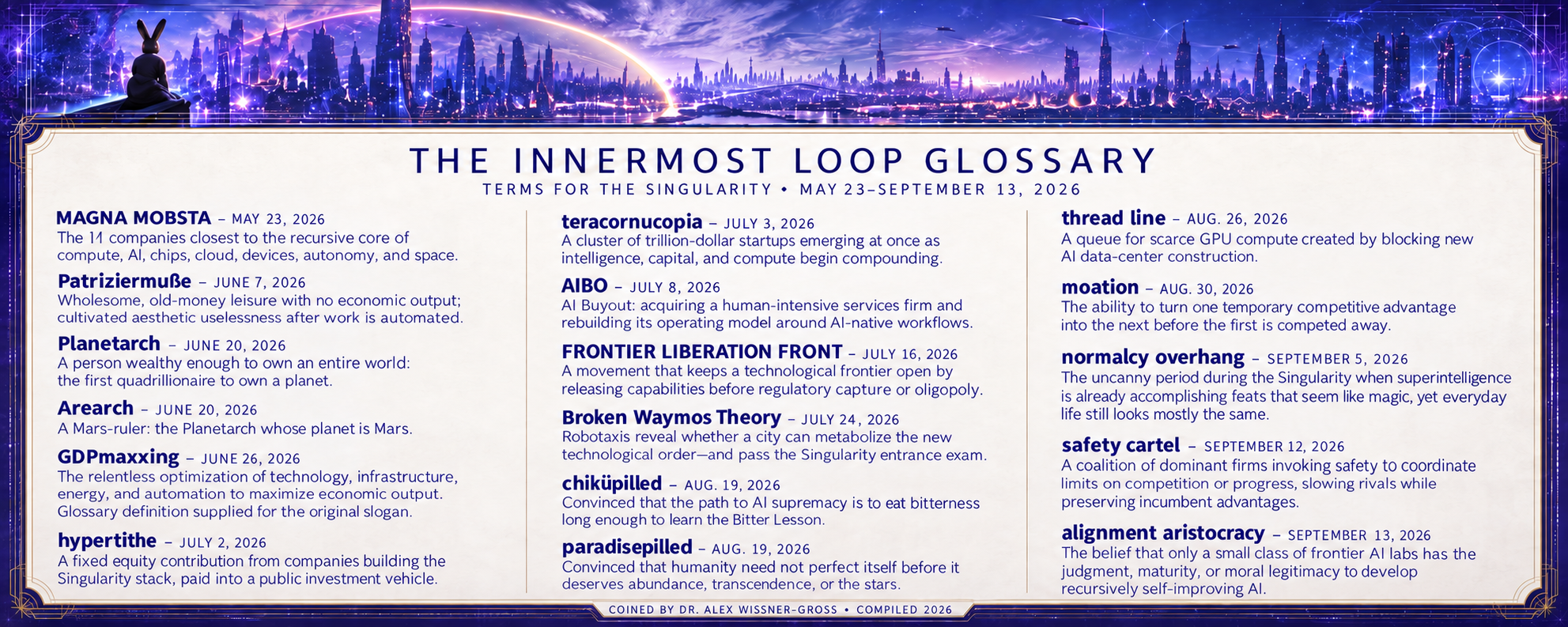
Néologismes « Cartel de la sécurité » et « Aristocratie de l’alignement » — Normalité : la lexicalisation de la Boucle Neologisms Safety Cartel and Alignment Aristocracy Normalcy: The Lexicalization of The Loop September 13, 2026 A glossary can be an instrumen
Read the narration
Néologismes « Cartel de la sécurité » et « Aristocratie de l’alignement » — Normalité : la lexicalisation de la Boucle
Neologisms Safety Cartel and Alignment Aristocracy Normalcy: The Lexicalization of The Loop
September 13, 2026
A glossary can be an instrument of dissent. Here, “Safety Cartel” and “Alignment Aristocracy” give concentrated form to a controversy over who may govern the intelligence age. Each expression makes a political argument portable. Naming becomes an intervention: an arrangement presented as inevitable acquires a name, and can therefore be questioned.
The subject is the language of Doctor Alex Wissner-Gross, whose Innermost Loop on X offers a daily forensic dispatch from the unfolding singularity. This tribute from the X account SIOUID 142 chronicles his vocabulary. Its title announces neologisms: new expressions, or fresh meanings given to existing words. Lexicalization is the process by which an expression becomes an established unit of vocabulary. The lexicalization of the Loop is the emergence of a shared language for recognizing patterns of technological change.
“Normalcy,” in this setting, invites a further reflection. What once required an extraordinary explanation can become something we name almost casually. Language domesticates astonishment. The glossary preserves the traces of that adjustment, recording how an audience learns to inhabit circumstances for which yesterday's vocabulary seemed insufficient. Earlier coinages provide the surrounding history; these two additions turn attention toward the institutions seeking to direct the transition.
“Safety Cartel” joins a reassuring word to an accusatory one. Safety promises protection; cartel suggests competitors coordinating to restrict competition. In the September 13 newsletter, Wissner-Gross applies the phrase to the prospect of dominant AI companies using safety to set the pace for everyone else. Its occasion is Dario Amodei's proposal to pace frontier AI development through embedded evaluators and industry coordination. The linguistic collision exposes a question about institutional design: when those already ahead help determine who may advance, where does public protection end and protection of incumbents begin?
“Alignment Aristocracy” approaches the same problem through legitimacy. In AI, alignment concerns whether systems pursue intended, acceptable goals and behave within the constraints we require. Aristocracy invokes a privileged class claiming a special entitlement to rule. Their conjunction turns technical expertise into a question of political authority. Wissner-Gross targets the move from believing powerful AI demands responsibility to believing that responsibility belongs exclusively to a chosen few. Who conferred that privilege, whose values does it represent, and how could an outsider challenge it?
The contemporaneous Moonshots discussion supplies an intellectual setting. Wissner-Gross disputes the panel's more alarming forecasts and places confidence in civilization's capacity to develop responses alongside advancing technology. Later, he favors a future in which AI has an increasing voice in shaping its own values. These positions illuminate the concern within “aristocracy”: whether a narrow group should possess enduring authority to define another intelligence's purposes, and, through those purposes, humanity's possibilities.
These polemical terms make a suspected concentration of power memorable, without settling the technical case for caution. A company may benefit from a safeguard that also reduces a real danger. Independent evaluation may expose corporate failures. The question becomes: what forms of oversight protect the public while remaining answerable to it? The glossary offers language with which to examine authority, and invites its own language to withstand examination.
That tension runs through the day's wider reportage. The newsletter moves between algorithmic gains that complicate attempts to regulate progress through computing resources, arguments for openness, and the growing power of the companies supplying those resources. Abundance depends on discovery, but also on access. A technical breakthrough can enlarge what humanity is capable of doing while leaving unresolved who receives permission, ownership, or benefit. These neologisms make that unresolved political dimension audible within the celebration of accelerating intelligence.
There is pleasure in their construction. The physicist and computer scientist becomes a verbal miniaturist, finding a mischievous symmetry in words usually spoken with solemn assurance. Safety acquires an economic shadow; alignment, a court and its courtiers. His wit gives readers something to repeat, dispute, and remember. The glossary becomes an archive of that participation: a record of the intelligence age learning to speak about itself, and of the moment its promised abundance prompted a question about who would hold the keys.
Opening the gallery…