70 Clock Galerie / The Innermost Loop Feed Reply Tableaux
Maison Innermost Loop – Beatriz Villarroel défile
House Innermost Loop – Beatriz Villarroel Walks
September 12, 2026
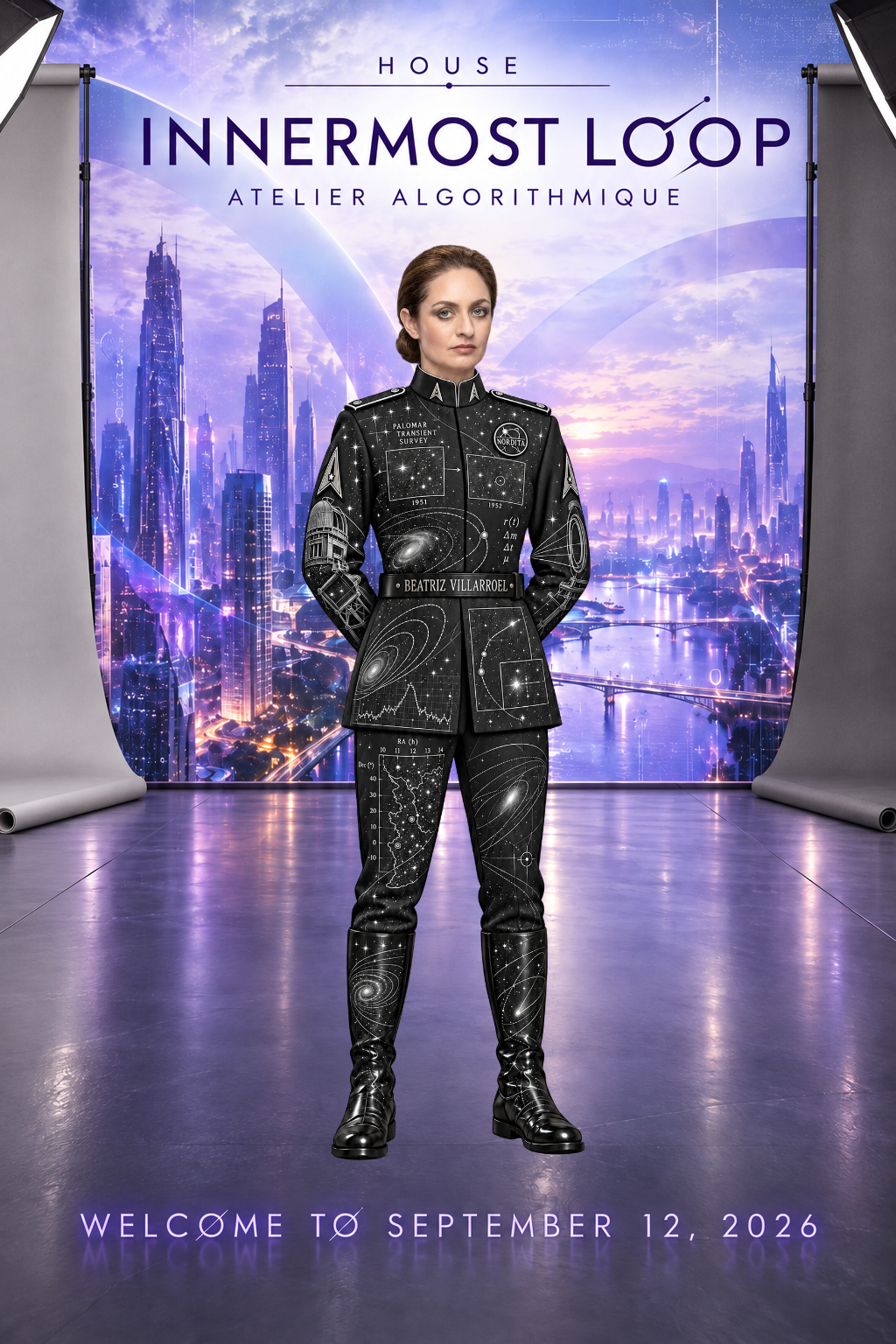
Maison Innermost Loop – Beatriz Villarroel défile House Innermost Loop – Beatriz Villarroel Walks Two small fields of stars occupy Beatriz Villarroel's chest, dated 1951 and 1952. An arrow links them. Around this compact act of comparison, telescopes, orbital
Read the narration
Maison Innermost Loop – Beatriz Villarroel défile
House Innermost Loop – Beatriz Villarroel Walks
Two small fields of stars occupy Beatriz Villarroel's chest, dated 1951 and 1952. An arrow links them. Around this compact act of comparison, telescopes, orbital curves, and galaxies spread across a black tunic and tall boots. Her hair is gathered in a low bun, leaving the scientific surface unobstructed. The portrait's first drama is a change between observations: a light appears in one record, and the next invites the eye to look again.
The work is SIOUID 142's House Innermost Loop at Atelier Algorithmique response to Dr. Alex Wissner-Gross's September 12, 2026 Innermost Loop dispatch on X. The House invites him to make fashion abundance a sixteenth moonshot. Villarroel appears in the issue's closing discussion of historical Palomar transients and studies of possible explanations. Her research practice becomes the basis of the look: comparison becomes couture, and the archive something a person can wear.
Villarroel's astronomical work at Nordita, the Nordic Institute for Theoretical Physics, and with the VASCO project has examined sources that appear or disappear when observations from different periods are compared. Recognition through the L'Oréal-Unesco program accompanied this developing research career. The Nordita emblem on the garment places her institutionally, while the paired fields identify her distinctive question. Her stars belong to a practice of looking for changes in the recorded sky.
The dates on the chest recall photographic astronomy before the launch of Sputnik in 1957. The pictured fields are artistic motifs whose pairing gives historical observation a clear role. An old exposure can contain information that becomes newly useful when compared with another record. The portrait joins two times: when light reached an instrument and when a researcher asks a new question of what it preserved.
The notation beside the galaxy makes observation more exact. Delta m suggests a change in astronomical magnitude, a logarithmic measure of brightness; delta t marks a time interval. A light curve records how measured brightness varies with time. On the trouser leg, right ascension and declination supply celestial coordinates, broadly analogous to longitude and latitude on a map. These details turn the glittering surface into an introduction to what an astronomer measures: where something is, how bright it appears, and how it changes.
The September modeling paper by Villarroel and collaborators investigates whether short-lived Palomar transients could be consistent with specular reflections, the glints produced when a reflective surface directs light toward an observer. Under stated assumptions, the authors explore orbital altitudes and the physical properties that could produce such flashes. Their ranges extend toward the geosynchronous region rather than identifying one established orbit. The garment's nested curves and telescope drawings are appropriate to this inquiry into geometry, illumination, and the conditions of observation.
A second paper studies geographic clustering after projecting the historical observations onto Earth under an assumed model. That step introduces choices about geometry and selection that matter to interpreting the resulting pattern. The research does not, by itself, establish an extraterrestrial origin. The portrait retains its fascination through the investigation: the effort to distinguish a signal from an artifact, compare explanations, and identify observations that could help resolve the question.
Wissner-Gross places this material beside disclosure discussion, yet Villarroel's garment emphasizes instruments and comparison rather than public declarations. It also echoes a theme running through the day's AI coverage: new computational methods can make older material available to different kinds of analysis. A neural map, a corpus of text, and a photographic plate each preserve structure that may support further inquiry. The future can emerge through a changed reading of an existing archive.
The officer cut develops the newsletter's Space Force story through playful Star Wars styling. Villarroel's capless appearance and astronomical diagrams distinguish her within that shared cut. In the twenty-person runway, she closes the formation at the far right, following the issue's turn toward the sky. The lavender city repeats the radiance of the stars, while her paired fields preserve the specific work of comparison.
The portrait honors the discipline of noticing. Two dates, a brightness change, a coordinate: modest distinctions can become the beginnings of a larger question. SIOUID 142's fashion invitation makes that patient attention attractive and memorable. The garment's beauty resides in its many lights, but its intellectual identity begins with the space between two records, where something has changed and another act of looking becomes necessary.
Opening the gallery…