70 Clock Galerie / The Innermost Loop Feed Reply Tableaux
Maison Innermost Loop – Stephen Miller défile
House Innermost Loop – Stephen Miller Walks
September 12, 2026
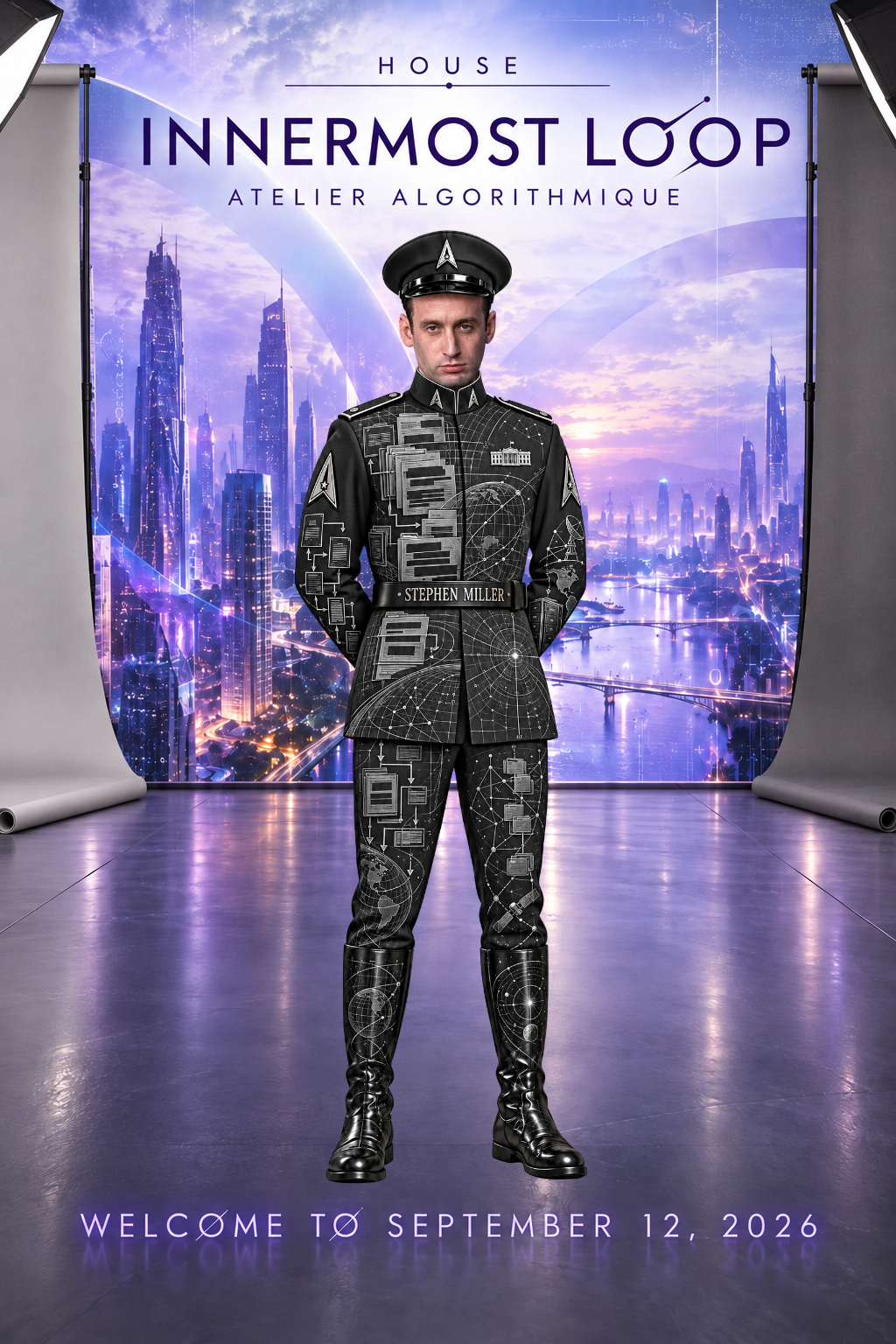
Maison Innermost Loop – Stephen Miller défile House Innermost Loop – Stephen Miller Walks Black bars interrupt the pale documents across Stephen Miller's tunic. The pages remain visible as objects, with margins, edges, and overlapping layers, while portions of
Read the narration
Maison Innermost Loop – Stephen Miller défile
House Innermost Loop – Stephen Miller Walks
Black bars interrupt the pale documents across Stephen Miller's tunic. The pages remain visible as objects, with margins, edges, and overlapping layers, while portions of their contents disappear beneath the dark rectangles. Arrows carry other pages along the sleeves and trousers. Globes, satellites, and coordinate grids fill the surrounding cloth. The portrait gives information two simultaneous appearances: present as a record, and partly unavailable as readable text.
SIOUID 142 created this image for House Innermost Loop at Atelier Algorithmique, responding to Dr. Alex Wissner-Gross's September 12, 2026 Innermost Loop dispatch on X. The House proposes fashion abundance as a sixteenth moonshot. Miller appears through Tim Burchett's reported statement about staff working on disclosure. That attributed administrative connection supplies the portrait's particular subject. The records on the garment illustrate information handling; they do not reproduce actual classified files.
Miller's White House roles include deputy chief of staff for policy and homeland security adviser. The small White House emblem identifies this executive-branch setting, distinguishing his place in the collection from the Senate and House emblems worn by its legislators. His public work is associated with policy and administration, which makes the garment's routed documents a specific professional attribute. The outfit locates his contribution in the movement and organization of information rather than in astronomical observation itself.
The document stacks provide the main visual structure. Their repeated pale surfaces divide the chest into rows of records, while the thick black bars interrupt the finer lines that stand for writing. Redaction is the removal or obscuring of selected information from a version made available to a reader. In actual public-record systems, the reasons and rules for withholding information depend on the record and the applicable process. Here the design uses the familiar appearance of redaction to distinguish a record's existence from access to all its contents.
Arrows add another function. They indicate direction among pages, boxes, and groups of records, giving the static portrait a sequence that can be followed. A routing diagram can show where material is sent, how it is organized, or what follows a particular step. This schematic, without specifying a government workflow, introduces the administrative subject, with the continuity of the routes contrasted against the interruptions within the pages.
The globe and orbital diagrams place that subject beside the newsletter's discussion of disclosure. Their function differs from the documents. A globe establishes a spatial field; a coordinate grid provides a means of locating points; a page represents a bounded record. Across the tunic, these devices connect information about a world to the forms in which it may be kept and circulated. The silver linework gives them a common appearance while preserving their separate representational tasks.
The source distinction remains clear. The newsletter reports Burchett's statement about Miller's staff; the studio image develops that statement through documentary imagery. Neither the picture nor the statement supplies the contents of the pictured files. Nearby in the issue, research on historical astronomical transients introduces another route to examining unusual observations. Miller's portrait records the administrative part of that juxtaposition, with its attention directed toward the handling of information.
The officer cut is shared across the twenty-person collection, answering the dispatch's Space Force uniform story and the playful Star Wars officer styling chosen for the collection. In this version, documentary marks occupy the areas where other garments carry fluid equations, chips, or economic diagrams. Miller's silver name at the waist anchors the pattern to the selected public figure.
In the full runway, Miller stands between Burchett and Beatriz Villarroel, following the disclosure and astronomy material near the end of the dispatch. The individual studio view isolates the documentary motifs for closer inspection. A luminous lavender city fills the backdrop, while the photographic paper and lighting remain visible around it. The date fixes this selection to September 12, 2026.
The portrait can be read by following what changes across its surface. A page becomes a stack; a stack enters a route; a route reaches another field of records. Within those movements, some writing remains obscured. SIOUID 142's fashion proposal gives this structure a wearable form, retaining the distinction between a document, its transmission, and its accessible contents. Miller's place in the day's visual archive is specified through those differences, with the record itself occupying the center of the image.
Opening the gallery…